

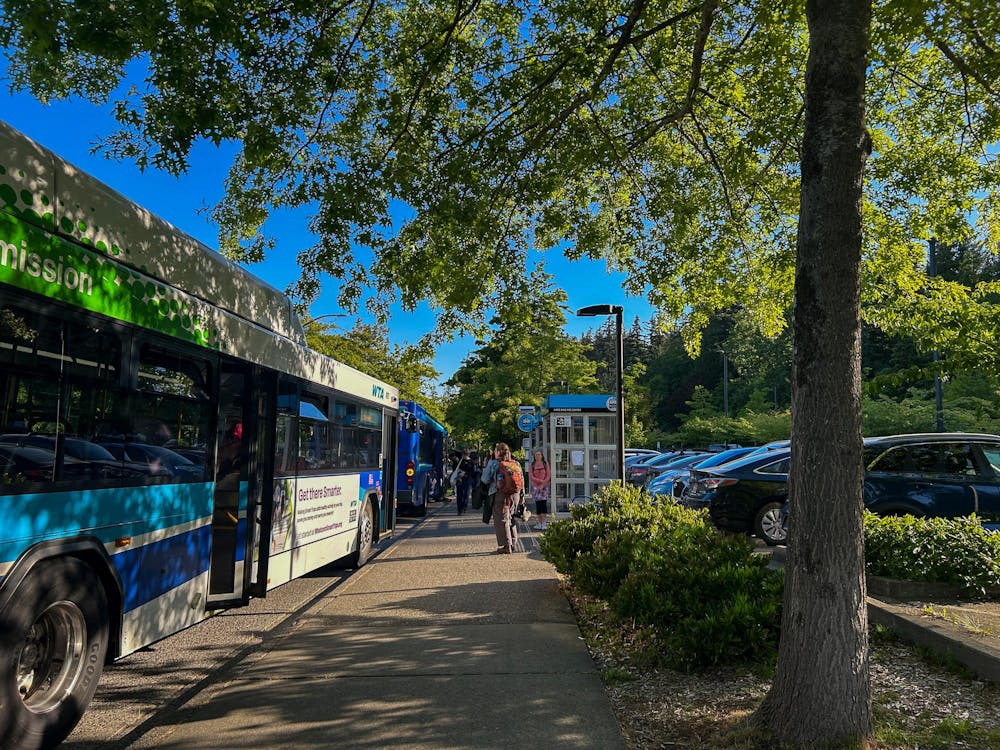
After Western Washington University's universal bus pass program with the Whatcom Transportation Authority nearly ended this year, local transportation leaders say the program's renewal has more impact than just student convenience.
The program allows Western students and employees to ride WTA buses using their Umo bus pass. Officials from WTA and the Whatcom Council of Governments say that access helps reduce single-occupancy vehicle trips.
Genevieve Carrillo, the WTA’s community relations and marketing manager, explained that the WTA’s partnership with Western is crucial as 38%-40% of its total ridership consists of Western students and employees.
Western students and employees' continued participation in this program helps the environment by building more sustainable transportation habits and lowering the negative environmental impacts of commuting in Whatcom County.
“Riding the bus becomes the first choice for a lot of students when it comes to getting to campus,” Carrillo said.
The number of students choosing public transportation makes a big impact, as one full WTA bus can take up to 50 cars off the road, she said.
“When you have thousands of students choosing to take the bus instead of driving, that impact can be felt,” Carrillo said.
Increased transit use goes a long way in lowering the local carbon footprint. Getting more cars off the road makes Whatcom County a more livable place for everybody, she said.
WTA holds itself to sustainability goals aimed at reducing its carbon footprint as an entity. Carrillo said that as of April 2025, the WTA stopped using fossil fuels for their bus fleet. Now, WTA buses all run on renewable diesel or electricity.
Michelle Grandy, the Smart Trips program manager for Whatcom Council of Governments, said reducing single-occupancy vehicle trips is one of the simplest ways students can lower their environmental impact.
Smart Trips is a part of the Whatcom Council of Governments. The purpose of the program is to encourage people to make more of their trips by bike, bus, on foot or via carpool. The program provides education and encouragement to help people use alternatives to driving alone.
Grandy said that college is a great time to develop better habits for traveling sustainably to destinations, such as public transit, biking or walking.
Students' access to bus passes removes a barrier to trying the bus by eliminating the need to obtain a pass or pay for the fare.
“Anytime we can break down barriers that might prevent people from trying something new, like public transportation, it's more likely that people will try it out and make it a regular habit,” Grandy said.
Although students' use of public transportation may seem to have minimal environmental impacts, Grandy thinks otherwise.
“If people can eliminate at least one car trip a week, that makes a huge difference,” she said.
Lul Sihel, a third-year communications student at Western, depends on the bus for transportation, as she doesn’t own a car in Bellingham. She finds the sustainable elements of public transit to be an added benefit to the WTA as a transit resource.
For Sihel, the bus pass is a necessity because she needs to use the bus frequently to commute to school and work, as saving up for a car is difficult while school restricts the hours she can work.
“I take the bus two to three times a day,” she said. “So at least 14 times a week.”
Sihel is just one of the 85% of Western students who contribute to the large student ridership of WTA’s buses.
“High student ridership fuels our sustainability goals,” Carrillo said. “Public transit plays a huge role in sustainability all around the world. But specifically here, we live in such a beautiful place and we want to keep it that way.”
Piper Jones is a campus life reporter. She is a third-year public relations major and is excited for her first quarter writing for The Front! Outside of school, Piper can be found reading or exploring Bellingham's local trails with her friends. You can reach her at piperjones.thefront@gmail.com.


