
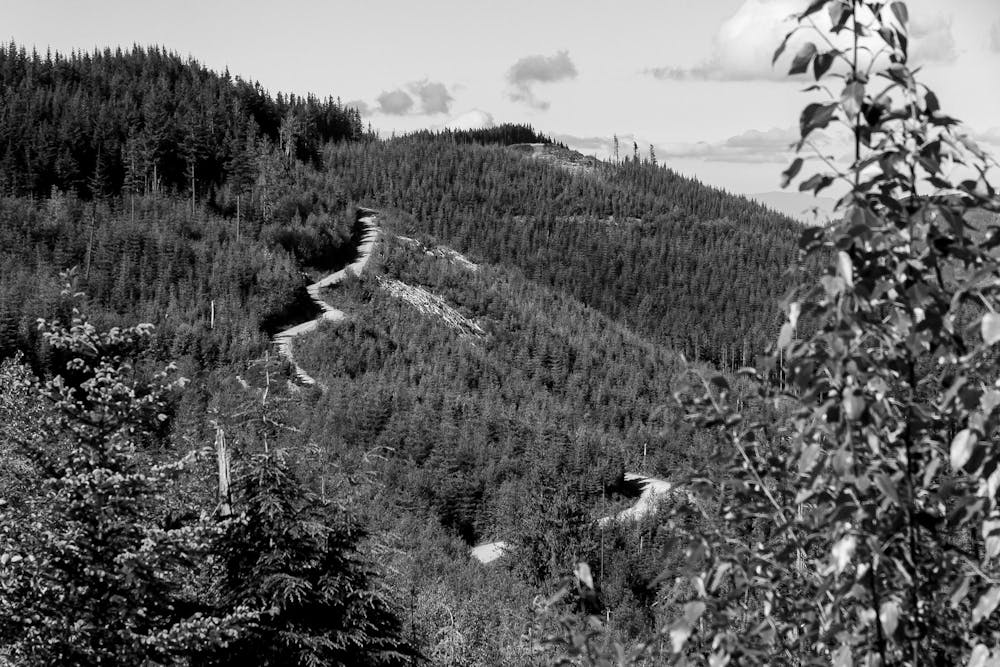
A new contract with the City of Bellingham will allow Janicki Logging and Construction (JLC), a Sedro-Woolley-based timber farming company, to log 80 new acres of land in a protected area of the Lake Whatcom watershed on Galbraith Mountain. 20% of the revenue generated will go back to the city for maintaining logging roads.
Washington, with its dense rainforests and vast evergreen-filled mountain ranges, is often referred to as one of the most heavily forested states in the nation. With over 5.5 billion trees in the state, or roughly 722 trees per person, 75% of Western Washington’s land mass is forested.
Washington accounts for the second most softwood timber produced per year, behind Oregon. Timber farming is considered a renewable resource, but maintaining the health of timberlands is no easy task.
Logging in Washington state is supervised and often facilitated by the Washington State Department of Natural Resources (DNR). The DNR, after a period of review and public comment, will open certain blocks of their land for auction to timber companies for a harvest. They then take the revenue from the timber sales and invest it in public infrastructure.
“When Washington state was granted statehood, the federal government didn’t have a giant pile of cash laying around to say ‘Okay, go be a state,’” said Washington State Lands DNR Communications Manager Ryan Rodruck.
What the federal government did have, Rodruck said, was most of the land within the state.
“What the feds devised was giving the state the land in trust to benefit Washington state priorities, which were education, so schools and construction of capitol buildings,” Rodruck said.
The DNR uses the same foresters who map out auctionable land to survey land after it has been logged. They ensure proper environmental regulations are upheld on both private and public timberland. Rodruck says that common violations include leaving behind “slash piles,” large mounds of unusable wood and debris that are often burned instead of being removed.
“Typically we do a lot of small piles that decompose a lot quicker,” said David Janicki, sales project manager at JLC. “It can be an eyesore, but as long as they’re less than 8 feet wide, you can plant around them and that provides a lot of nutrients for the soil.”
The Janicki family owns three major companies: JLC, Janicki Residential, which builds and rents sustainable housing communities in Bellingham, Wash., and Janicki Industries, which delivers composite tooling for aerospace and defense applications. Rob Janicki owns 70% of Galbraith Mountain and leases the land to JLC for timber operations. David Janicki is Rob Janicki’s son.
“It’s pretty special when you look at it from the perspective of the two industries working together,” said the Whatcom Mountain Bike Coalition’s (WMBC) Trails and Programs Director James Pulse. “There’s not a lot of private timber companies that are willing and open to working with a recreation organization like us. We have several other private timber operations in town, and we do not have the same relationships with them.”
JLC and the WMBC, who have been authorized trail stewards of Galbraith Mountain since 2001, have an agreement that allows for perpetual trail building on the mountain. Tokul, a popular and sustainable riding area on private land in Fall City, Wash., is currently up for sale as buyers eye timber, residential, and conservation assets, leaving the fate of the trail system in limbo.
“I’ve seen the logging on Galbraith, I’m not totally against it. It’s definitely sad to ride the same trail that you’ve ridden for years, but now there’s no forest overhead,” said Matt Hermanson, a computer science major at Western Washington University and an avid mountain biker and trail builder. “Janicki leaves a lot of slash piles and mess behind. It also seems like they’re cutting faster than areas are growing back.”
“That visual of an entire section of forest just getting cut down doesn’t happen in the state of Washington,” Rodruck said in opposition. “Variable retention harvesting is kind of the industry standard now, which means that we will leave set-asides for riparian areas, habitat (and) endangered species.”
Whatcom Million Trees Project (WMTP) is a Bellingham-based nonprofit that plants native trees for urban habitat restoration around Whatcom County. In 2022, WMTP, along with other activists, stopped the sale of the 1,400-acre “Bessie” parcel, which was later set aside for DNR’s first-ever Carbon Project.
“From my personal point of view, the DNR protocol is extremely problematic and is damaging the ecosystem in Western Washington,” said Jim Smith, WMTP’s planting coordinator. Smith compared these variable retention harvesting practices to the strands of hair on the top of a Dr. Seuss character’s head: too thin to notice.
“In the current iteration of logging, large feller buncher machines are used,” Smith said. “They essentially go in and they just rake the hillside clean; they just destroy everything.”
Galbraith Mountain also closes down completely a few days a year for pesticide spraying and deer culling. The latter has drawn criticism as deer were hunted by bow and arrow, widely considered an inefficient and painful method of hunting.
Pulse said that the culling is necessary as the dense deer population eats cedar saplings and other forest floor plants, harming biodiversity, and that the entire mountain is closed for safety during hunts.
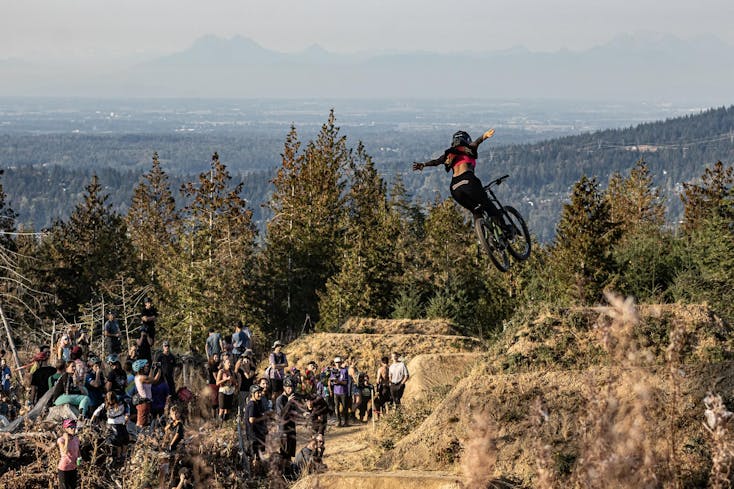
“One of the things the tree farm navigates is dealing with different diseases the trees might have,” Pulse said, referencing a recent clear-cut on north Galbraith near the trail, Vitamin R. “So a particular parcel that wasn’t planned to be logged had to be logged to try and prevent the spread of that (laminated root rot).”
Rodruck emphasized that the term “clear-cutting” is no longer used by DNR, and said that type of operation has not been in practice since the early 1980s.
“Typically you buy a cutover tree farm, so they’ll nuke it and sell it,” said Janicki. “And to get it on your harvest plan, which for us is about a 40-year average, there’s a certain section on the next cycle where you actually have to log more to not let the tree farm run away from you.”
Last year, in a statement to Cascadia Daily News, Janicki expressed interest in building logging roads in the Mount Baker-Snoqualmie National Forest to aid in forest preservation. 400,000 acres of forest could be opened for logging if the Trump administration succeeds in repealing the roadless rule, which bans the making of roads in national forests, and is set to be voted on this fall.
“I fully support what I said,” Janicki said. “It’s hundreds of thousands of thousands of acres that (were) clear-cut and then it came back, so it’s all the same age, it’s super overstocked. It’s a dead forest … It’s so tight that most of the trees can’t even fall down.”
The U.S. Forest Service said that 95% of forest fires are started by humans, and that building roads in overstocked forests increases that danger. Janicki argued that the forest service is understaffed and does not physically spend the same amount of time working in the forests as JLC and DNR do, and therefore does not know how to manage the land properly.
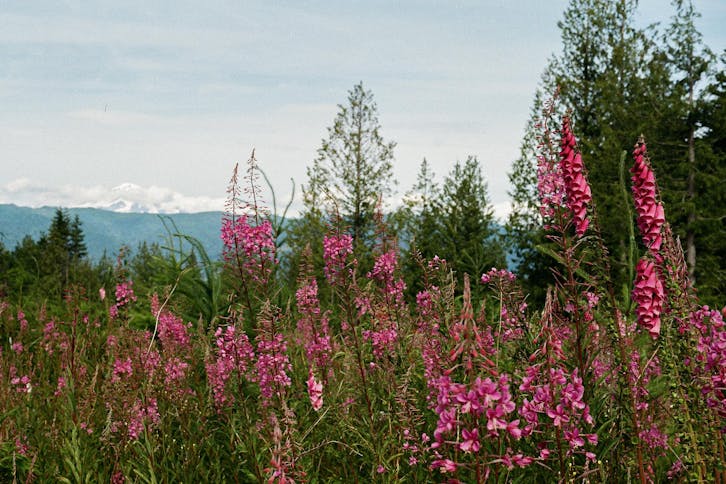
Native foxgloves regrow in a previously logged area on Galbraith Mountain in Whatcom County, Wash., on Aug. 15, 2025. The flowers in this image are roughly 8 feet tall. // Photo by Brianna Dickey
Despite the intricacies of forest preservation enacted by JLC, logging on Galbraith Mountain remains a controversial practice. For lovers of the great forests of the Cascades, it remains a disturbing sight to see large swathes of land flattened in a matter of days.
“Some zones have been clear-cut before I’ve been in Bellingham (Cedar Dust and parts of north Galbraith) and still barely have trees. Meanwhile, they’ve logged at least four to six new areas,” Hermanson said. “The point is, from my perspective, it seems like the area will be a clear hill before any meaningful forest regrowth happens.”
Benji Cook (he/him) is a city news reporter for The Front. He is a post-baccalaureate visual journalism student with over a decade of experience as a professional photographer, covering everything from outdoor sports to political rallies. He holds a bachelor's degree in creative media production from the University of Colorado, Boulder. You can reach him at benjcook.thefront@gmail.com.