

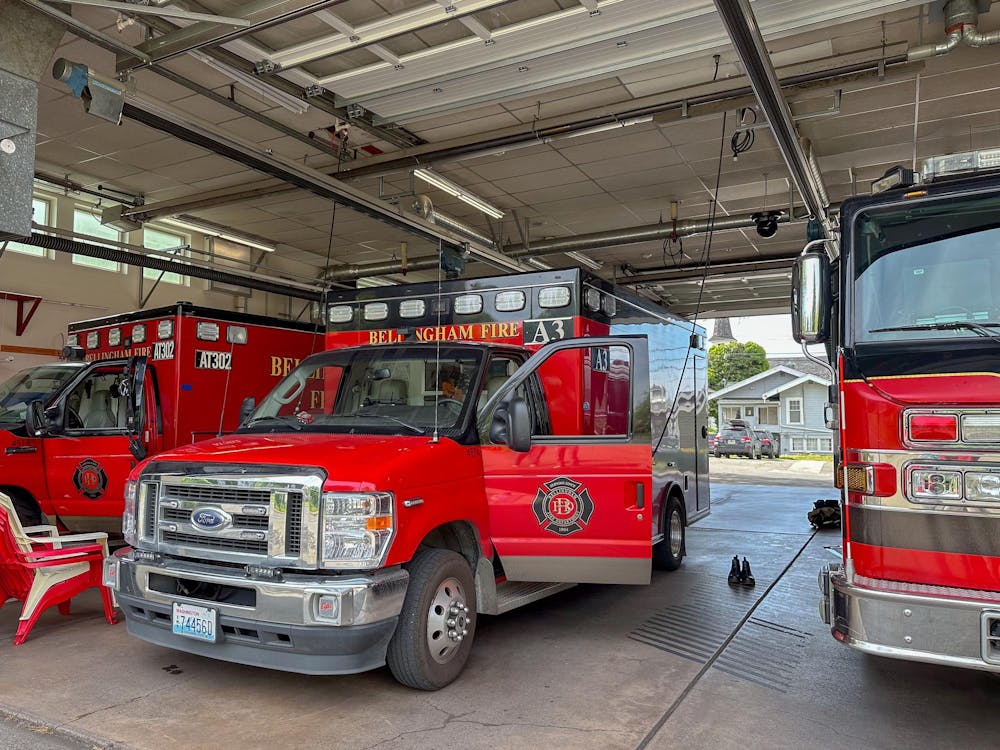
The Bellingham City Council unanimously passed an ordinance on May 11 to establish financial penalties for care facilities inappropriately utilizing emergency medical services to supplement labor shortages.
The fire department responds on average to about 230 non-emergency lift assistance calls per year, according to Bellingham Emergency Medical Services Captain Steve Larsen at the Public Health, Safety, Justice, and Equity Committee meeting on April 27. These calls come from staff at licensed care facilities who need help moving residents with no medical needs.
“These are places that are being paid to provide medical services to their residents,” Fire Chief Bill Hewett said at the committee meeting.
There are 28 facilities in Bellingham impacted by this ordinance. These facilities have called 1,153 times in the last five years for help lifting residents, something the facility is required by state law to have an adequate amount of personnel to achieve.
The fire department hopes that the potential $1,000 fine is enough to encourage these facilities to better support their employees and eliminate the use of EMS for labor substitution.
“We’re not trying to generate revenue from this,” Larsen said.
The Bellingham Fire Department modeled this ordinance after several similar laws passed by nearby cities. The frontrunner for this kind of penalty in Washington was the Tacoma’s Fire Department. In 2018, an ordinance granted the fire department the ability to fine licensed care facilities $850 per lift assistance call after a non-injury fall.
“When the ordinance first passed, we issued about two or three fines per month. Now, we issue three to four fines per year,” Chelsea Shepherd, the public information officer for the Tacoma Fire Department wrote in an email.
Shepherd wrote that the Tacoma Fire Department has not been able to expand as quickly as the city of Tacoma has, so assisting private businesses with non-emergencies felt like a misuse of public funding.
In the coming months, Larsen plans to meet with staff of the affected facilities to ensure they are aware of the purpose of this ordinance and are not discouraged from dialing 911 for real medical emergencies. The care facilities will not be fined if there was a genuine medical concern. Hewett said the medically trained staff on hand at these places are equipped to determine if a situation is a true emergency.
Geo Henderson, who works as an expert witness in legal cases regarding EMS standard of care, wrote in an email that these calls are burdensome beyond just helping to pick the fallen resident up.
“The response ties up personnel, vehicles and equipment. It contributes to call volume, fatigue, documentation workload, fuel usage, apparatus wear and overall system strain,” Henderson wrote.
Bellingham Fire Department paramedic units respond to emergency calls all over Whatcom County and need to be available to be dispatched to true emergencies.
“When emergency responders are repeatedly used as a substitute for routine staffing or lifting capability, it can significantly impact EMS system readiness,” Henderson wrote.
According to Larsen, responders spend about 30 minutes on each of these non-medical, non-emergent calls. That’s 30 minutes that the crew is unavailable to respond to any other incoming emergency calls, leaving it to the next closest unit to handle, which may take several additional minutes to respond.
“Seconds mean lives,” Larsen said.
Atlanta Moss (she/her) is a city news reporter for The Front this spring. She transferred to Western this year and is excited to jump in as a third-year news/editorial journalism major. She can usually be found at the movies, the bowling alley or the Viking Union cafe. You can reach her at atlantamoss.thefront@gmail.com.