

Bellingham Public Schools is facing reductions to the Running Start program and a $7.5 million funding shortfall from the Washington State Legislature for the 2026-27 school year, resulting in planned cuts to staff positions, school libraries, athletics and student programs.
During the 2026 legislative session, the Washington State House and Senate proposed reducing the maximum Running Start enrollment from 1.4 full-time enrollment to 1.2 full-time enrollment, lowering the amount of free college credits per quarter and cutting roughly $14 million in funding. Later negotiations resulted in a phased reduction to 1.3 FTE for the 2026-27 school year, according to the Washington State PTA.
With the new 1.3 full-time enrollment, Running Start students taking only college classes can register for 130% of the standard 15-credit full-time workload. This allows students to take up to 19 college credits per term and up to 20 in the spring term, according to the Washington State Board for Community and Technical Colleges.
The Running Start program allows high school juniors and seniors to take college classes that count towards their high school diploma and earn them college credits. Full-time Running Start students can save two years’ worth of college time and money by graduating with their associate degree.
Running Start is one of the most impactful college access programs in Washington, according to Jamie Traugott, director of Student Services & K12 Alignment.
“Most students successfully complete the credits they attempt and families save thousands of dollars in tuition,” Traugott wrote in an email.
With reduced funding and access to Running Start, enrolled students may be expected to pay more out-of-pocket fees and face fewer course options, potentially deterring students from the program, according to Traugott.
Cuts to Running Start may save the state money now, but could destabilize budgets and limit students' access to college, according to a Running Start overview from the Washington State Board for Community and Technical Colleges.
Rylee Carr, a previous Running Start student, expressed her disappointment with the funding cuts for the program.
“I believe that education is the most important tool,” Carr said. “Reduced funding for these types of programs can hinder those less fortunate from gaining a higher education.”
Many Running Start students choose to transfer their earned credits to in-state universities. Lower program registration could result in decreased enrollment at nearby colleges, causing a ripple effect on funding throughout Whatcom County.
Bellingham Public Schools has already complained about the consistent lack of state support, citing the Washington State Legislature’s refusal to keep pace with inflation or to acknowledge pleas for more funding.
To balance the proposed $7.5 million budget deficit, Bellingham Public Schools plans to cut 60 teaching and staff positions, and increase student activity fees.
Bellingham Public Schools Chief Financial Officer Kathryn Weilage explained that the state places caps on the amount of funding from local communities, while continuing to underfund the basic costs of preschool and K-12 education.
The Washington State Legislature relies on outdated models to base its funding on, including regionalization and experience factors, according to Weilage. This forces the school district to adjust its budget and make tough decisions on where its limited money goes.
Feedback from the community included suggestions to reduce District Office staff, protect people and programs closest to the classroom and students, and not increase class size, according to Weilage.
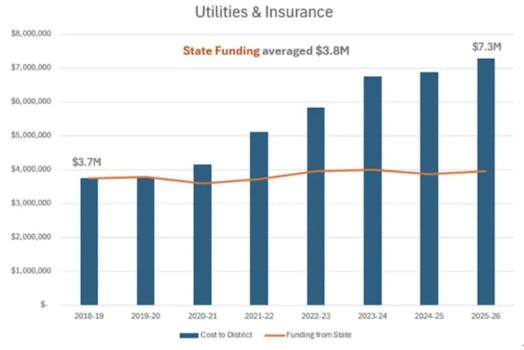
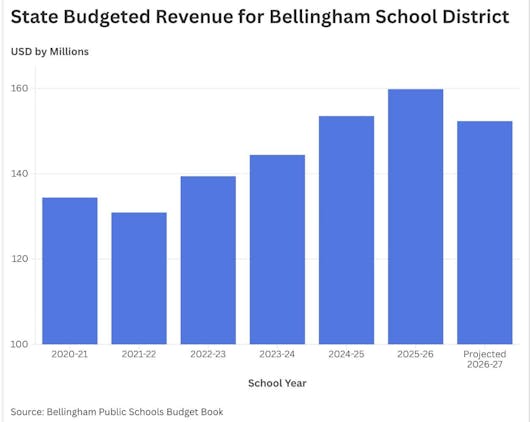
According to Bellingham Public Schools' budget books, the amount of funds provided by the state has been slowly increasing over the past few school years. However, the funds haven’t matched the rising costs experienced by the district.
Currently, Running Start policy conversations are focusing on maintaining enrollment and stabilizing funding so colleges and high schools can sustain the staffing and services.
A BPS budget update detailing plans not to increase class size, restructure support and District Office staff, and refine the costs and availability of athletics and activities was released on March 27, 2026. The final budget is expected to be approved during a regular school board meeting over the summer.
Maevis Croteau (she/her) is a first-year reporting student and campus news reporter for The Front this quarter. When she doesn't have her face glued to her laptop, she's usually out enjoying a sunset or staying up ridiculously late to cuddle with her hamster, Bolt. You can reach her at maeviscroteau.thefront@gmail.com.