

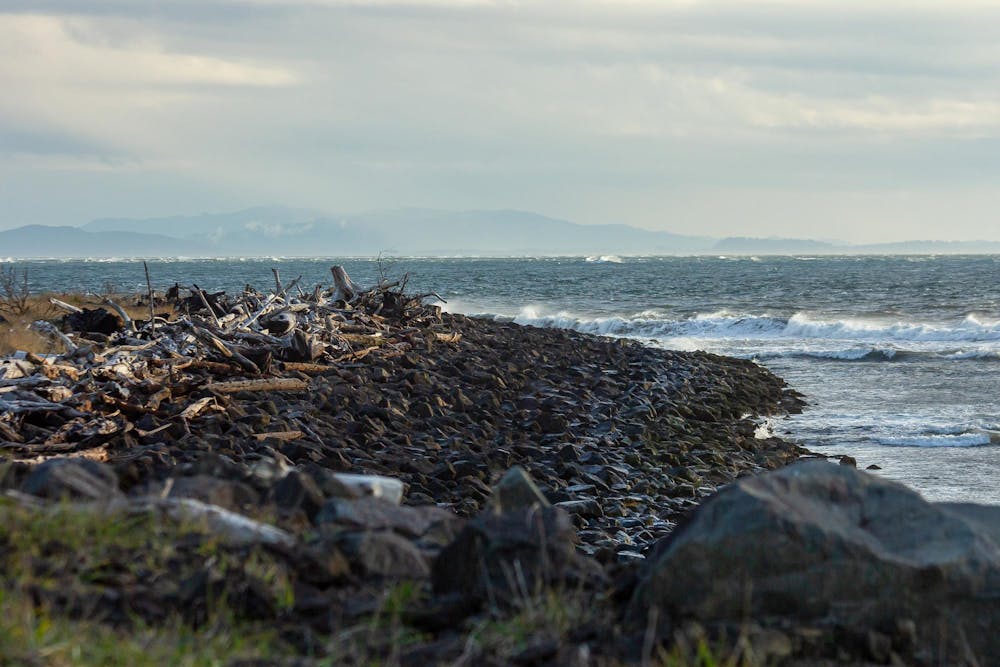
The case of approximately 25 skinned canine carcasses that recently washed ashore on Guemes Island in Skagit County last week has been uncovered.
According to the Skagit County Sheriff’s Office, a veterinary forensics team concluded the dead canines were foxes. The sheriff’s office noted these foxes originated from a farm outside of Washington and were brought in to use as crab bait.
The report comes after theories of the carcasses being domesticated dogs, which may have been dumped by breeders or a fighting ring. Some island residents speculated that the carcasses may be used in ritualistic practices for a satanic cult.
Lieutenant Jeff Willard from the Skagit County Sheriff’s Office said they released the report early in the interest of public safety and to combat the ongoing rumors. DNA and blood toxicology reports from the veterinary forensics team will be released in approximately a week, Willard said.
Skagit County Fire District 17 Chief Olivia Cole was one of the first responders on the beach when the bodies washed up. She told KIRO 7 the fox carcasses were skinned, and some had orange twine around their necks.
Authorities said they do not have confirmation if the interstate-transported foxes were part of a fur farming operation, after questions about the skinning of the foxes were raised.
Adam Karp, a Bellingham-based lawyer who practices animal law exclusively, discussed his shock at the use and skinning of the canine carcasses.
“There’s a dignity to how we handle lives, human or nonhuman,” Karp said. “This is not the way to do it.”
According to the Skagit County Sheriff’s Office, the fox carcasses were dumped after a commercial crabber may have encountered a mechanical issue, causing some cargo to go overboard, including the fox bodies.
The Skagit County Sheriff’s Office said that they do not anticipate any charges regarding the dumping of the fox carcasses.
Some have drawn similarities to a dumping case from over a decade ago, where over 2,000 pounds of mink carcasses were dumped in the Port of Brookings Harbor in Oregon. The crab boat captain was charged with first-degree water pollution.
Willard said that the fox carcass case is not related to water pollution regulations.
“As long as they are not polluting or contaminating the water, they can dump their bait,” Willard said.
Willard noted that, as a recreational crabber, he was unfamiliar with the use of mammals such as foxes.
“I've never heard of it, but I haven't heard of using minx either,” he said. “You don't know what you don't know.”
Janine Ceja, the shelter director at the Humane Society of Skagit Valley, noted with concern how the incident has impacted the people of Skagit.
“It’s appalling and horrific to discover this as it is slowly but surely coming up,” she said. “It brings an unrest.”
Karp said there may be a civil case to this incident under Washington state public nuisance law and noted the emotional damage this may have caused to Guemes Island residents.
“If there are people who were shocked or affected on Guemes, they can contact me,” he said.
River Martinez (he/him) is a city news reporter for The Front this quarter. He is a first-year visual journalism and political science major. River spends his time doing model United Nations, climbing and tinkering on his film camera. You can reach him at marti722@wwu.edu.


