

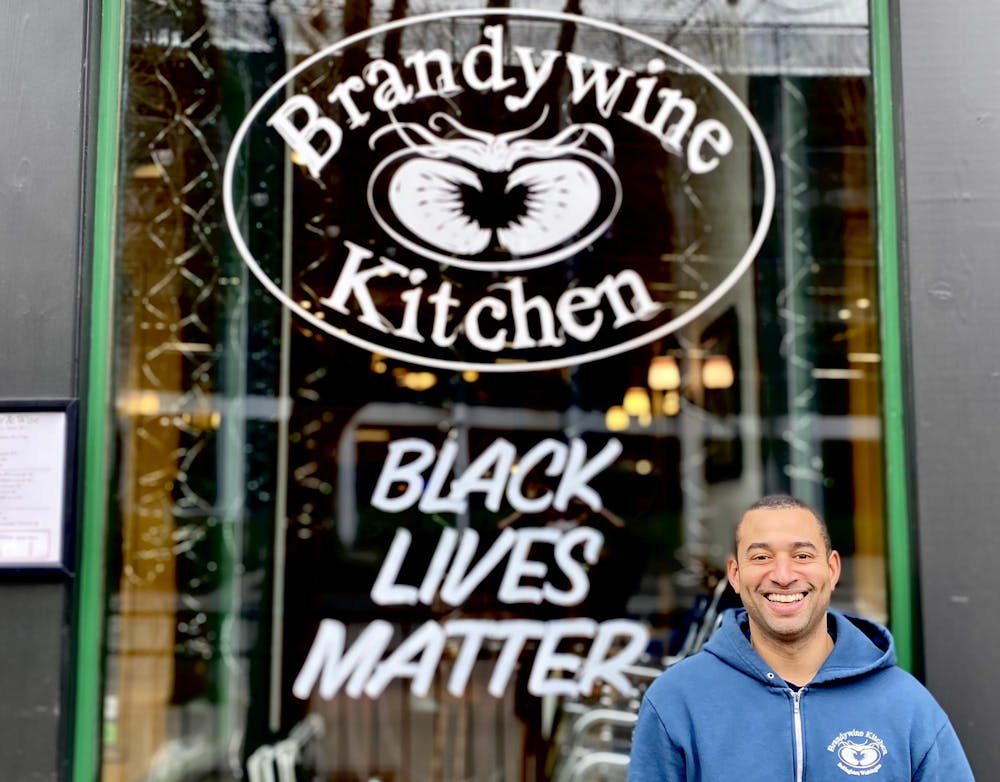
Brandywine Kitchen got its start at the Bellingham Farmers Market 15 years ago. Co-owner Azizi Tookas did mobile events, catering the market before they got their permanent location on Commercial Street.
“When we were vendors at the farmers market, people were very interested in us being a locally owned business,” Tookas said. “When we opened up our storefront we got a lot of support because (community members) were like, ‘Those are our guys at the farmers market, let's go support them.’”
Support from Bellingham community members is vital to keeping local restaurants alive. It's time to direct all of our support exclusively to locally owned eateries and combat the ever-growing expansion of chains.
In recent years, Bellingham has seen chain restaurants pop up frequently. Next up on the list is Chick-fil-a, predicted to open its doors in April 2026. A new Wingstop isn’t far behind, taking one more space away from local restaurants to move into.
Construction for the new Chick-fil-a started in early January 2026. The restaurant is on Cordata Parkway and will be neighboring Bellis Fair Mall, adding to the already large number of franchises and chains in the area.
Ryan KeyWynne, planning and community development communicator for the city, clarifies how it is decided who expands into Bellingham, chain or local.
“City codes do not distinguish between chain or independent restaurants. We regulate based on land-use type. For restaurants which we call ‘eating establishments’ if the use is allowed, the city would allow them, whether they are independently owned or part of a chain,” KeyWynne said.
Decisions to lease land to certain institutions are left up to property owners, KeyWynne explained.
Due to property managers having autonomy over who expands into the area, there is no consistent way that the city maintains a balance of local and chain restaurants. This leaves it up to the members of the Bellingham community. It is an opportunity for us to support what matters most: locals.
City council member Lisa Anderson shed light on one way that chain restaurants may be compromised in moving to the city.
“The city does not necessarily prohibit any particular restaurant chain from locating or expanding in the area,” Anderson said. “There may be constraints based on zoning requirements and what the chain hopes to develop.”
Despite zoning requirements, regulations on chain restaurants do not exist in the city, which leads the community to other resources to help maintain restaurants locally.
“Bellingham used to have a campaign called Buy Local. I feel it was very successful to educate our community on the importance of supporting small businesses because the money spent has a better chance of circulating and staying in the community,” Anderson said. “National chains often distribute money to shareholders and do not redistribute it back into the community.”
Dining at a local restaurant produces more than twice the local economic impact of eating at a chain restaurant, according to a study by Civic Economics.
Tookas described a local untold secret that keeps downtown eateries local.
“A few years ago there was a Starbucks that went in on the corner of Holly and Railroad, and it has since closed,” Tookas said. “I have a sneaking suspicion that there is some sort of informal ordinance about allowing corporate chains in the downtown core.”
This unspoken regulation against chains should not only exist downtown, but across Bellingham. Supporting a local economy that consists of friends and neighbors builds a community. A community that thinks local and eats local.
Rowan Braeckel (she/her) is a third-year communication studies major, news/editorial minor and an opinions reporter for The Front this quarter. When she's not writing for The Front you can find her listening to music, at home with her snake, or spending time with friends. You can reach her at Rowanbraeckel.thefront@gmail.com.


