

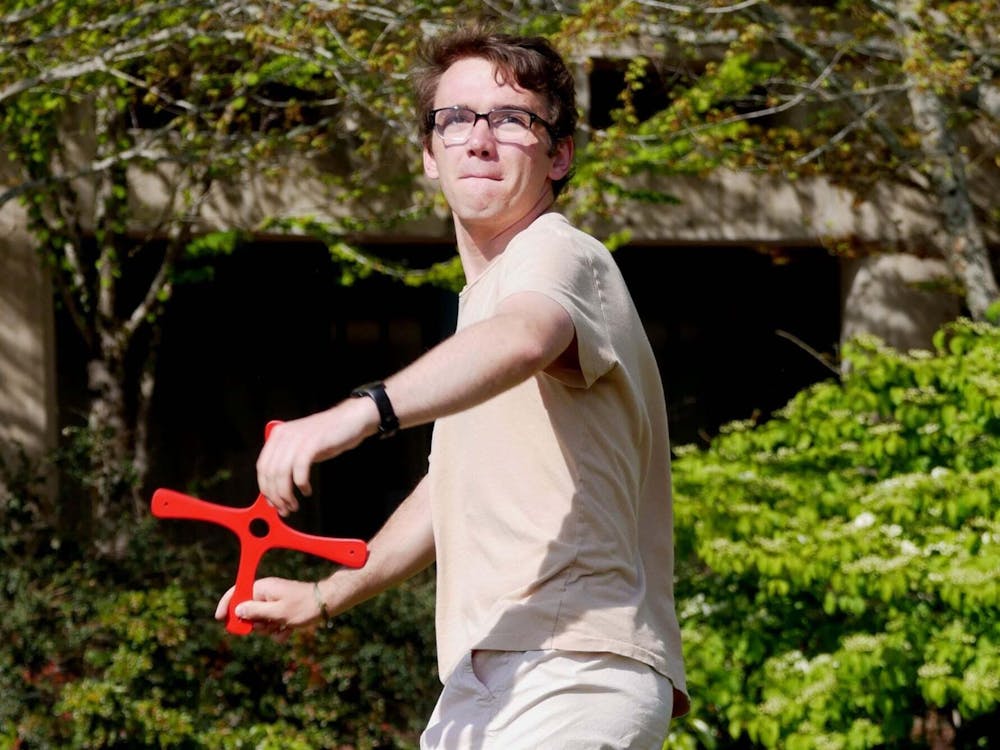
This summer, Western Washington University will be represented on the national boomerang stage. Western second-year Forrest Morse, among others, will represent Team USA at the 2026 World Boomerang Championships in Indonesia.
The Front spoke to Morse about how he is preparing, how he throws a perfect boomerang and how people can keep up with his performance on the big stage. His answers have been trimmed for clarity and brevity.
Q: How did you get involved with the boomerang community?
Morse: It was my freshman year. Honors college has this event before classes start called Honors Prologue. It's the week before classes start and they get all the honors kids together as a bonding thing.
One of the activities I signed up for was boomerang throwing with professor Ed Love. He taught us all how to throw. Some of us went on to form a club out of the people in that group, and that was my introduction into boomerang throwing.
Q: What about the world championships are you most excited for?
Morse: I'm very excited to compete. Also, I think almost more than anything, getting to meet all of the international community. There's a lot of throwers around the globe and there's quite a bit of younger people too, and some really good throwers that my peers in the boomerang community who have been at previous world cups have looked up to. Also, just being around that community. I'm very excited to meet everybody.
Q: Is there anyone in the boomerang community that you look up to or idolize?
Morse: I would definitely say Ed Love. He is the first person who taught me how to throw and he has been teaching me along the way how to be a boomerang thrower and introduced me to the community.
Throwers I look up to throwing-wise, definitely Logan Broadbent. He is on Team USA and he is the world champion from last year. He is really good. He's also a very down-to-earth, super nice guy, and very open to mentoring.
I would say the other two big ones are Daniel and Richard Bower. They are very involved in the boomerang community and work in the United States Boomerang Association. Both are just really good throwers and very open to teaching people and helping you get involved.
Q: So you got 13th place at nationals, is that correct? How did you feel about your performance and what are you hoping to improve on?
Morse: Yes. That was my first big boomerang tournament. We had one here in Bellingham last spring, but nationals was my first bigger competition. I was really happy with getting 13th. I didn't know what to expect or what competition looks like, especially on that scale. I was very proud of doing that well.
But I have a lot of room for improvement on events like “Aussie Round,” which is accuracy combined with distance, so you have to throw it a certain distance and try to get it to land very close to you, which is something that just comes with a lot of practice and experience. Having that big tournament allowed me to see that there's a lot of room for me to improve.
Q: How will your experience from the USBA national championships help you in the world championships?
Morse: I think having the exposure in a tournament of a professional level will be a big help. I'm very new; I think almost everybody else on the team has already been to a boomerang championship, so I'm a little rookie.
I'm glad I had nationals as an introduction for tournaments, and learning how they work and what the process is, as well as just competing in a competitive environment. The longer you're in it, the more comfortable you are in it and the more conditioned you are to perform well in it.
Q: What are you doing to prepare for the world championships?
Morse: Practicing! I've gone down to Arlington, Washington, to meet up with some of the Seattle throwers there. In Bellingham, me and Ed Love are here. In Seattle, we have three throwers on the boomerang teams who are going there, Daniel and Richard Bower and Stevie Kavanaugh. Then in Portland, there's another one of my team members, Gavin Bohling.
We all are going to be meeting up in Arlington about once a month to run more of the team events – because there's team and individual competitions.
We've been running team events when we get together like endurance, relay, timing, practicing transitions in that maximum time aloft relay. (You work) on counting down timing for your next person to throw, because if they catch it and you haven't thrown yet, that's the end of your turn. You have to throw it before they catch it.
You have a lot of independent events that you can work on and improve on, (like) trick catch, fine-tuning new boomerangs, fast catch and endurance, which is just repetition. The more you practice the same movement, the more confident you'll be.
In Bellingham we have crappy weather sometimes, which I would say can be a bonus for when you're practicing boomerang throwing, because competitions aren't always going to be in great weather.
Reporter: I know with some sports, if there is any rain it's immediately cancelled, and with other sports, it's the exact opposite. Like with soccer, they just keep going.
Morse: We have a max wind level. I think it's around a constant 13 mph wind. If it's higher than that, it's just a pain. The best throwers in the world that we've been with – they’re a lot better at throwing in wind than me, don't get me wrong – but once it gets to a certain level, no matter who it is, it's rough.
Q: Where do you get your boomerangs from?
Morse: A lot of people! We've ordered the trick catch ones, which we use at boomerang club, online. Ed Love also teaches us how to make boomerangs, so I've made a couple out of wood and polypropylene, which is a really fun process. But I've made more casual boomerangs for myself, not really competition-based.
My competition (boomerangs) have mainly come from the Bower brothers in Seattle.
When you've been throwing boomerangs for a long time, you have a lot of boomerangs and the community is very welcoming to new people. Even if that's in regards to helping me have enough boomerangs that I can throw in the wind, because that takes a different boomerang. The wind ones will have more holes in them so that it's less affected by big winds. So they have helped my boomerang kit grow quite a bit.
And then Jim Schramm – he's the vice president of the USBA – has also given me a number of boomerangs that I've been using for competition.
Q: So how do you throw a perfect boomerang?
Morse: Vertical. You want your boomerang to be vertical. You want to get a lot of snap on it. Every time I'm in competition, my mentors are always yelling “high and right.”
You want to release at a decent angle, parallel to the ground. If the wind is coming straight at you, you throw 90 degrees to your right. (Stand) perpendicular to the wind with it coming at your left shoulder if you're right handed. If you are left handed, it's the opposite. Then get a good snap, get a decently strong throw on it, keep it vertical and let your boomerang do the work.
Q: Where can people keep up with the championships?
Morse: Where there will definitely be news is the USBA Facebook page. There will also be some updates on our WWU Boomerang Club Instagram.
Nathaniel Nagel (he/him) is a reporter for the campus news beat. He is a third-year visual journalism major. This is his first quarter writing for The Front. Outside of school, Nathaniel can be found watching sunsets and spending time in the mountains, always with a camera (or two) in his hand. You can reach him at nathanielnagel.thefront@gmail.com.


