
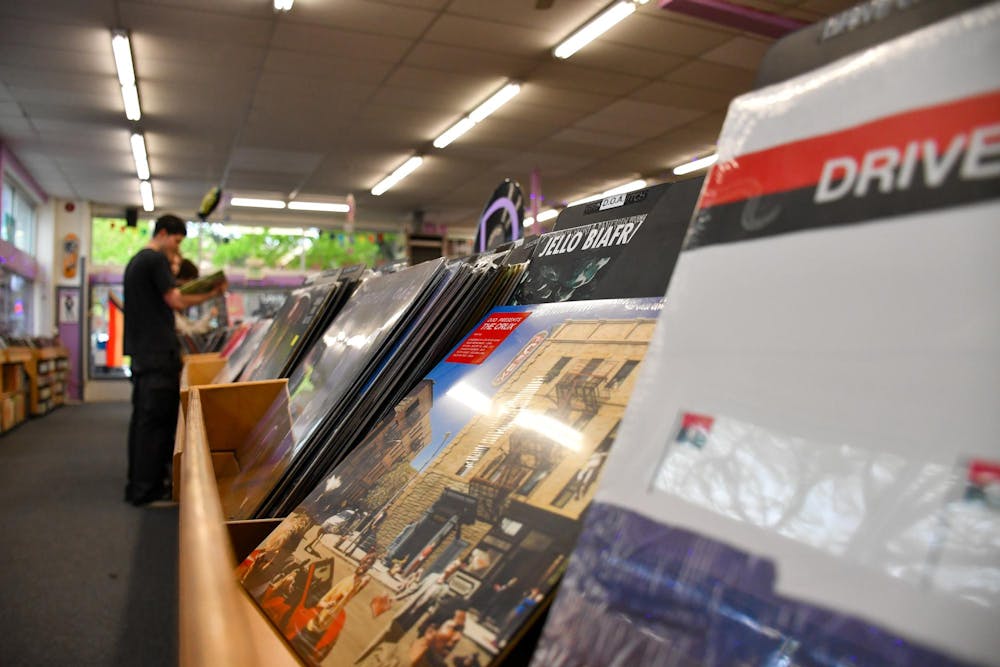
Since the beginning of the digital age, which began in the early 1970s and grew quickly from there, physical media has been used less and less. The introduction of the internet and mobile technology has made practically every form of media available all on one device, yet – in recent years – analog media has had a revival, particularly in the music industry.
Having access to so many forms of media on our devices can make things easy. Whether this is movies, podcasts, news or music, your phone holds a library of entertainment. However, these forms of media are also out of our control. Many of them are run or supported by algorithms, showing us certain content based on a prediction of what we will like, but that doesn’t mean it’s always accurate.
Ava Gedicks, Western’s Art & Music Productions concert coordinator, spoke on the CD burning nights that AMP hosts.
“There is kind of a real thing people are looking for these days that owning an entire album gives someone,” Gedicks said. “Algorithms push media in a bite-sized way, not in the way you would consume media on a CD. It's refreshing to turn back to that and (that) people want to engage more critically with art as opposed to algorithms.”
The use of predictive algorithms isn’t the only issue people have with digital music programs. Cory Blackwood, owner of Ritual Records, explained that morals may be turning people toward analog music.
“I don’t think people trust streaming,” Blackwood said. “Especially when you see how poorly artists are paid through Spotify.”
Spotify pays artists an average of $0.003 to $0.005 per stream, and streams are only eligible for payment if played longer than 30 seconds. While streaming platforms make all genres of music available to the user for a seemingly low price, they are underpaying the artists who make that possible, causing some users to stray away from digital platforms.
“You don’t own your media, you’re paying rent on it. So if it goes away, you have no recourse there,” Blackwood said. “I think people really appreciate actually owning their own media.”
This is where the ability to physically own pieces of media has become important again. It directly supports the artist and it can’t be taken away from you without your permission. Tyler Dick, a Western student who primarily listens to records, CDs and cassettes, has a similar reason for collecting physical media.
“It’s a way to get away from using technology and not being on my phone as much. I think it steals a lot of your time,” Dick said. “I like owning things versus a subscription model; a subscription model can be really predatory and it feels better to own things.”
Analog music not only supports artists directly, but also gives one the opportunity to own their access to music. Living in such a digitally-driven world, it is important to find ways to entertain hobbies off of our devices. Regardless of whether this surge of interest in analog music is genuine or trendy, it impacts communities in positive ways.
Rowan Braeckel (she/her) is a third-year communication studies major, news/editorial minor and an opinions reporter for The Front this quarter. When she's not writing for The Front you can find her listening to music, at home with her snake, or spending time with friends. You can reach her at Rowanbraeckel.thefront@gmail.com.


