
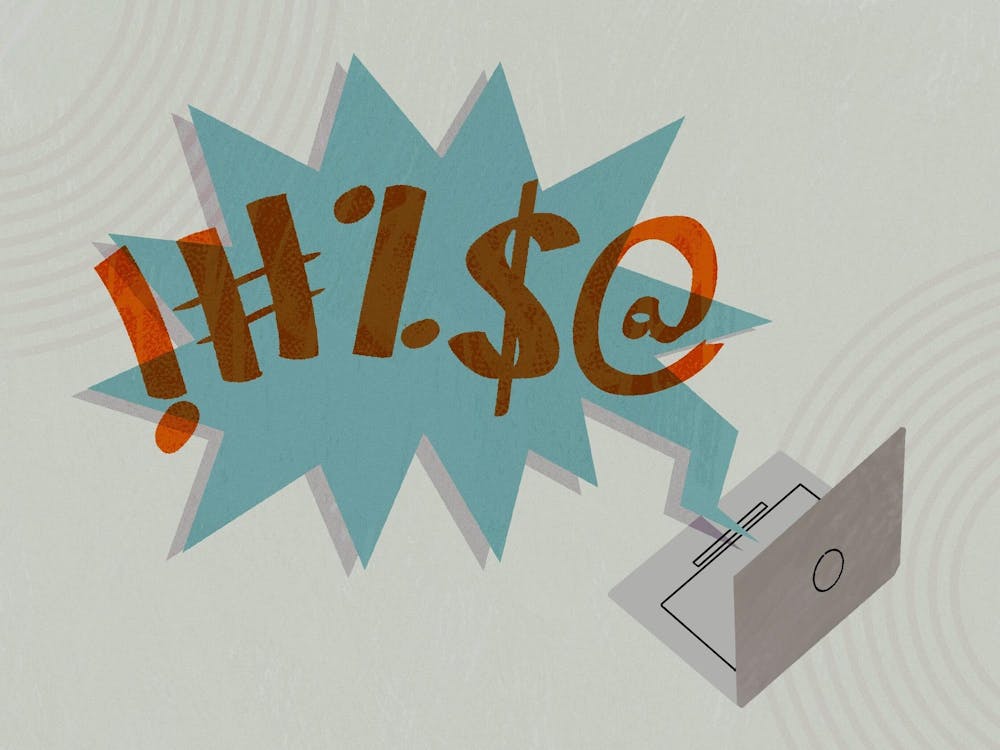
In the early 2000s, it was commonplace to hear the R-word used in media and in casual conversation. Usually intended to insult someone’s intelligence or physical capabilities, it was hurled around without regard for others.
That is, until 2009, when the Special Olympics led a campaign to encourage the eradication of the slur. The movement was largely successful and reduced the use of the word significantly, including the passage of Rosa’s Law in 2010 and the removal of the slur from the “Diagnostic and Statistical Manual of Mental Disorders” (DSM-5) in 2013.
Rosa’s Law sought to strike the terms “mental retardation” and “mentally retarded” from federal, labor and educational policy, in turn replacing them with the terms “intellectual disability” and "individual with an intellectual disability.”
“Like many words over time that have been associated with intellectual disability, it started to take on this negative connotation,” said Rebecca Monteleone, an associate professor of disability studies at the University of Toledo, who has her Master’s of Intellectual and Developmental Disabilities.
The campaign was successful in categorizing the R-word as taboo for years — until recently. According to a study conducted by Montclair State University, casual usage of the word has increased significantly on social media over the last few years. The number of posts containing the slur jumped from 2,000 per day in 2020 to 46,000 per day in 2026, a 2000% increase.
The rising trend of conservatism in the United States seems to be directly responsible for this resurgence. Use of the slur by President Donald Trump on multiple occasions has created an atmosphere wherein other prominent political and entertainment figures feel not only comfortable, but emboldened to follow suit.
Social media posts containing the R-word made by President Trump and Elon Musk caused the use of the word to triple within hours. Statements by Joe Rogan and Kanye West saw similar results.
An important aspect of Monteleone’s research in disability studies, and of disability advocacy in general, is acknowledging the fact that people with intellectual and developmental disabilities (IDDs) are rarely taken seriously in regard to their own disabilities. This is also known as epistemic injustice.
“It’s thinking a lot about why we don’t take people with intellectual disabilities seriously as producers of knowledge, including knowledge about themselves and about the world around them,” Monteleone said.
She says this is in part due to credibility politics, the idea that only people with certain credentials or authority are taken seriously. People not respecting differences in communication abilities also plays a role.
“If you have some sort of nonnormative speech or you don’t have verbal speech at all, you’re often not taken seriously, regardless of what it is that you’re sharing,” Monteleone said.
Usage of the R-word is wholly unacceptable. It is extremely harmful to people with IDDs and should never be used in any context.
“At the heart of it, it’s lack of love for humankind,” said Naaman Hinton, a Max Higbee Center (MHC) board member.
According to their website, MHC is a nonprofit organization that provides community-based recreation programs for youth and adults with developmental disabilities.
Hinton, 45, was diagnosed with multiple sclerosis when he was 23 years old. He has been a member of MHC for 14 years and on the board of directors, as well as the member-led advisory council, for seven years.
Hinton is an active member of the community and an inspirational poet, using his voice to spread kindness and awareness to those around him. Use of the R-word brings him feelings of deep irritation, and he does his best to correct the mindsets of the people who use it.
“This wheelchair, it gives me an even louder voice and platform,” Hinton said.
Michelle Hasenjaeger has been a member of MHC for 14 years and is on the advisory council. People close to her have used the R-word in the past, but have since stopped thanks to her willingness to educate them on the matter.
“Sometimes I feel like less of a person. It’s feeling almost like my self-esteem will go down,” Hasenjaeger said.
As an autistic woman, she sometimes has concerns for her safety when alone in public, especially when people might not understand her mannerisms. She finds comfort in her community at MHC.
“We need to learn to stand up for ourselves, for Pete’s sake,” Hasenjaeger said. “I’m still learning my self-advocacy sometimes.”
Using the R-word reinforces these harmful ideals and endorses hundreds of years of ableism, which kept disabled people institutionalized, ostracized and abused.
“We’ve created this category around intellectual disability to put these groups of people that we deem to not be credible witnesses of their own experience in,” Monteleone said.
Nowadays, there are a multitude of programs that combat ableism and work toward inclusion. Unified Sports, a program within the Special Olympics at Western Washington University, connects people with and without IDDs through inclusive sports.
“Passing a ball is the quickest form of connection,” said Alexa Marcelo, co-president and partner liaison of WWU Unified Sports.
She says that participating in Unified Sports, such as unified basketball and soccer, builds the confidence of athletes with IDDs.
“Inclusion means friends and having fun,” said Kaden Jensema, co-president and athlete representative for WWU Unified Sports.
Besides building confidence, participating in Unified Sports cultivates meaningful connections and friendly competition between players.
“It’s fun hanging out with friends and getting to know new people,” said Adan Adame, a WWU Unified Sports athlete.
Best Buddies WWU is an organization that promotes inclusion through integrated employment and leadership development, as well as one-to-one friendship pairs. Gabbi Smith has been involved with Best Buddies for six years and has been the president of Western’s chapter since 2025.
Smith says that there is absolutely no excuse for using the R-word. Every use of the word is harmful, whether intentional or not; especially when the word has such a long and painful history.
“If you really didn’t mean it in a harmful way, you would just use a different word,” Smith said.
If you happen to hear someone use the R-word, call that person out. Hinton says that if he hears the word, he confronts the user to find out why they feel so comfortable saying it. If the person refuses to see the error in their ways, he will no longer associate himself with them.
“Be more selective with your words, because the words hurt worse than physical beatings,” Hinton said.
Simply put: if you use the R-word, you’re projecting an image of hatred onto the world; you have no respect for those with IDDs, other disabilities or yourself.
“When you use certain words, other people are making assumptions about the kinds of values and commitments that you have,” Monteleone said. “Think through what kinds of values and commitments you want the people around you to think that you hold.”
Raleigh Nolan (she/they) is an opinion reporter for The Front. She is a journalism major and a women, gender, and sexuality studies minor. Raleigh is originally from Michigan and has lived in Bellingham since 2021. Since then, she has made many wonderful friends and adopted a sweet/evil kitty named Olive. Some of her favorite spots in Bellingham are Rumors Cabaret, Avellino Coffeehouse and Colophon Cafe. You can reach her at raleighnolan.thefront@gmail.com.


