
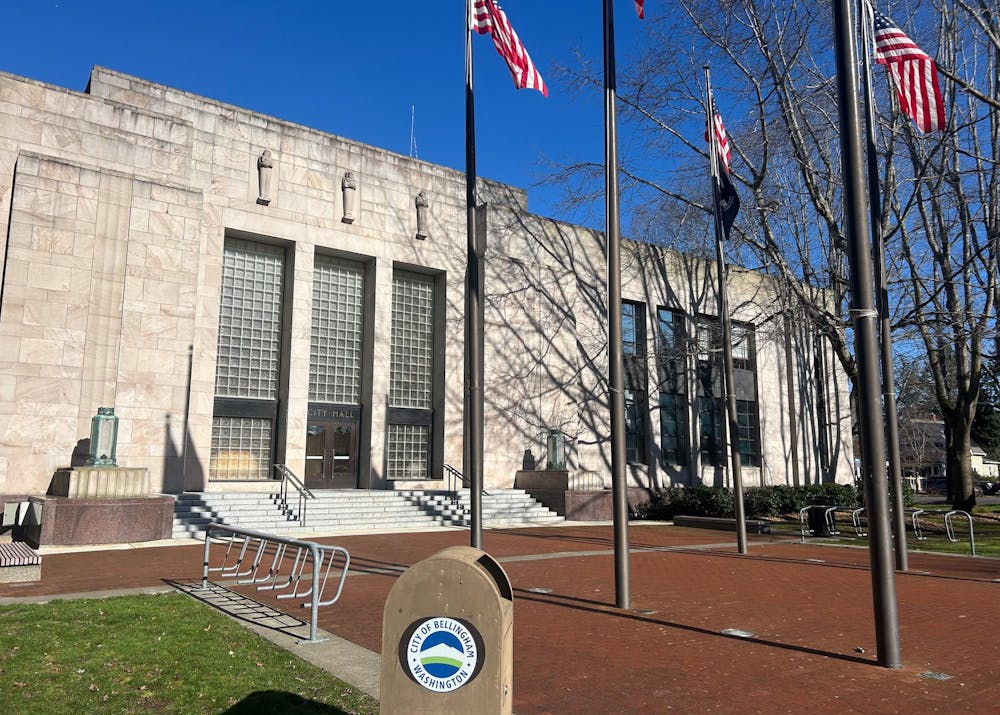
The City of Bellingham formed the Keep Washington Working Act Work Group (KWW) in 2025 to ensure the city’s policies, training and data collection complied with the Keep Washington Working Act.
The advisory work group was formed as a limited-term group intended to examine city practices and, after a sufficient period of time, would provide the city with suggestions on upholding state laws that protect immigrant community members. After extensive research and collaboration, the work group is scheduled to hold its final meeting on April 16.
“It’s so troubling to see that what’s happening in the federal government is having devastating impacts with severe ripple effects,” said Catalina Hope, who works with immigrant communities and is one of the KWW’s voting members.
According to Hope, although the Keep Washington Working Act works to positively uplift the immigrant community, it conflicts with current federal directives.
“During the first Trump presidency and actually even beyond, there was a lot of deep fear in communities,” said Roxana Norouzi, the executive director of OneAmerica.
As a response, the bill aims to prevent collaboration between local and federal law enforcement on civil immigration matters and create uniformity across the state on guidelines and education, Norouzi said.
Collaboration isn’t always calculated – it can be small interactions, data collection or insufficient training that inadvertently lead to assisting federal law enforcement.
According to Norouzi, in a lot of instances, even if agencies aren’t actively sharing information, data can still be accessed and used to harm communities and target deportations.
On Washington's broader scale, the current legislative Session is developing a bill limiting the state's ability to use automated license plate readers (ALPR), which track and store license information that U.S. Immigration and Customs Enforcement (ICE) could access.
Ian Garconnette, a KWW voting member who immigrated to the United States as a child and served in the Navy before becoming a cybersecurity student, said his lived experience and qualifications bring a unique combination to the group.
“I kind of have an idea of what it's like to live life without the ability to trust and know when it is safe to ask for help,” Garconette said. “Without trust, you don't have a community, you just have people living near each other.”
While the KWW bill lays out policies to follow throughout Washington, it’s difficult to enforce unless each city has policies that reflect state law and systems actively searching for violations. Although there is no statewide initiative for this, the work group takes on that role for Bellingham.
“Right now, immigrant populations are being underserved in our community as they fear accessing basic needs and care,” Garconnette said.
The work group is composed of eight voting members who have lived experience as an immigrant, connections to immigrant communities or technical experience relating to the KWW bill. The rest of the work group are ex-officio members who provide expertise on city operations.
“We want to make sure that we are concise, precise and make sure that the work we're doing has a real impact in the future,” Garconette said.
The members work collaboratively using their individual perspectives to examine federal contact data, 911 dispatch calls and review police training manuals. This work ensures there’s proper training and education on Keep Washington Working Act policies to prevent violations.
According to Garconnette, the steps the work group takes to ensure the police, fire department, EMS and local dispatchers aren’t working with federal law enforcement are so these services can be safe for all of the community.
“It looks like trying to build trust in the community so that they know they can call 911 for help,” Garconnette said. “It looks like people not having to live in fear that any black unmarked SUV that passes by could be ICE.”
One of the work group's priorities while conducting its research is to hold the city accountable to its policies and resolutions, which, without verification, are just words. These policies aren’t just about protecting a special category, but making sure everyone can participate in the community and feel safe enough to access basic services.
“It's part of that building of the community, building that trust, and that is what I am hoping we can slowly do,” Garconette said.
According to Garconnette, at the end of the group's term, the members will present a report on their research and suggestions to the city council, which will hopefully lead to the implementation of policies.
“The group has had influence on city practices already, and we look forward to their presentation of recommendations later this spring,” Janice Keller, deputy city administrator, wrote in an email.
Although the work group is scheduled to end in early spring, Bellingham city leadership is committed to upholding the values of the Keep Washington Working Act.
“We are fortunate to be in a community with key authority figures that really do believe in the Keep Washington Working Act," Hope said.
While the work group's future isn’t yet clear, its mission to serve the community will continue after it concludes, whether as a work group under a different name or implementing policies based on its examinations, Garconette said.
“These are things that were won by the people,” Norouzi said. “We have to keep fighting and pushing our governments at every turn of the way to stand up for additional protections.”
Katherine Konicke-Dunlop (she/her) is a city life reporter for The Front. She is in her second year at Western, this is her second quarter writing for The Front and she is majoring in news/editorial journalism. Katherine can be spotted out hiking, on long walks around town or with her eyes glued to a book in her spare time. You can reach her at katherinekonickedunlop.thefront@gmail.com.