
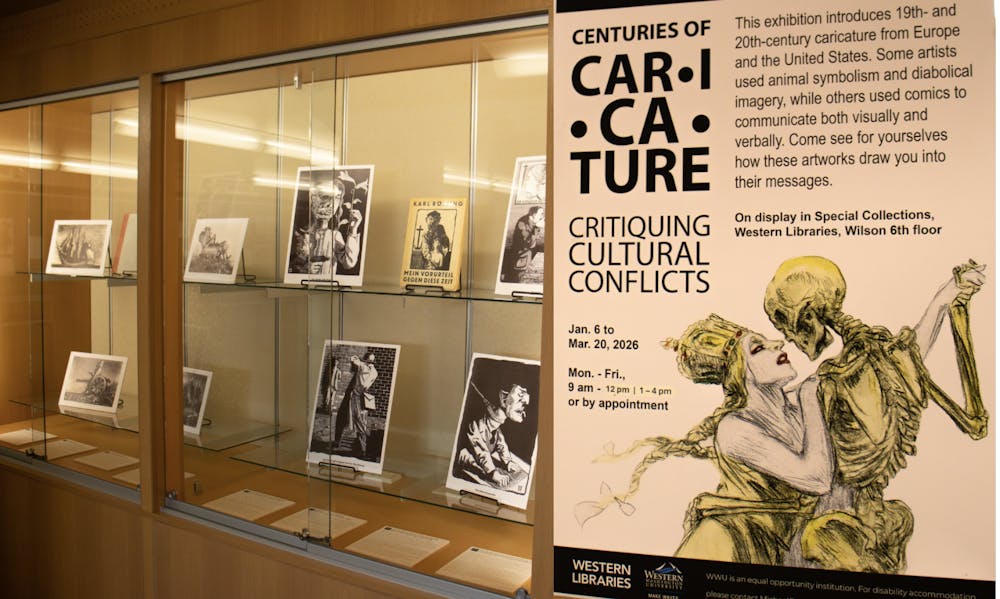
A new exhibit titled “Centuries of Caricature: Critiquing Cultural Conflicts” opened earlier this January in Western Washington University’s Special Collections. The exhibit features more than 40 historic caricature art pieces focusing on major conflicts like world wars, political divide, antisemitism, capitalism, communism and morality.
“This exhibit is extremely relevant right now, given the unrest happening in the United States and around the world. We are seeing history repeat itself,” said Morgan Buhler, fourth-year Western Washington University student and co-curator of the exhibit.
The entire exhibit was co-curated by students in ART 490: Exhibition Theory and Practice. They studied 19th and 20th-century literature and caricature art from Europe and North America to research and refine their exhibit curation skills.
The class is taught by art history professor Julia Sapin, who has been a part of Western’s faculty for 22 years. Sapin collaborated with Michael Taylor, the Special Collections librarian, to gather a wide variety of 19th-century European and American caricature art for students to analyze and turn into an exhibit.
“Students took off. They researched art and organized the exhibit all themselves,” Sapin said.
Students selected caricatures to study and formed groups based on similar artistic themes.
“Because of the conflicts happening today, I think students were all the more riveted to curate this exhibit; some students even explicitly mention them,” said Sapin.
One student in particular, Ross Vitale, made an effort to connect these historic arts to the world today. He chose a piece depicting a green devil-like figure titled “Sleeping Partner” by Louise Raemaeker.
The caricature was critiquing the leader of Germany during World War I, who the artist claimed was working or sleeping with the devil. Vitale alludes to the idea that the same critique could be applied to the current U.S. president.
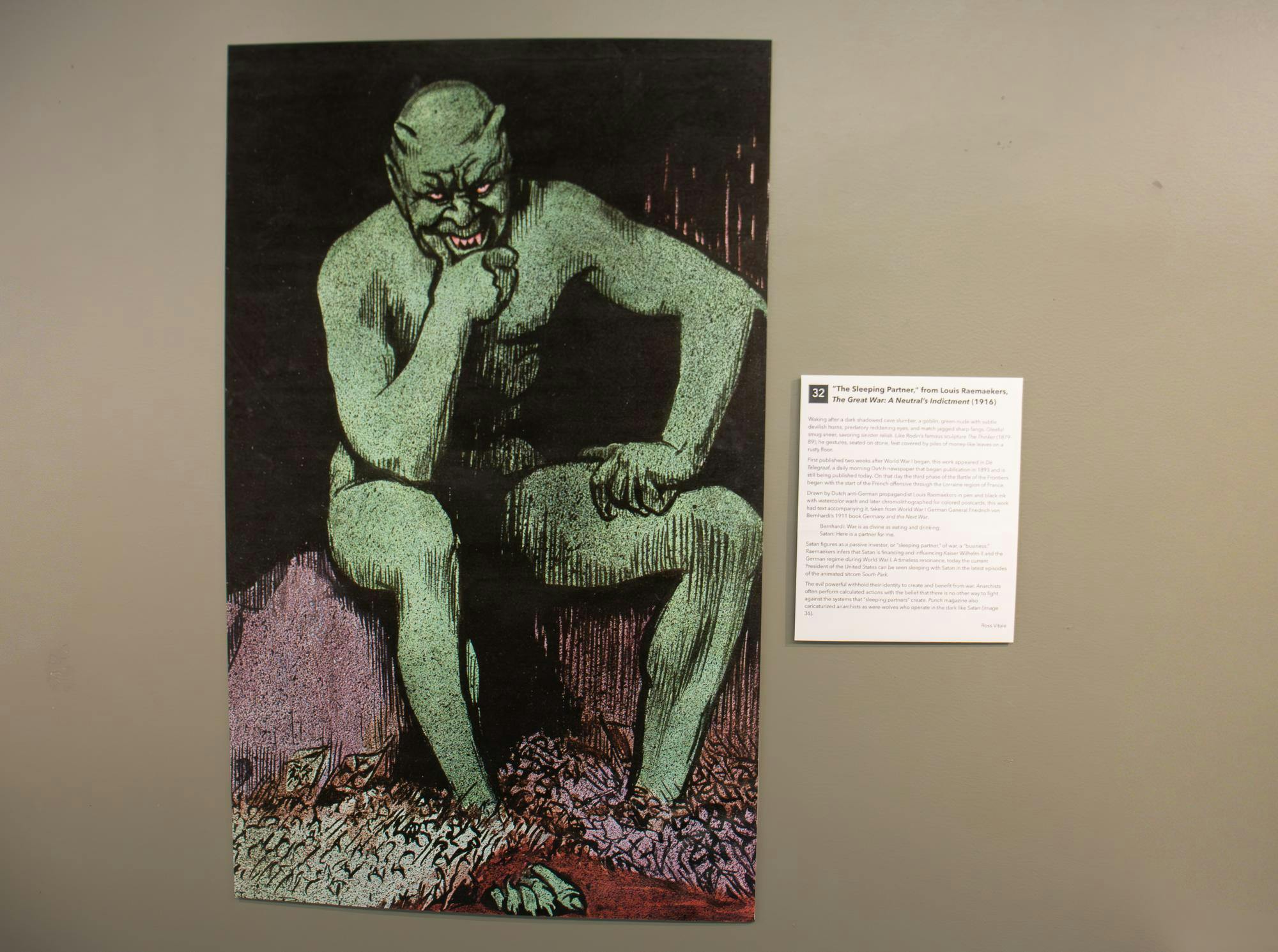
“A lot of these texts and art pieces were extremely dark in subject matter. Each of us chose our own pieces to focus on, and we had the freedom to express our own connections we made from them,” said Vitale.
There are many ways viewers can interpret this exhibit, Buhler highlighted two in particular.
“The exhibit can give viewers a dark reminder that history is repeating itself but also a sense of hope that humanity has faced these conflicts before and overcome them,” Buhler said.
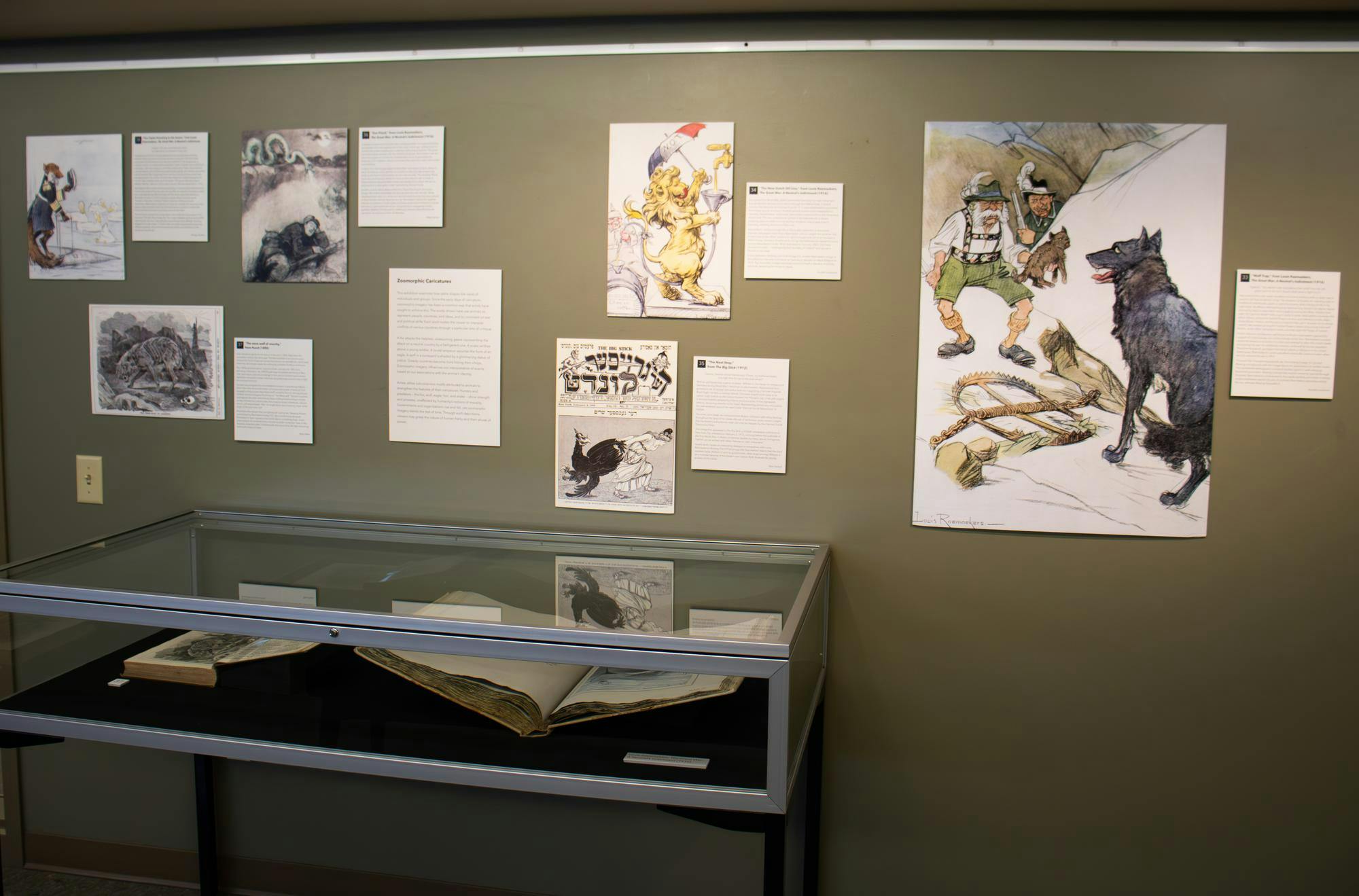
Fort Lewis College art history professor David Cahoon explained the different intentions of caricature, specifically with propaganda.
“A lot of propaganda is meant to create a sort of ‘us vs. them’ mentality. Artists would exaggerate features or dehumanize the subject in order to make them into an ‘other’,” Cahoon said.
He said that a prime example of this was how Jewish people were drawn in antisemitic propaganda leading up to the Holocaust. Caricatures such as these are featured in the exhibit.
“It was very informative learning about the different types of caricature,” Buhler said. “It’s not only political cartoons or war propaganda, it's a display of freedom of expression, or sexual freedom.”
“Caricatures aren’t just drawings of people; they’re a direct response from the artist and a reflection of society during that time period,” Sapin explains.
This is the first time ART 490 has used Special Collections as its exhibition venue; in previous years, the class’s exhibit had been in the sky bridge glass display on the second floor.
“Now it’s great to have such a vast amount of space for students,” said Sapin.
Many Western students have set foot in the Wilson Library, but not everyone has made the journey up to the mysterious sixth floor, which holds the dense and historic Special Collections exhibits.
“I had never gone up to the sixth floor before. I didn’t know it existed,” said second-year Western student Zoe Michalak. “I thought the caricatures were so cool. The captions the students wrote seemed like they could be in a real art museum.”
Special Collections is the university’s space of historic materials like documents, manuscripts, artworks and rare books, some of which are 500 years old. The university makes them available for students to access and for classes like ART 490 to practice exhibition skills.
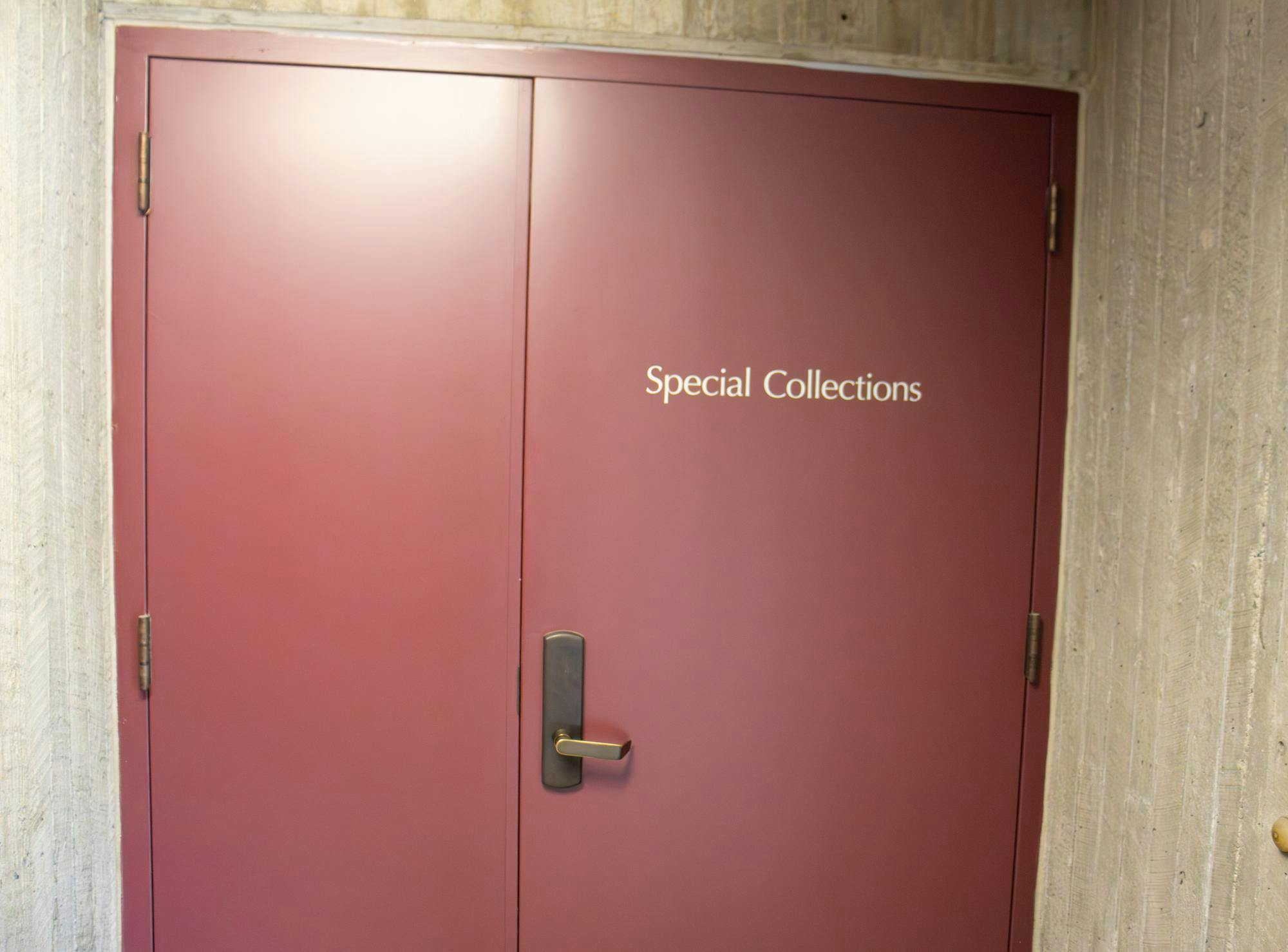
“Centuries of Caricature” is available for viewing in Wilson Library’s Special Collections on the 6th floor every weekday from 9 a.m. to 4 p.m. or by appointment. Additional information can be found on the library’s website.
Katherine Rogers (she/her) is a reporter on The Front’s campus life beat. This is her first quarter on The Front. She is a second-year visual journalism major. Outside of the newsroom, she does concert photography for local artists. You can reach her at katherinerogers.thefront@gmail.com.