
“We protect each other.”
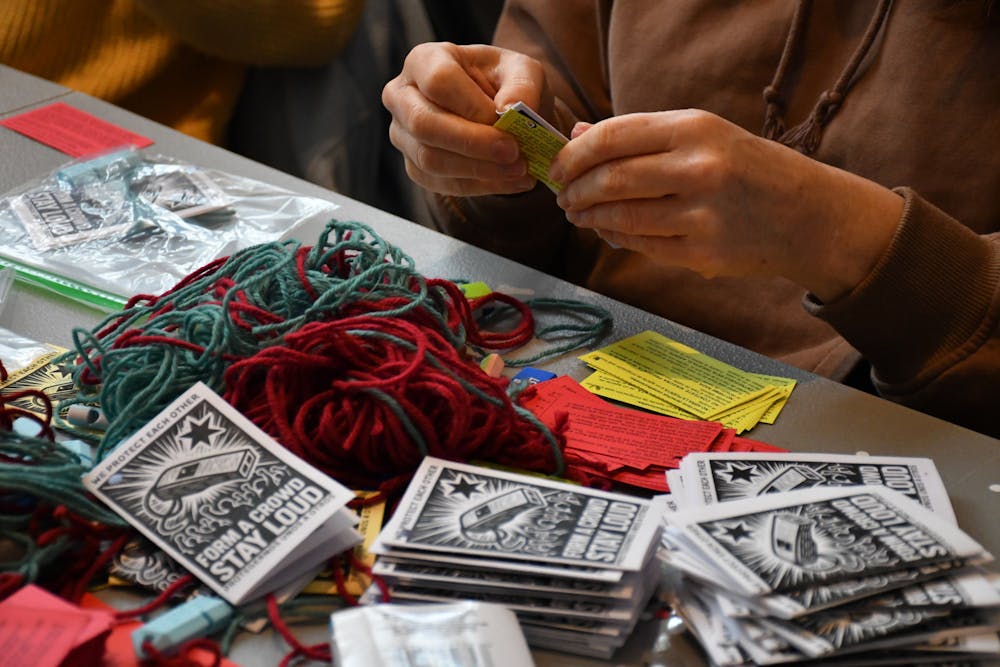
The words appear in bold on the cover of zines with whistles attached to them, tucked neatly into small plastic bags.
On Sunday, in between spurts of heavy rainfall and patchy blue skies, dozens of people squeezed into the Whatcom Peace and Justice Center in Bellingham with two things on their minds: whistles and resistance.
Bellingham Whistles aims to protect community members and build networks with one another in times of disarray and uncertainty. At the WPJC, more than 300 whistle alert kits were assembled as part of Bellingham Whistles’ first community workshop.
The use of whistles to warn community members of the presence of U.S. Immigration and Customs Enforcement has become common in cities including Los Angeles, Minneapolis and Chicago. In the past month, the form of resistance has reached Bellingham.
Whistle use is divided into two categories, as noted on the WA Whistles welcome document: ICE being in proximity (alerted with short bursts of “PREE — pause pause — PREE — pause pause — PREE — pause pause — PREE — pause pause”), or ICE actively attempting to detain somebody (alerted with an elongated whistle, “PREEEE PREEEE PREEEE”).
The zine inside whistle kits instructs readers to “Get to safety” or “Follow the sound, form a crowd, stay loud,” if a whistle is heard.
“I think what’s happening is terrible,” said a representative of Bellingham Whistles, who requested anonymity due to safety concerns. “I feel like no matter where we are or how safe we think we are, it’s good to prepare for the worst, especially after seeing what's happening in other cities across the country.”
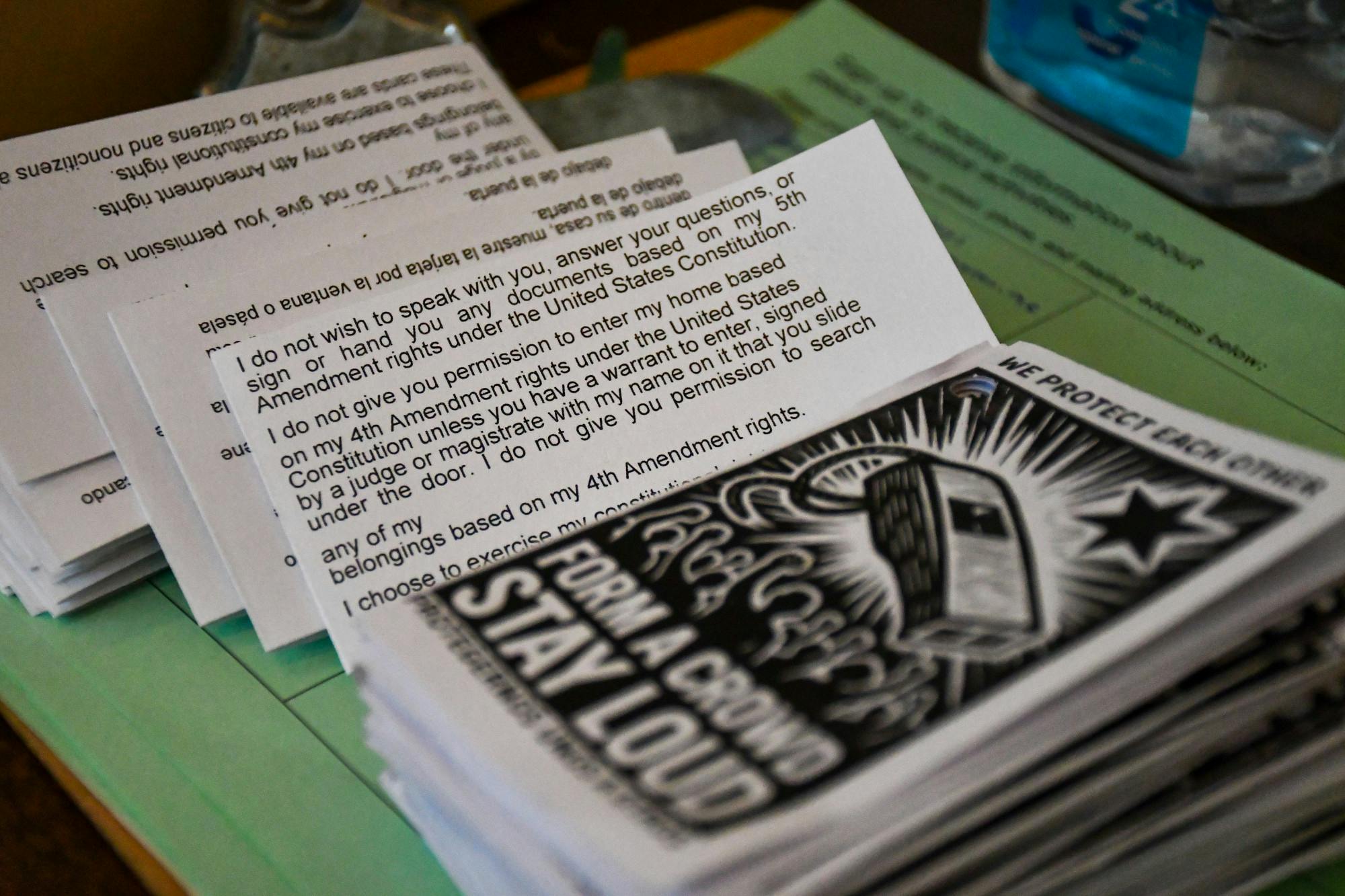
One of the rights cards, along with the zines included in each whistle kit from the event hosted by Bellingham Whistles at the Whatcom Peace and Justice Center on Sunday, Feb. 1, in Bellingham, Wash. The cards and zines offer guidance on legal rights and list local support resources. // Photo by Caitlin Grygorcewicz
Bellingham Whistles describes itself as less of an organization and more a space for community members to connect, prepare and show up for one another.
Participants brought whistles, folded zines and talked through the ways community members can respond when they witness ICE activity.
“When things feel hopeless, being able to do things in community, both with people you know and strangers, is so important because it helps remind you that you’re not alone,” said another attendee, who requested anonymity due to workplace circumstances. “Social change only happens through lots of people mobilizing.”
The kits come with a whistle, a card listing your rights if detained and a zine with important information, such as hotlines and organizations that are offering legal and community support. The zines and cards were offered in English, Spanish and Vietnamese.
Listed on the zine inside whistle kits was the phone number for the Washington Immigrant Solidarity Network (WAISN) Deportation Defense Hotline, although Washington Whistles is moving away from including the hotline number at the network's request.
WAISN has a rapid response team that monitors violations of immigrants’ constitutional rights and civil liberties, as well as a program that provides accompaniment to immigration and state court hearings. In November, ICE arrested two men outside courthouses in Bellingham and, in doing so, violated state law which prevents immigration arrests within one mile of courthouses.
The whistle kits are appearing as a free resource across town in numerous business and community spaces. As of Feb. 1, the Bellingham whistle map includes Village Books, Leaf & Ladle, Make.Shift Art Space and MW Soapworks.
MW Soapworks will serve as a space to both acquire and drop off whistle kits. Community members with access to 3D printers are encouraged to produce as many whistles as they can to help forward the cause.
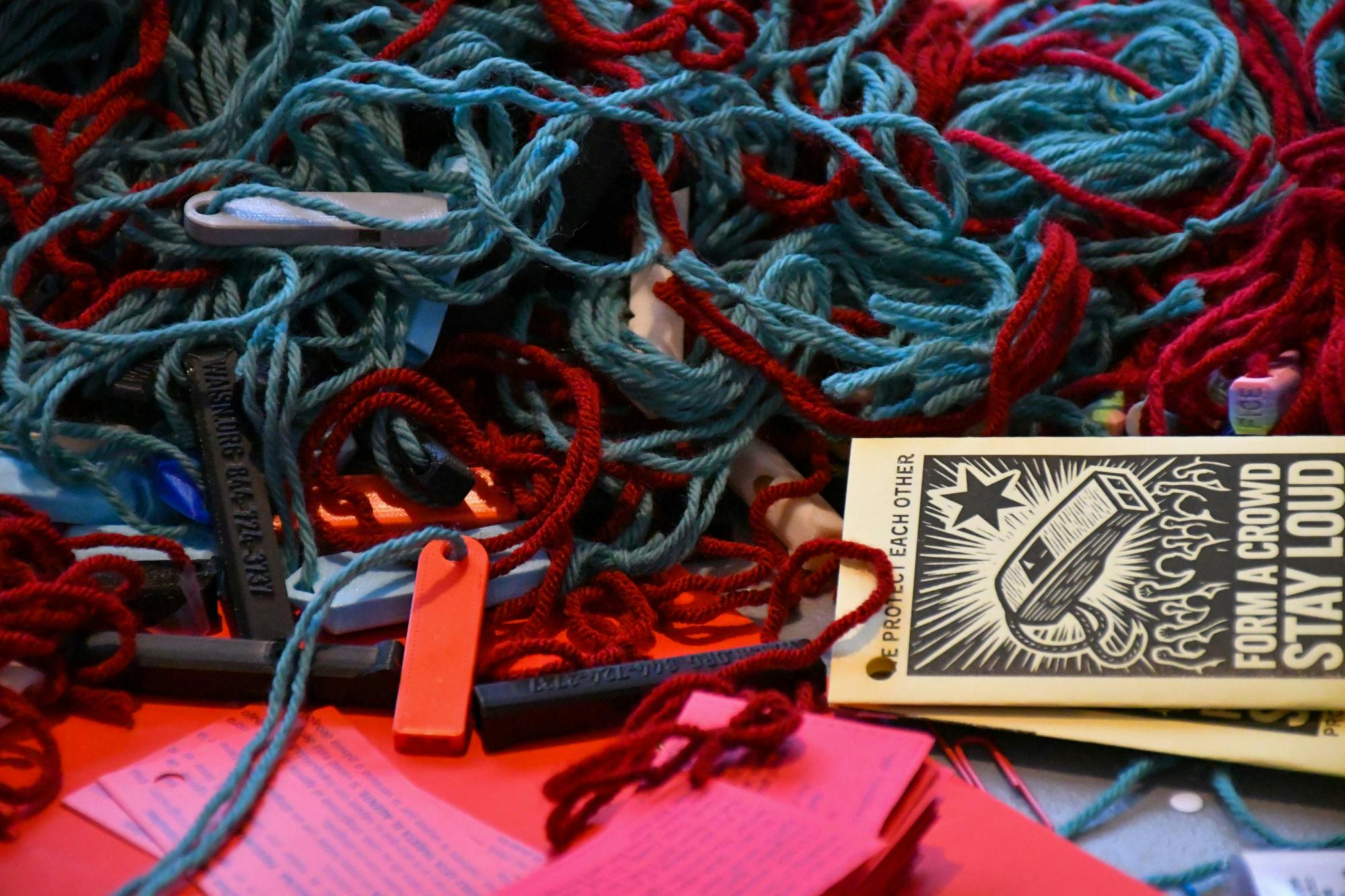
3D-printed whistles with yarn lanyards sit on a table at a whistle kit-making event hosted by Bellingham Whistles on Sunday, Feb. 1, in Bellingham, Wash. The whistles were donated to the event, making it more easily accessible to the community. // Photo by Caitlin Grygorcewicz
“We only have each other and we have to protect each other. People who are the most privileged and able to be on those front lines of blowing the whistle or recording (are) protecting the people that are most at risk,” said the representative of Bellingham Whistles.
For many at the event there was a strong feeling of shared responsibility and collective care as they worked to assemble each whistle kit.
“It’s good to feel like you're part of the solution, as opposed to part of the problem,” said participant Amber E., who requested that her last name be withheld due to safety concerns, as she hole-punched zines.
Over the course of the afternoon, more and more people showed up to participate, including two steering committee members of Community First Whatcom who opened their doors to accommodate more participants.
While the Feb. 1 event centered around community-based resistance, the impacts of immigration enforcement are seen deeply rooted in workplace environments as well.
“(ICE) is an agency that hasn’t always existed. There are people who are older than it. It doesn’t need to exist — it’s a mechanism for federal overreach from an authoritarian dictator,” said Gwennan Pritchard, steering committee member and vice chair of the Whatcom County Democratic Socialists.
ICE was created with the Homeland Security Act of 2002, signed by George W. Bush that same year in the wake of 9/11. Under Trump’s current administration, ICE activity has intensified, with at least nine deaths linked to ICE in January and increased detainment of individuals with no criminal record, regardless of citizenship status.
“I’ve been waiting for this sort of organization to pop up in Bellingham,” said Paul Carlson, president of WFSE Local 1381 and steering committee member.
As a union member representing Western Washington University’s staff, Carlson said immigration enforcement is closely tied to labor issues, noting that workers are often the most affected. He said his union has formed a working group to prepare for potential ICE raids or I-9 audits and is working with other campus unions to develop a coordinated rapid-response plan.
“If the institutions that we rely on break down, then all we have is each other. We need things like this (event) so that we know who each other are,” Carlson said.
For information on future whistle days, visit Bellingham Whistles.
Kenna Peterson (she/her) is a city news reporter for The Front this quarter. She is a fourth-year news/editorial journalism major and when she isn't working on a story, she can be found baking bagels, making collages and hanging out with her cat, Rigatoni. You can reach her at kennapeterson.thefront@gmail.com.
Caitlin Grygorcewicz (she/her) is a sports and recreation reporter this winter quarter. She is in her second year, majoring in visual journalism, and is returning to The Front for a third time after previously serving as the photo and video editor. In her free time, you can catch her cleaning her camera, climbing rocks and cooking good food. You can reach her at caitlingrygorcewicz.thefront@gmail.com.