

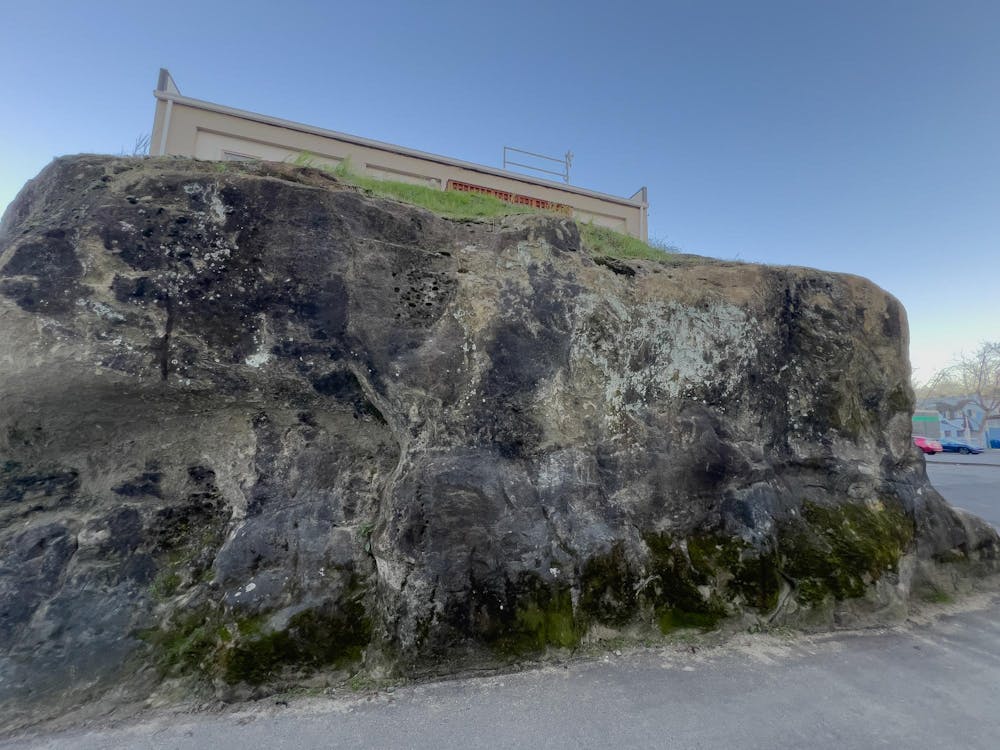
Between Flora St and W Champion, nestled behind the backs of O-Pole dance studio and the Mount Baker Theatre, lies the Great Bellingham Boulder. Standing almost two stories tall, it looks disarmingly natural and serene amongst paved asphalt and urban alley.
The rock is a Bellingham icon. There’s a presence to it. If you catch it out of the corner of your eye, it simply demands a second look or even touch. But for all the local admiration, there was a question that seemed to have no answer. How did this giant rock end up in the middle of this alley?
Kevin Leehan, a former archeologist at Washington State University, had several theories as to the rocks' path towards settling in the middle of a city.
“You have this large chunk of sandstone, isolated by itself. Based on what I've seen in glacial geology, one possibility is that the area was glaciated and it got picked up from somewhere in that same geological formation and was moved. When the ice melted, that's where it ended up,” Leehan said.
Over the millennia, Washington state has been subject to many tsunamis that could have deposited it. The rock around it also could have been cut by man or by nature.
“That stuff is interweaved with shales and siltstones and the like, so it could have been eroded out and it was the harder piece of rock that’s left,” Leehan said “You see that, where the rain just washes away that soft stuff. Essentially over time it was carved out.”
Although certain natural possibilities exist, the rock hasn’t been a standalone monument for long. The boulder can be traced back through many photographs from Bellingham’s development.
“So that rock is the last remaining outcropping of the Chuckanut formation,” said Jeff Jewell, archivist and historian at the Whatcom Museum. “That was a ridge that extended from Central all the way to Dock St. It’s removed piecemeal, to the point that by the Mount Baker Theatre being there, it seems like that is a boulder or piece that is contained, but it’s just a remnant.”
Over several decades, the entire ridge was removed bit by bit for various projects, at one point to build the original Bellingham Carnegie Library, the Swedish Baptist church, the Mount Baker Theatre and countless other homes and businesses.
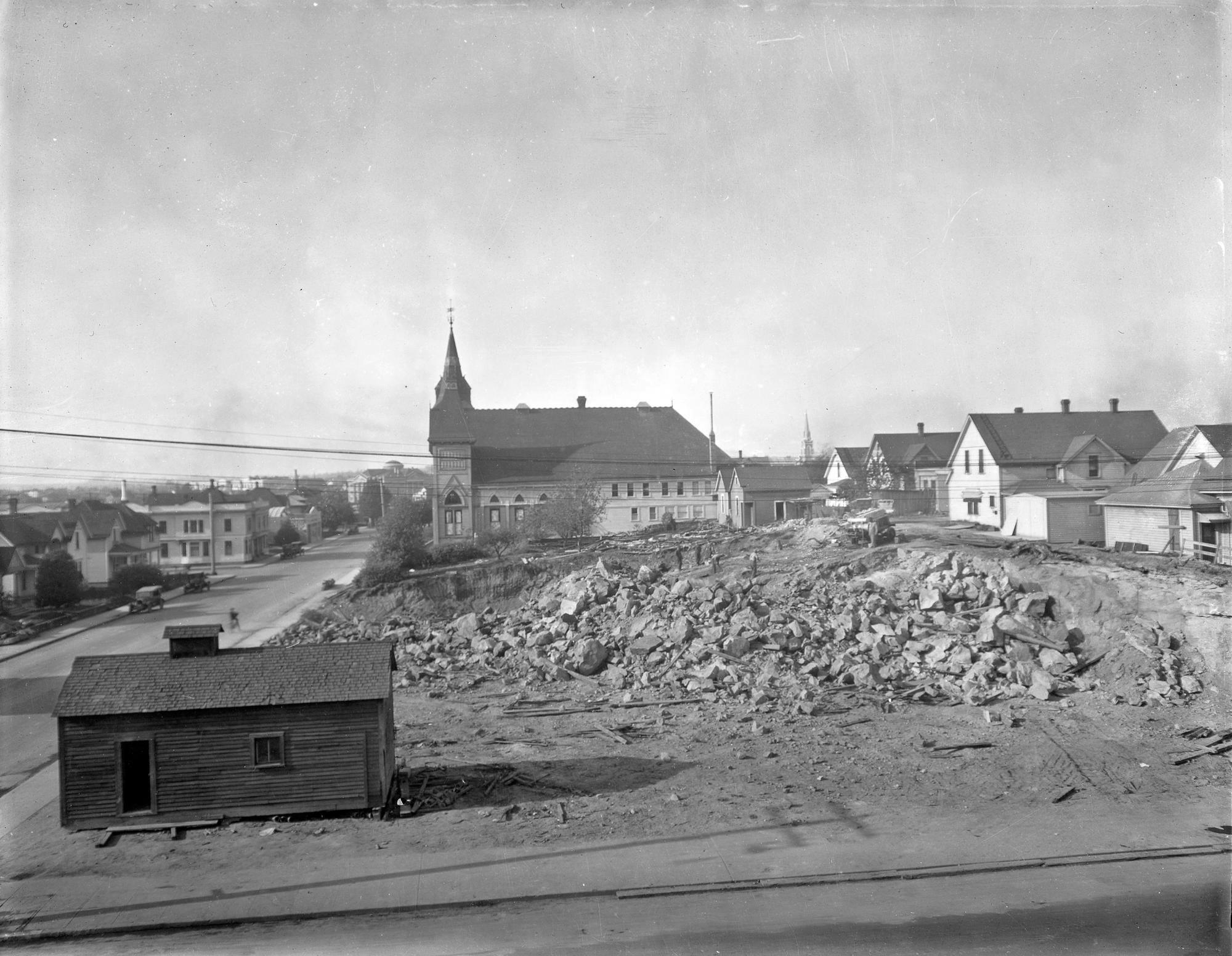
Chuckanut sandstone was a desirable building material and would be used for a plethora of purposes — from our own Whatcom Falls park bridge to the rebuilding of Seattle after the great fire of 1889.
“So they would have built into the rock, when the rock was the ridge and the rest of the rock outside the building was removed for the theater, creating that alley,” Jewell said. “They left that rock there because it is the back of that building, so it was holding up that building before it was just a rock.”
The rock’s ability to stand the test of time can be attributed to its structural necessity of 115 Unity. Current day occupants of the building have grown to love and cherish its presence.
“It just looks like a giant wall, like the building is up against a rock wall,” said Brianna McElfish, an instructor at O-Pole dance studios.
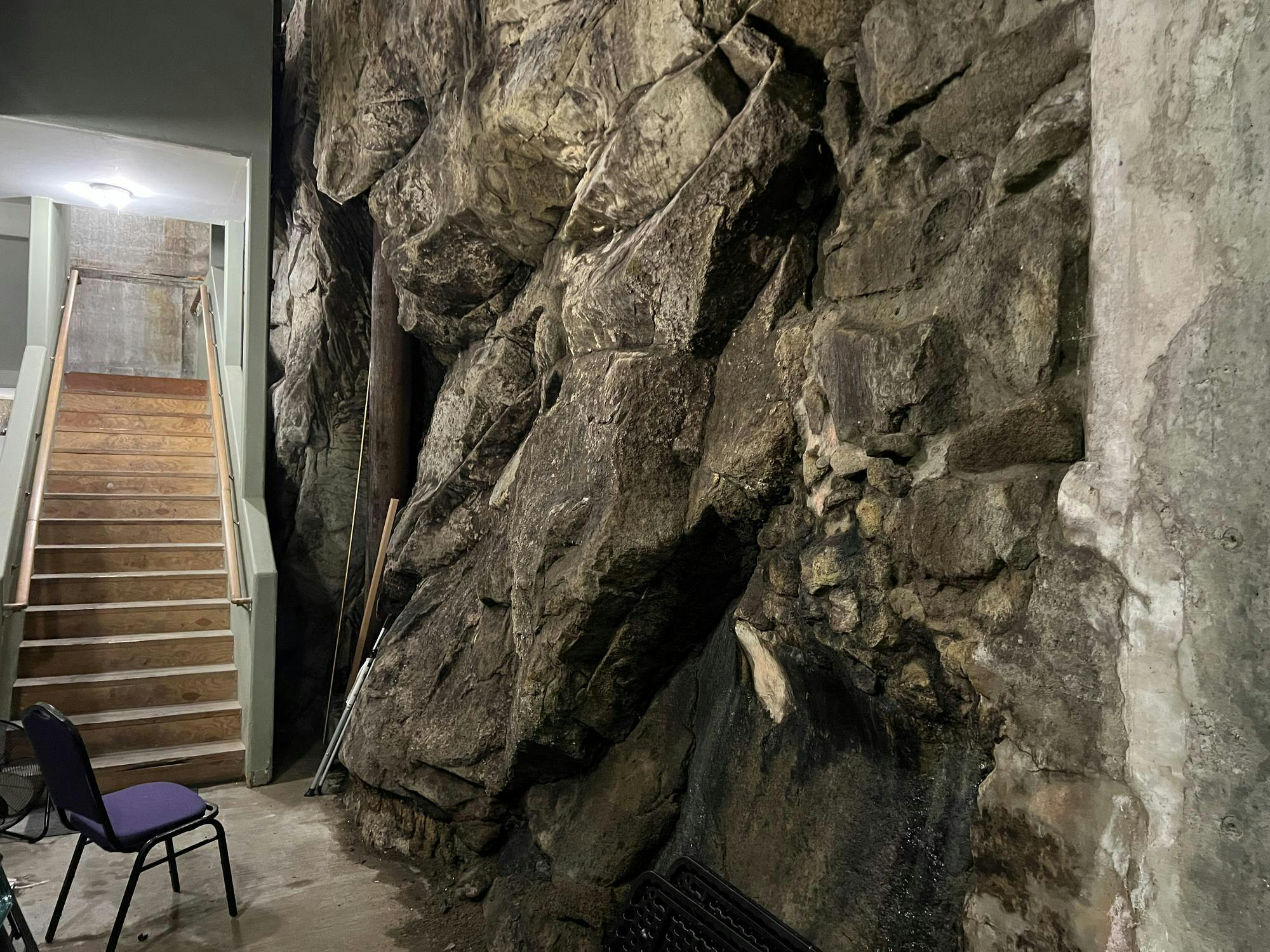
The entire backside of the studio, a sort of utility corridor separated from the main dance space by a second inner wall, is the length of the entire boulder.
“It really just seeps water and has its own weather system in there. Whenever it gets too hot here in the summer, we’ll all be like, ‘Should we open the cave?” McElfish said.
In the studio at least, they call it the cave. Every dancer had an anecdote to tell about the boulder, whose presence is a part of their daily lives.
While it may look strange and unusual, the rock is both structurally and culturally embedded in downtown. Embellished with consistently green grasses and trails of moss, the boulder is reminiscent of a Cape Cod sand dune or a Chuckanut cliff hanging over the sea.
Although it looks over commercial dumpsters rather than a quiet landscape, the rock’s majestic and natural quality instills a wonder that is hard to ignore. Sure to charm any fan of the unique, the rock stands to remind us where we come from as a lasting relic of a different time.
“It feels like it’s kind of an honor to see the other side. We love it being here,” McElfish said.
Eva Breitinger is a third year Visual Journalism major writing for the Front this quarter. Originally from Minneapolis, she is an avid outdoorswoman, writer, and photographer. Outside of school and work, she can be found hiking with her dog Winnie or at the barn, riding dressage with her horse Emmitt. You can reach her at evabreitinger.thefront@gmail.com


