
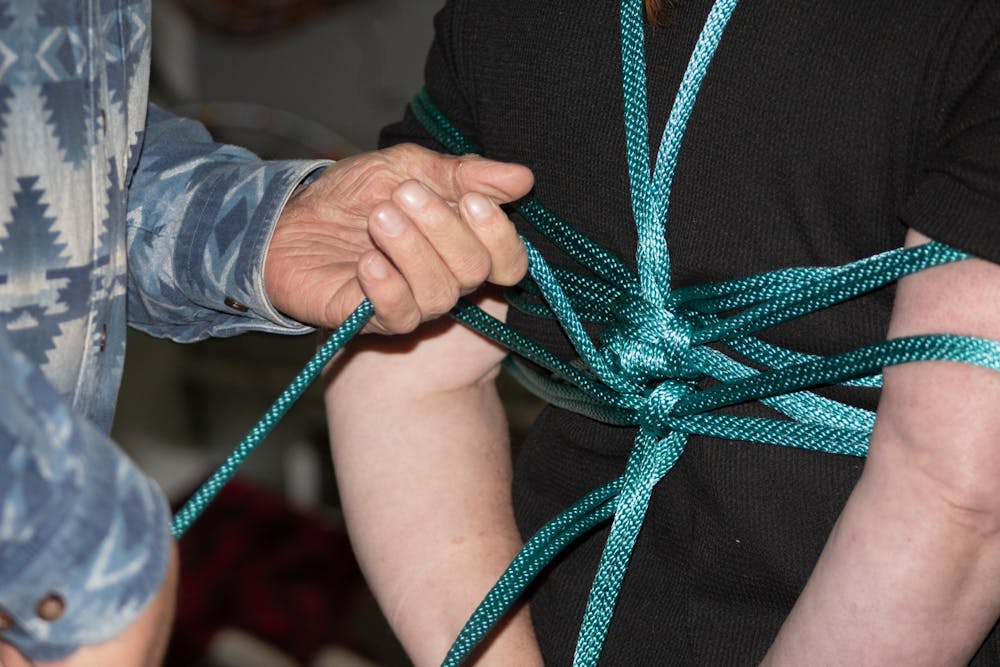
Shibari, a style of Japanese rope bondage, is an art form that uses rope to create intricate patterns on the human body. As a subculture of the BDSM community, it is often viewed as taboo or scandalous.
Although this community is typically underground, you can find it if you know where to look. The Bellingham Vista Club is a collective that hosts events, parties and meetups for sex-positive people, including a monthly Shibari workshop.
Scotty Shuken has been practicing Shibari for 12 years and leading Shibari workshops at Bellingham Vista Club for three. They said that they enjoy sharing their extensive knowledge with others, teaching with both an aesthetic and functional approach.
“There’s not really that much separation culturally now between the art form of Shibari and the kink of bondage. But it’s essentially human macrame, right?” Shuken said. “If you pretty much only engage with rope in a kink or sexual focus, it's gonna almost give you a Pavlovian approach, like, ‘this is what this is for.’”
While Shibari can be sexual in nature, it’s not an inherently sexual practice. It’s an art rooted in trust, consent and a desire to form a deeper connection with one's self or tying partner. Many enthusiasts describe the practice as grounding, empowering and as a way to express themselves creatively.
“A lot of people do it just for the art form, or for practice, or for just learning something new because they want to find something cool and interesting to do,” said Rei Andrews, founder and director of Bellingham Vista Club.
Practicing knots also benefits people who have additional sensory needs. Tying is a great stim activity for autistic people, those with ADHD and other neurodivergent folks because it keeps their hands busy.
Bob Bowles, a retired crane operator rigger, enjoys creating his own ties. He and his tying partner have become close friends since embarking on their Shibari journey.
“The more I work with somebody, the more comfortable (and) safer they feel when I’m working with them, and the deeper the connection becomes,” Bowles said.
Shibari is an incredible tool that can be used to gain a sense of empowerment and control over your own body, as well as deepen the relationships you may be in already.
“It offers people a chance to really be heard and seen and valued and cared for, and most of us are looking for that in our romantic relationships or sexual relationships,” said Katie Olvera, who has a doctorate in psychology and is a senior instructor at Western Washington University.
Fundamentally, Shibari is rooted in consent and playing with power dynamics. It creates an opportunity for people who have experienced sexual trauma to reclaim power over their bodies in a safe, fun and controlled environment.
“All the elements of consent and communication and safety that are woven into BDSM in general can be really healing and empowering for folks,” Olvera said.
When the element of tying the body is introduced, the art then intersects with somatic therapy.
“Somatic work really focuses on freeing up trauma that’s been stored in the body, and when done intentionally, can actually be healing on a neurobiological and physiological level,” Olvera said.
The practice can appear intimidating, but it’s easier to begin exploring than it may seem. As long as you’re implementing safe practices, going slowly and not attempting suspension right away, you have nothing to be wary of.
“If you know how to tie your shoes, then you can do at least a little bit of Shibari,” Shuken said. “If you feel like putting rope on you or you feel like putting a rope on somebody else, just go for it.”
Raleigh Nolan (she/they) is an opinion reporter for The Front. She is a journalism major and a women, gender, and sexuality studies minor. Raleigh is originally from Michigan and has lived in Bellingham since 2021. Since then, she has made many wonderful friends and adopted a sweet/evil kitty named Olive. Some of her favorite spots in Bellingham are Rumors Cabaret, Avellino Coffeehouse and Colophon Cafe. You can reach her at raleighnolan.thefront@gmail.com.