

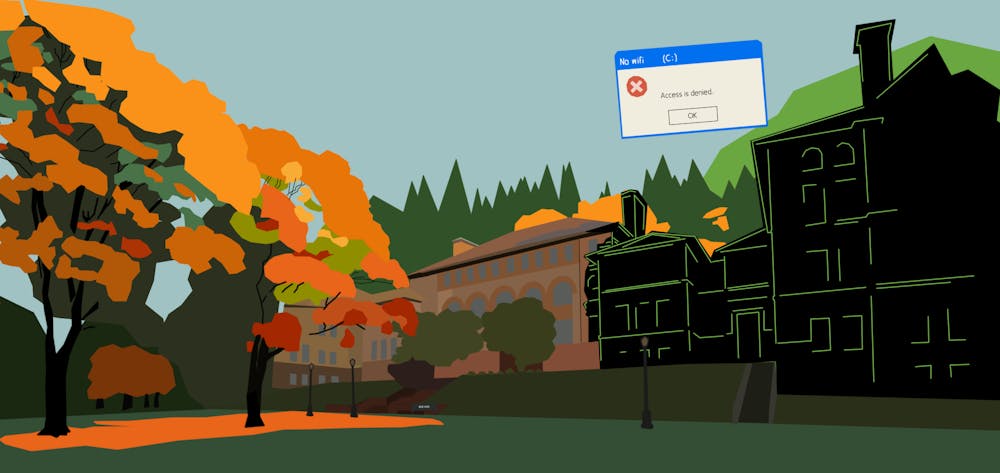
Students were pushed toward digital learning during the COVID-19 pandemic. Despite the return to in-person learning four years ago, classwork, homework and studying have all remained widely connected to technology.
The two largest contributors to this transition have been affordability and accessibility. By integrating more coursework into the digital format, universities have made class available anywhere, without the cost associated with physically producing a learning environment.
This shift has flaws that aren’t easy to overcome, though. As coursework has shifted more towards screen-based learning, problems with the system have become apparent. Excessive screen time has been linked to negative behavioral changes, such as worsened mental and physical health, weakened problem-solving skills and decreased productivity.
“Students really struggled to focus online, and their learning suffered as a consequence,” said Ethan Bushelle, an author and professor of humanities at Western. He believes that learning happens best when it’s performed in person, face-to-face.
When students aren’t able to spend enough time socializing during their education, they struggle to grasp an important aspect of learning. That aspect is communication. The learning experience is inferior when students can’t be physically connected to their studies.
“Learning has an irreducible social dimension, and that cannot be replicated online,” Bushelle said. “The intellectual side and social side are interconnected, and we should really be mindful of that, when we’re thinking about online courses.”
Even during in-person classes, many aspects are still digital. Worksheets, tests and note-taking, for example, are often done in front of a screen.
When students are connected to technology in the classroom, they can easily become distracted and lose focus. It becomes harder to pay attention and there’s less face-to-face connection when screens are in the way.
With programs like Inclusive Access becoming larger, textbooks have also become digital. Preference for digital materials (37%) has surpassed print materials (33%) for the second year in a row, according to the 2025 Student Watch Survey.
“The digital price is usually better enough that we’re just not selling the books off the shelves,” said Lara Konick, the director of the Western Associated Students Bookstore.
Konick has worked in university bookstores for decades and has watched as coursework transitioned from a handful of textbooks to a handheld device.

“When I worked at the University of Washington, there were two other bookstores on University Way, but that just doesn’t exist anymore,” Konick said. “The competition is now that other local business, Amazon.”
This has economically harmed the Western Bookstore, which is self-funding. Sales aren’t what they used to be, as many students no longer need textbooks or pen and paper. According to Konick, sales at the bookstore were around $7.5 million in 2008, while last year, they were only around $3.3 million.
Some, however, believe this shift has been necessary.
The Center for Instructional Innovation supports learning and technological endeavors on campus. They work as a part of the Academic Technology and User Services, and primarily provide support to faculty.
Justina Brown, the director of the CII, believes that some professors can’t always rely on brick-and-mortar lesson plans, especially with large class sizes.
“They’ve taught it this way for years to 35 people, but now it’s going to be 120 people,” Brown said. “The learning strategies are going to be much different in these scenarios.”
It’s a balancing act, according to Brown. The CII makes sure faculty can teach the way they want to, all while answering student needs and reaching learning objectives.
“We rely on what we know because it’s comfortable, but I don’t think there’s anybody who thinks the way we taught in 1965 was the best way to learn,” said AJ Barse, a designer at the CII.
Western, like many universities, is at a crossroads. The digital shift may be more efficient in theory, but it shouldn’t replace the foundations of teaching. It begs the question – What kind of learning environment are we building?
Technology should support education, but it shouldn’t define it. As the university continues to expand digitally, it should remember what makes higher education irreplaceable: the experience of learning together, as humans. If we lose that, no amount of innovation will make up the difference.
Liam Britt (he/him) is a second-year visual journalism major and opinion writer for The Front this quarter. Liam also writes for The Rage, a student-run magazine at WWU. In his time away from work, Liam enjoys going to music venues, skateboarding with friends and getting creative in the kitchen. You can reach him at liambritt.thefront@gmail.com.


