

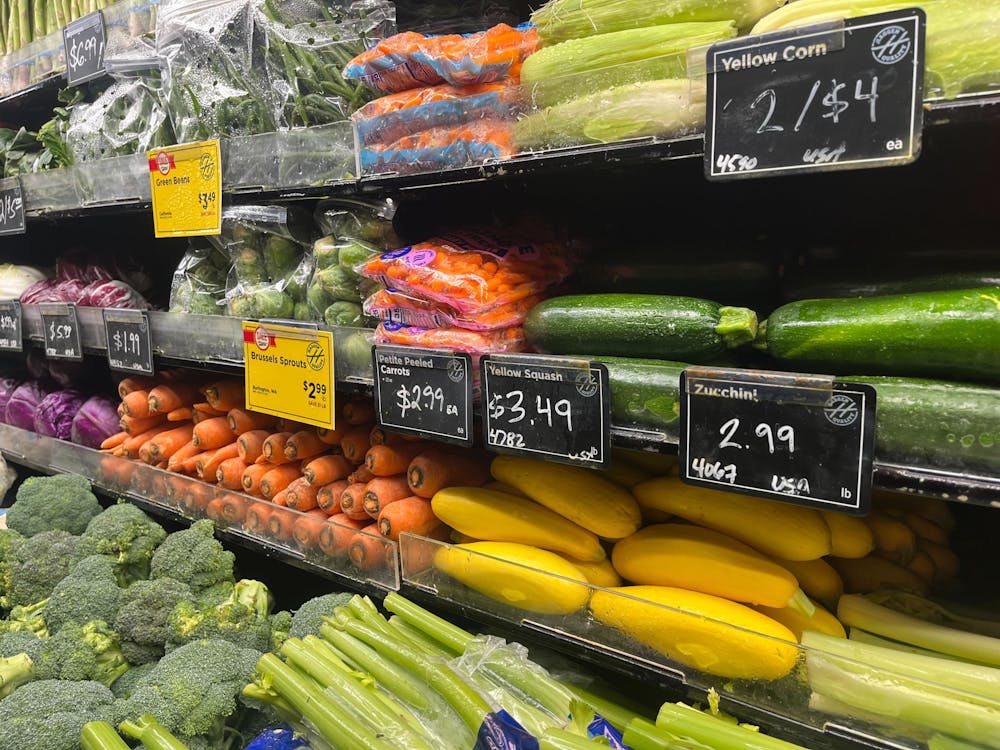
Being poor in America often means paying more for the basics of survival. From unaffordable housing and overpriced groceries to overdraft fees and payday loans, the cost of simply existing without wealth is nearly impossible to escape.
“If you’re lower income, you do realize how much of the system is working against you in so many ways,” said Trudy Shuravloff, the executive director of Whatcom Dream, a program that offers free and paid financial empowerment courses in Bellingham.
According to Whatcom Dream, 45% of households in Whatcom County fall below a budget that covers just the essentials of housing, childcare, food, transportation, and healthcare. High interest loans, unstable housing, limited access to credit and daily financial obstacles all add up.
“It's like a snowball effect,” said Yousef Tirhi, a peer financial coach for Western’s Merriman Financial Literacy Program. “Not paying your credit card often will get you a lower credit score, lower credit score will get you worse loans, and it goes on.” It can really hurt someone who's already struggling financially, he said.
These structures aren’t accidental; they’re built on profit models that depend on people staying desperate.
“They’re charging crazy amounts of fees for accounts with low balances, or if you go over your credit limit, you’re going to get charged a penalty or fee,” said Tirhi, “It’s just kind of, you know, hurting America.”
For many students, this struggle is personal.
“I work part-time and budget carefully, but it still feels like I’m always one step away from falling behind,” said India Sanborn, a psychology student at Western. “You try to be responsible, but the system doesn’t make it easy.”
The less you have, the more you pay. The boots theory perfectly illustrates this. The concept argues that poverty is expensive because low-income individuals are forced to buy cheap, low-quality items – for instance, poor work boots – that must be replaced more frequently. This is compared to someone who can afford to buy one pair of high-quality shoes that would last longer, spending less in the process.
America’s broken system punishes people not for how they manage their lives, but for the circumstances they can’t escape.
Many people in Bellingham fall into a category called ALICE – Asset Limited, Income Constrained, and Employed – a way to represent the working class. To combat this, Whatcom Dream believes in a model that states; given the right to knowledge, support and opportunity, people can break free from the cost trap and move toward stability, self-reliance and hope, said Shuravloff.
For low-income individuals, one small emergency can spiral into debt that takes months to recover from. “The truth is, all of us are one or two paychecks from living in our car,” said Shuravloff.
Sanborn said she’s seen that play out among her classmates. “I know people who, like, skip meals or take extra jobs to cover rent or random housing fees,” she said.
Western Success Scholars is a program that supports students who were in the foster care system or have experienced homelessness. In an email, Jon Stubblefield, the program manager for WSS, said there are many barriers that many people are not aware of.
“Some property managers allow folks without a co-signer to pay a higher deposit in order to qualify,” said Stubblefield. “It is great that there can be an option for folks who don’t have a co-signer, but that means they’ll be paying even higher amounts.”
Shuravloff noted another challenge: many low-income residents face transportation difficulties and can’t always afford gas. Since housing in Bellingham’s inner city is so expensive, they’re often pushed to the outskirts where rent is cheaper, but that means paying extra to reach affordable grocery stores.
Tirhi said that it's not a coincidence that the closest grocery stores are the most expensive, like Haggen and the over-priced markets on campus.
Poverty forces people into survival mode, where long-term decisions are sacrificed for short-term relief.
“It’s hard to think about saving when you're just trying to make it to the end of the month,” Sanborn said. “People don’t realize how exhausting it can be.”
The phrase “being poor is expensive” isn’t an exaggeration. It’s a reflection of how our economy treats vulnerability as a business opportunity. Until systems stop profiting from hardship, poverty will remain less of a situation and more an industry.
For those interested in supporting local financial empowerment efforts and keeping Whatcom Dream’s classes free, they are always accepting and encouraging donations.
Myla Balser (she/her) writes opinions for The Front. She’s a third-year Journalism student at Western, minoring in political science and film. You’ll usually find her reading, movie-marathoning or never turning down a good debate. You can reach her at mylabalser.thefront@gmail.com.


