
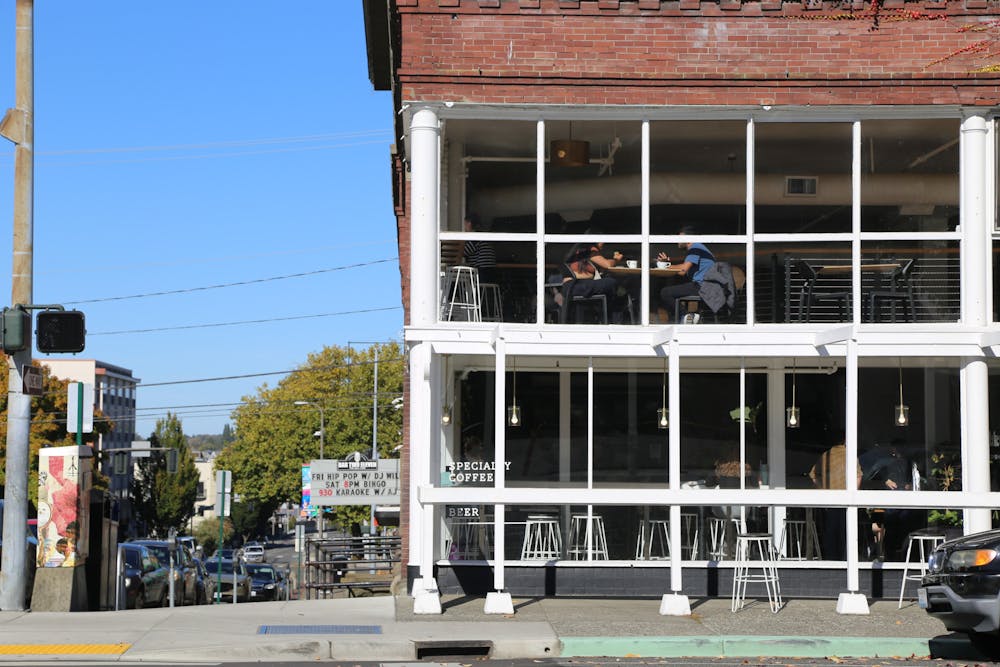
“Everyone is asking the question, ‘How much are we going to eat the cost of tariffs before passing that on to our customers?’” says Tim Shenkin, co-owner of Makeworth, a bright, plant-filled, brick-and-mortar coffee shop on North State Street.
At the cash register of a trendy local shop, the increased price of a cup of coffee might appear to be just another infuriating example of inflated prices in a desirable college town. However, these shops need our support as they react reasonably to far-reaching issues, including unprecedented tariffs and climate change-related weather events in distant countries.
As the coffee economy reverberates from the effects of Trump’s towering tariffs, small shops are the most vulnerable. Larger corporations might have the resources to keep prices down for customers, but by spending your money at a local shop, you are paying for more than just a cup of coffee.
Zachary Martin, a 19-year-old student at Western Washington University, feels strongly about the role of local coffee shops in the community.
“There’s not enough third spaces anymore, especially as young people,” he says. Martin describes third spaces as a community space outside of the home, work or school. “It’s not like I can go to bars yet, so it feels like a coffee shop is one of the best options.”
“People can come in and use our Wi-Fi and work and study, have first dates, weddings, funerals … We love being that watering hole for the city,” says Shenkin. These vulnerable, local businesses comprise a cornerstone of the community.
Shenkin is aware that from an external perspective, raised prices could appear to be a cash grab. But he wants the community to know this isn’t the case for small shops. “In a low-margin industry like coffee … no one is getting rich…”
Shenkin says Makeworth’s import process has been significantly impacted by the Trump administration's 50% tariff on Brazilian coffee beans. In addition to costly tariffs, Brazil has spent much of 2025 battling crop-destroying droughts. The combination of these events has compromised Makeworth’s Brazil-dependent supply chain.
Shops like Makeworth have to walk a delicate line, balancing the bloated cost of importing beans without raising prices to a level that could turn away customers.
“Tariffs are paid by the importer in the U.S. but are mostly passed along to buyers,” says Professor Brandon Dupont, who teaches economics at Western Washington University.
“It’s a completely different landscape,” says Shenkin about the present coffee market. Both climate change-driven droughts and extreme tariffs are unprecedented, making it difficult for small shops to adapt. “Tariffs more recently have been very low – until, of course, the Trump administration,” explains Dupont.
Now more than ever, spending money at brick-and-mortar shops is integral to maintaining Bellingham’s vibrant community.
“It doesn’t have to be Makeworth,” says Shenkin. “Whatever your local thing is, if you’re a tea drinker, you’re a coffee drinker, you have a favorite food — pick your spot and support that.”
Sarah Zieger (she/her) is a Journalism major and Opinion writer for The Front this quarter. When she's not holed up in a coffee shop writing this week's piece, you can find her drawing in a hammock somewhere off Chuckanut or lifting at the rec. You can reach her at sarahzieger.thefront@gmail.com.