
Every fall, six to eight people in a city-sponsored program bring Bellingham’s community together to restore the city’s native ecology.
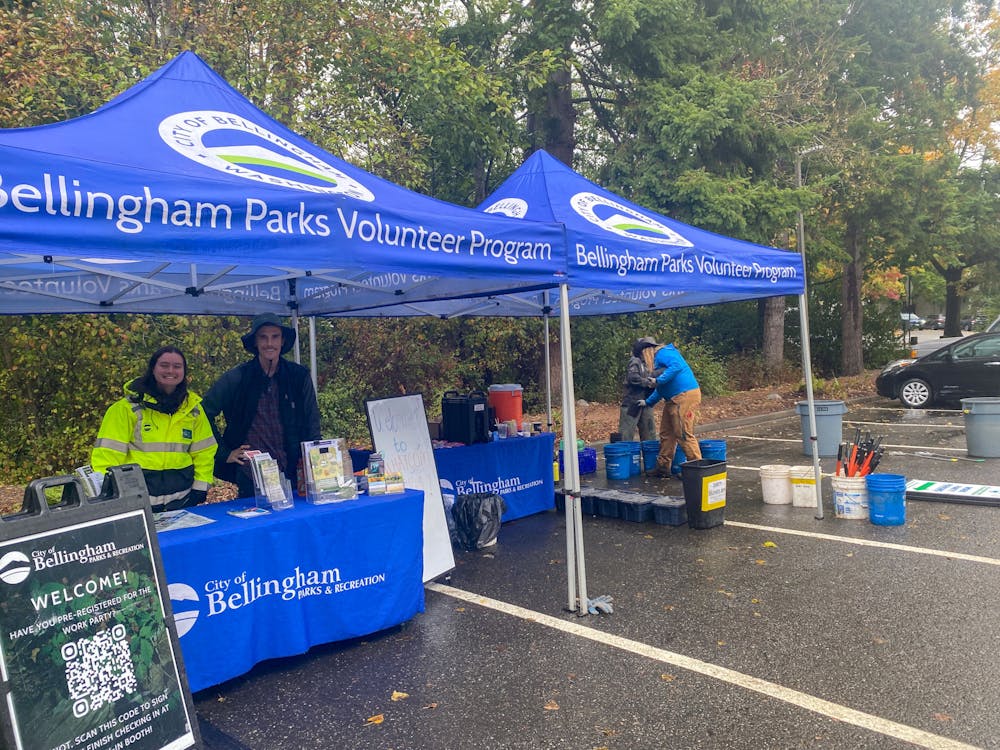
The City of Bellingham’s Parks Volunteer Program has begun community work parties for its fall work season. These parties, hosted every Saturday from 9 a.m. to noon, focus on the reintroduction of native species to Bellingham parks and trails.
The next work party is being hosted at Happy Valley Park on Nov. 1, according to the City of Bellingham’s Parks Volunteer Program page. Participation in all work parties requires pre-registration due to limited space. People of all ages, abilities and experience levels are able to participate.
Volunteer work done at community work parties includes removal of invasive plants, soil mulching and replanting of native vegetation.
According to Rebecca Bunn, a Western Washington University professor specializing in plant-soil interaction in the context of invasion ecology, invasive plants change local ecosystems through out-competing native vegetation. This causes a loss of biodiversity and potential changes in soil function depending on the species of the invading plant.
“Putting down a layer of mulch will help reduce the ability of an invasive plant for its seeds to be successful,” Bunn said. She says certain plants are extremely successful invasives through producing lots of seeds, such as the Himalayan blackberry, an introduced plant and aggressive noxious weed according to the Whatcom County Noxious Weed Control Board.
“There’s the removal aspect in the beginning of the work parties, and then putting the mulch down afterwards,” said Rachel Clark, a native plant steward and volunteer with the program. “I kind of like that whole process where you see a big difference of what you’ve done from the beginning, where it’s covered in a base of plants, to the end where you can just see the work that you’ve done.”
In 2024, volunteers with the Parks Volunteer Program removed 324 cubic yards of invasive vegetation, spread 339 cubic yards of mulch and planted 3,010 plants, according to Freya Fradenburgh, a Park Stewardship Supervisor for the City of Bellingham.
The Parks Volunteer Program works on an academic quarter schedule with community work parties hosted through the fall, winter and spring seasons, from September through the end of June.
“Fall, winter and spring are the best seasons for ecological restoration work due to softer ground conditions and less likelihood of accidentally spreading invasive seed load,” Fradenburgh wrote in an email.
She also cites the availability of support from three to four volunteer interns and the two to four-person Parks Volunteer Program staff team as reasons for the program’s operation on an academic quarter system. The program’s volunteer interns are only available during the academic year, and year-round weekly work parties are unsustainable with a small staff team, Fradenburgh wrote.
“The park is a special place, and the parks department really does not have enough paid workers to keep it up to the standard that the community expects, and the only way to do that was with volunteers,” said Jane Madden, a member of Friends of Big Rock Garden Park and a participant in the Big Rock Garden community work party on Oct. 18.
Fradenburgh also wrote that summer work seasons are not hosted because of higher turnout during fall, winter and spring work seasons.
“We average anywhere from 30 to 60 folks at smaller work parties, and 150 to 250 at some of our larger events like Make A Difference Day/Arbor Day, Martin Luther King Jr. Day of Service, and Earth Day,” Fradenburgh wrote.
Madden says collaborative work helps the people working together see each other as people. Clark has a similar sentiment in the volunteer work parties being a community-building exercise.
”There’s an impact, just showing up, getting to know the people,” Clark said. “A lot of the times it’s the same people, so you get to know people.”
Carden Mercier (he/she) is a City Life reporter for The Front. This quarter is his first publishing for The Front; he is currently a sophomore at Western Washington University seeking a degree for news/editorial journalism. Outside of writing for The Front, he is a hobbyist digital artist and writer and can often be found exploring Bellingham for new spots to eat. He can be contacted at cardenmercier.thefront@gmail.com.