
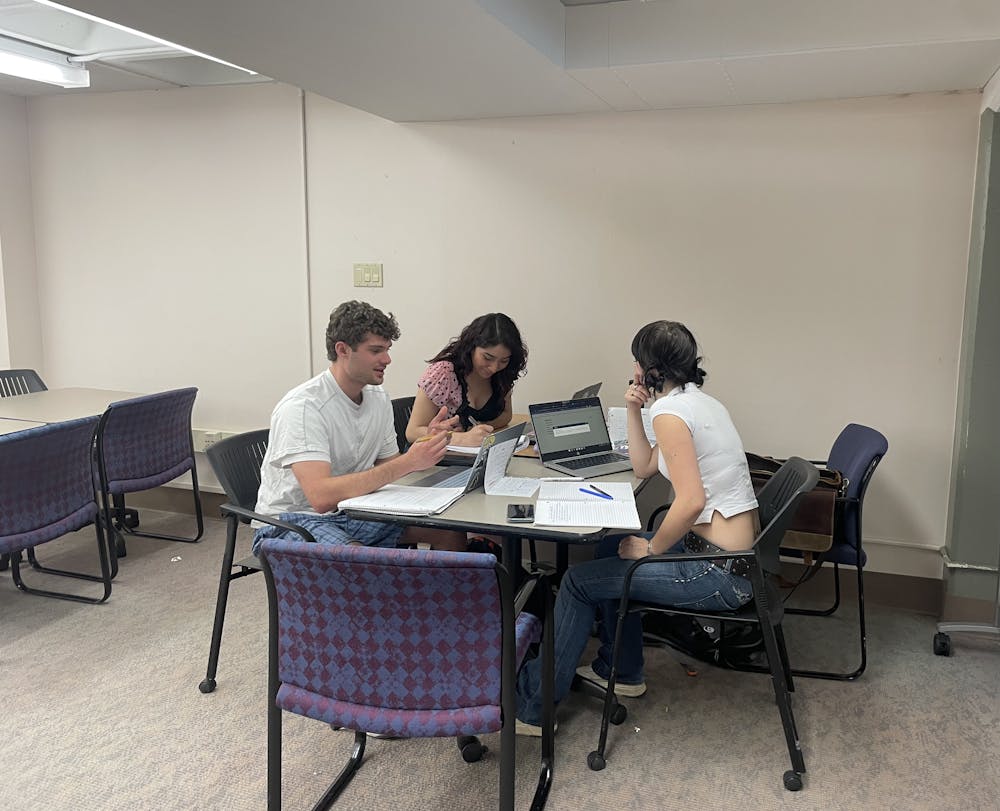
Group projects: two words that can ruin a perfectly good syllabus. These assignments are often justified as a way to teach collaboration, communication and problem-solving skills. While they have long been a staple in college classrooms, many students say the reality doesn’t match the theory.
It’s not that students are lazy or antisocial. It’s that group projects, in practice, rarely work the way professors think they will.
“I think it’s really important to have a type of project that allows for collaboration,” said Mal Travis, an English literature major at Western. “A group essay is a terrible group project. If you read a group essay, you can tell it is written by a different person in different parts.”
One of the biggest criticisms of group projects is how they often lead to an uneven workload distribution.
Kaleigh Deines, a third-year transfer student from Whatcom Community College, shared her experience with a group project in a recent biology class. Deines noted that half of the group members neglected to show up for class, requiring her to catch them up on missed lectures.
“We did our lab on yeast fermentation, and it was four of us,” Deines said. “Two out of the four girls never came to class, so I was regurgitating information that I wasn’t even solid in.”Whether it’s unanswered messages, skipped meetings, or blank Google Docs, some students just vanish. Getting four or five college students to meet outside of class is a logistical nightmare.
“[The girls] would come to class and ask, ‘what are we doing? Can you catch me up?’ I would already be kind of confused, so it made our group project so much more difficult,” Deines said.
Without enforced accountability, like peer evaluations that affect grades, group work can feel less like collaboration and more like freeloading.
A 2024 National Library of Medicine study examined why group projects might not work for everyone. Their findings identified a number of factors: problems with group formation or interpersonal conflicts within a team, different levels of engagement from team members, and the notable unfairness of a student's reliance on another individual for their grade.
On the other hand, there are benefits to group work that students might not pay attention to.
Small groups can be good for a number of reasons, allowing students with different backgrounds to bring their special knowledge, experience, or skills to a project and giving them a chance to teach each other.
“I think this is a learning opportunity for students to prepare for their ‘real world’ careers outside of academia,” Stephanie Gomez, an associate professor of critical media studies at Western, wrote in an email. “It’s going to happen everywhere they go, so it’s important to learn how to deal with it in the classroom where, frankly, the stakes are lower.”
When discussing how individual contributions impact group project grades, Travis recalled a time when fairness was upheld.
“I remember telling the teacher afterwards, and she told me their grades will definitely reflect what I told her and the work that they’ve done,” Travis said.
So, what’s the solution? Students aren’t necessarily asking to scrap group work entirely. They’re asking for a structure that forces group mates to take initiative and be held accountable.
Rory Peterson, a Western alumnus with a degree in recreation management leadership, highlighted the value of collaboration in academic settings, emphasizing the importance of group work and thoughtful course design.
“The cooperation and ability to put together a diverse set of ideas into an end product is very meaningful and really important,” Peterson said. “Professors really have to determine whether or not it makes sense in their courses.”Group work can be a significant source of stress for students, especially in an already high-pressure environment. In fact, anxiety is the most common mental health concern among college students.
Gomez said that being honest and transparent about your feelings, especially anxiety, can be helpful. She suggested that using tools like email, group chats, or Discord can make it easier to open up to your peers and let them know what you’re going through.
“It's a good idea to learn about conflict styles and figure out what your conflict style is. I think in general, if it's not possible to take a class about this, there are plenty of resources online about conflict styles, conflict management, and small group communication,” Gomez said.
Professors may find solo or collaborative projects more popular with students. Rather than assigning traditional group projects, incorporating individual roles with clear deliverables or offering “opt-out” solo versions of group assignments could prove beneficial.
Until that happens, group projects will continue to be the most universally hated assignment in college classrooms.
And students will keep asking: “When are you guys available to meet?”
Kaitlyn Ward (she/her) is an opinion writer for The Front this quarter. She is a fourth-year news writing and editorial journalist minoring in psychology. When she’s not reporting, she loves singing and spontaneous road trips. You can reach her at kaitlynward.thefront@gmail.com.