
At the southern tip of Western Washington University's campus, tucked between Fairhaven College and Buchanan Towers lies five acres of land, teeming with life and activity, student contributions, chickens, beehives, community gardens and organic food forests, a greenhouse and a creek running through it all.
This is The Outback, a 53-year-old student-driven farm that is a main source of learning, reflection, advocacy and agriculture for Western students according to Outback Farm.
Always free and accessible to every Western and Fairhaven student, The Outback is a hub for those interested in farming, food justice and beyond.
Though much of this understanding can be gained from volunteering or working with The Outback. The farm hosts 12 experiential learning classes throughout the year, each focusing on developing farm skills, food justice practices or fostering sustainability understandings.
“Students are hungry for hands-on, engaged work, specifically having to do with growing food, tending food, learning about soil, sustainable biology and all the practices of how we grow food and how we learn about food. But also just a hunger for how we learn these skills and then take them beyond The Outback Farm,” said Clayton Pierce, associate professor of youth and society in Fairhaven College of Interdisciplinary Studies. Pierce teaches a myriad of courses utilizing The Outback as an outdoor classroom.
The Outback operates on a mutual aid model, meaning everything the farm produces is given back to students for free. Year-round, the farm donates home-grown eggs, honey and produce to the food pantries throughout campus, mainly to Fairhaven and the Viking Union WHOLE Pantry.
In the summer the farm supplies a regular free market, successfully complying with the overall goal to maintain healthy and free food systems throughout campus, where the tagline of the team is students feeding students, said Terri Kempton, The Outback Farm manager.
“Food justice, food sovereignty, and security are tangible real problems that connect to larger problems students want to learn about, but also want to learn about solutions,” Pierce said.
According to WWU’s Basic Needs Hub, about 38% of university students in Washington experienced food insecurity in the past 30 days. For Western students, resources can be found on the Basic Needs Hub page in multiple forms from SNAP/EBT resources to campus pantries and more.
Beyond the offered classes, volunteer and work opportunities are vast for The Outback, with twice-weekly work parties hosted by The Outback team and regular volunteer availability.
The parties consist of volunteer meet-ups on the farm, where participants maintain the gardens and trails, pull weeds and take care of the chickens. Work parties occur on Tuesdays and Wednesdays from noon-2 p.m., rain or shine.

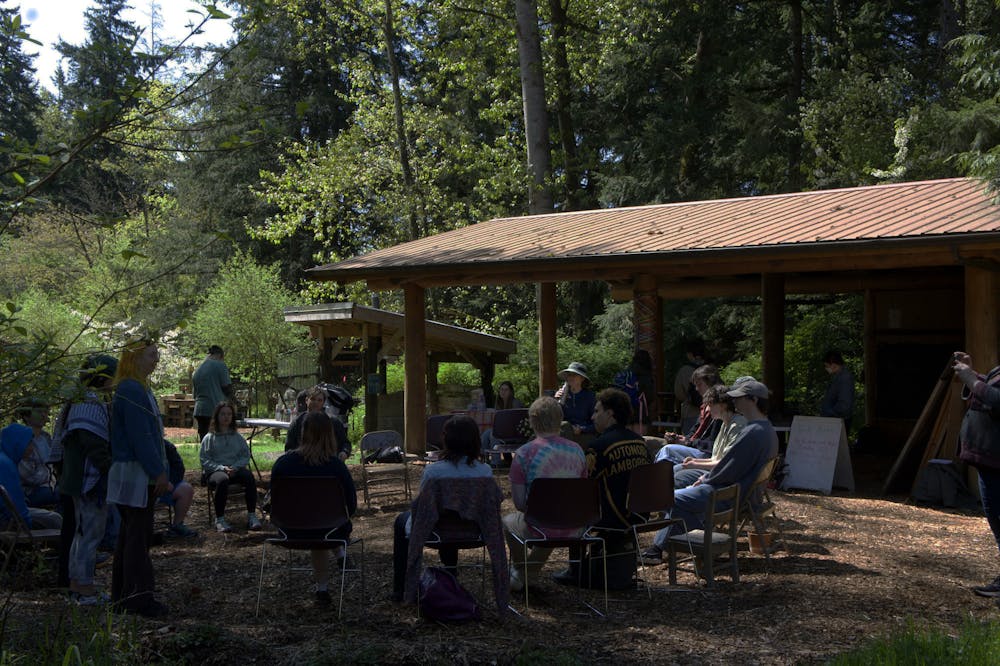
Even outside of volunteering, working or attending events, The Outback serves as a gathering place for students to just hang out on April 22, 2025, in Bellingham, Wash. The farm is a hotspot for students looking to meet up with friends, study or simply sit in nature. // Photo by Lynn Piefer
There are three student leader jobs on the farm, each focusing on a different aspect of farm life: operations coordinator, permaculture coordinator and engagement coordinator.
There is a team of work-study students and three summer apprentice positions as well, said Kempton. Students may sign up for a short garden plot waitlist to reserve one of 60 community plots to grow anything they want. To receive a plot or get on the waitlist, students may contact the Outback Communications Coordinator.
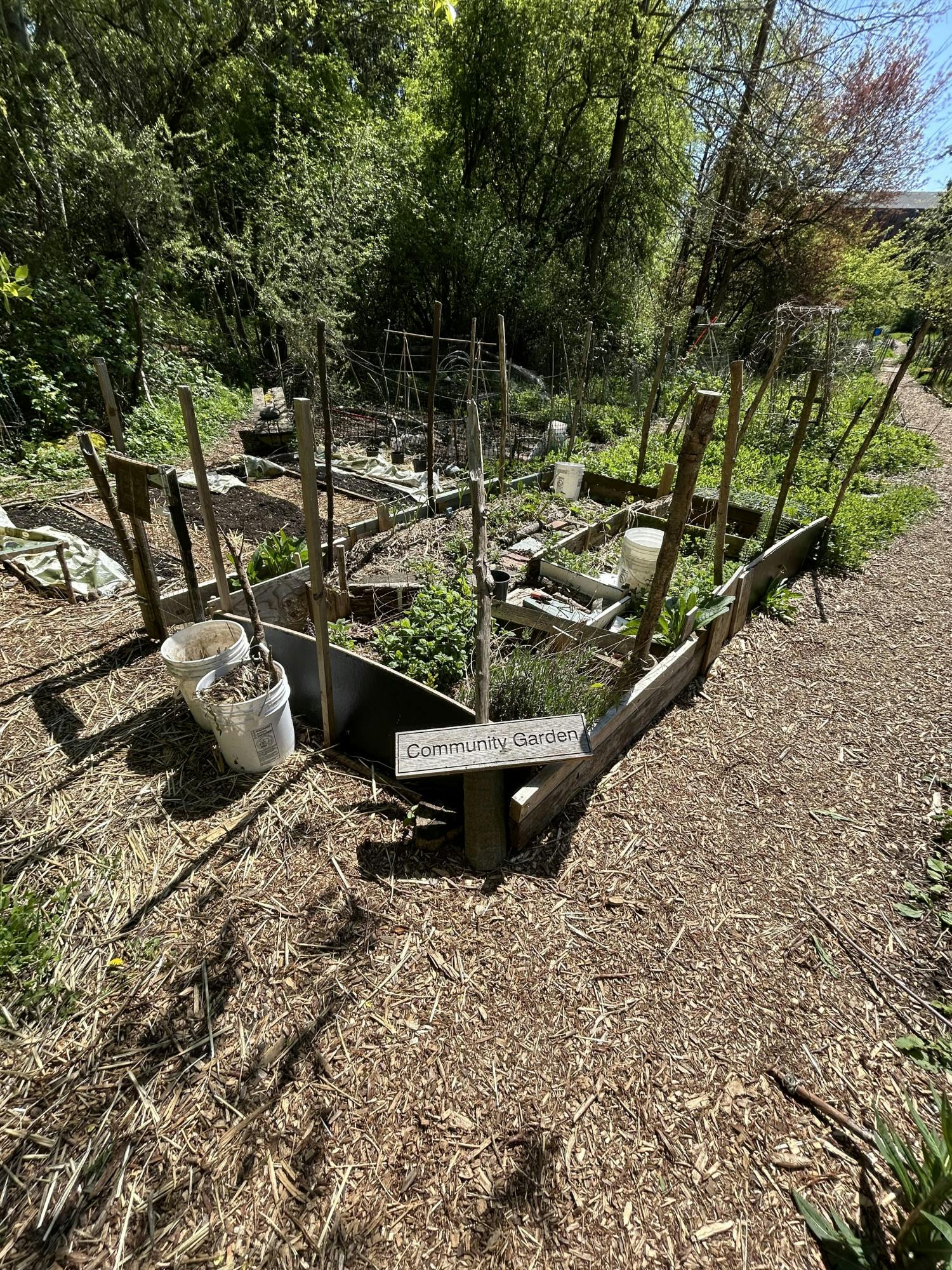
Community garden plots on April 22, 2025, in Bellingham, Wash. Students may sign up to tend one of 60 garden beds where they can grow anything they want. // Photo by Lynn Piefer
“The farm historically was created to be a space for students to have access to growing food and skill development,” Pierce said.
The Outback was created in 1972 by Western students from a space that was formerly a flat dirt plot used for construction vehicle parking. Fairhaven students began farming on the land, and were at the forefront of ensuring its existence throughout the years. These efforts notably included restoring the small creek within the farm and registering it as a delineated wetland, which prohibits by law any man-made structures from being built on the premises without acquiring the proper permits, disallowing the school from expanding into the farm.
The farm team makes a point to highlight the value of learning to grow one's own food, or food for others, and the community and connection derived from that understanding is evident throughout the farm.
Sabine Hopper, AmeriCorps food educator for Common Threads Farm in Bellingham, seeks to underline the disconnect between modern methods of food consumption, as opposed to growing it oneself.
“A lot of people are really alienated from the food they eat when they go to the grocery store… Food is something that has been the center of community and culture for the entirety of human history, and only in the last hundred years have we changed that,” Hopper said.
For Western students, reconnection to nature and developing community through food begins in The Outback .
“I feel our best shot at surviving and thriving in the future is together, and we’ve kind of created a culture in which we have distanced ourselves from that village life feeling, and so it's up to us to learn the patterns and pick up the threads and join each other and that's a big part of what we do,” Kempton said. “It really is a place of respite and solace.”
To keep in touch with The Outback opportunities and events, see their Instagram.
Lynn Piefer (she/her) is a campus life reporter for The Front, she is a visual journalism major. Outside of her academics, Lynn is a practice player for the WWU club volleyball team, and a Lakewood Boathouse attendant. Beyond school, Lynn is typically found outside involved in some recreation activity or another, exploring Bellingham, or dropping in on events throughout town and campus. You can reach her at lynncpiefer.thefront@gmail.com.