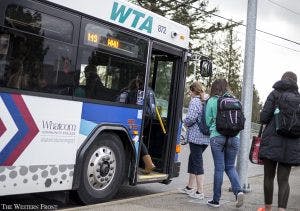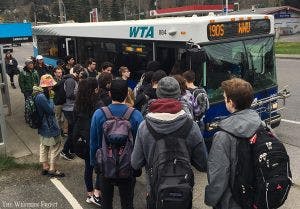

On a brisk Tuesday morning at the corner of Bill McDonald Parkway and Samish Way, a crowded bus stop spills into a nearby parking lot. The cluster of over 35 people gathered there can do nothing but watch as three full buses pass by them en route to Western’s campus. Some students elect to walk as the minutes pass, but junior Alex Rimbey waits, and soon the two buses needed to fit the students pull into the stop.
“We’re maxed out in terms of our drivers and buses at key peak times. We’re trying our best to address that, but part of it, like rush hour, will come with students helping to flatten the demand at some of those times by leaving a little bit earlier.”
Maureen McCarthy, community relations and marketing manger for WTA
“You can’t get on the first bus ever. It’s ridiculous,” Rimbey said. Students interviewed said crowding has become noticeable around Western since the Whatcom Transit Authority made changes to its route schedule, which took effect March 19. Maureen McCarthy, community relations and marketing manager for WTA, said the changes were determined through WTA’s Strategic Plan, a two-year planning process taking community requests and identifying needs based on where population has grown over the last 10 years. “Patterns of when and where students ride change every quarter, and there [are] often these choke points where everyone happens to want to ride at the same time,” McCarthy said. “We’re maxed out in terms of our drivers and buses at key peak times. We’re trying our best to address that, but part of it, like rush hour, will come with students helping to flatten the demand at some of those times by leaving a little bit earlier.” McCarthy said the new routes increase WTA’s total hours in service by nine percent, and provide Sunday services for the first time to Lynden, Ferndale, Kendall, Gooseberry Point, Lummi Nation and Sudden Valley. The changes to routes which service Western had a different goal than the overall changes. McCarthy said they aim to consolidate the names and numbers of lines running to Western and provide year-round access to places where students now live in larger numbers, like NXNW, a student apartment complex located off Lincoln Street. The choke point this quarter, McCarthy says, is around 9:40 a.m., when most students catch buses to 10 a.m. classes. She said an extra bus has been added, which is currently being dispatched on a moment-to-moment basis to help deal with overloads. The hope, McCarthy said, is that overcrowded stops will start to thin out as students adjust their schedules to the routes and the weather warms up, causing more students to walk to campus. “I really think it will improve with the weather,” McCarthy said. “We carry a ton of students less than a mile. In fact, some of the biggest overloads were at Campus Services.”