

Swearing is commonplace on college campuses, including Western Washington University. But what happens when that language seeps into the classroom? Can it make professors more relatable or the material more engaging?
More young people are using, or are being exposed to profane language than ever before. Exposure to profanity in media correlates with increased use among young adults, and this trend has become more evident in recent years.
Dr. Mark Neff, a professor in the Department of Environmental Sciences, is known for using profanity frequently in his lectures.
“I know I swear,” Neff said. “I’m probably not conscious of the extent to which I do. But it's probably a reflection of the relative comfort I feel with my students. I hope that's reciprocated.”
Swearing in lecture halls is becoming increasingly common. A 2019 study found the vast majority of U.S. college students report having professors who swear in class, with 9% saying they’ve "never" experienced it.
Environmental science student Katie Hovind said swearing is part of her everyday language. She finds professors like Neff feel more relatable.
“I would say it's definitely context dependent,” Hovind said. “But I think it's a sign of the classroom feeling a bit more tight-knit in a way than if it were a big, strict, formal lecture hall.”
Neff said it’s part of creating a fun and open atmosphere for exploring ideas.
“I try to not be provocative in a way where I'll use the F-bomb or something,” Neff said. “I try to be provocative in a way just to keep us all honest and encourage groupthink.”
Whether swearing helps professors connect with students or not, it’s clear personality plays a role in how instructors are perceived. That’s one reason why sites like Rate My Professors remain popular among students picking their classes.
As students register for fall quarter, many look to Rate My Professors (RMP) to find instructors they’ll connect with.
One review from Neff’s page reads: “[Neff’s] pessimistic humor makes discussions interesting. Fun class, would recommend.”
Rate My Professors is a website offering anonymous peer feedback and advice for choosing classes. Founded in 1999, it encourages users to “be honest in [their] reviews” and allows students to rate individual professors and universities based on factors like campus happiness and academic opportunities.
Western holds an overall score of 3.7—an average rating among Washington’s four-year public universities.
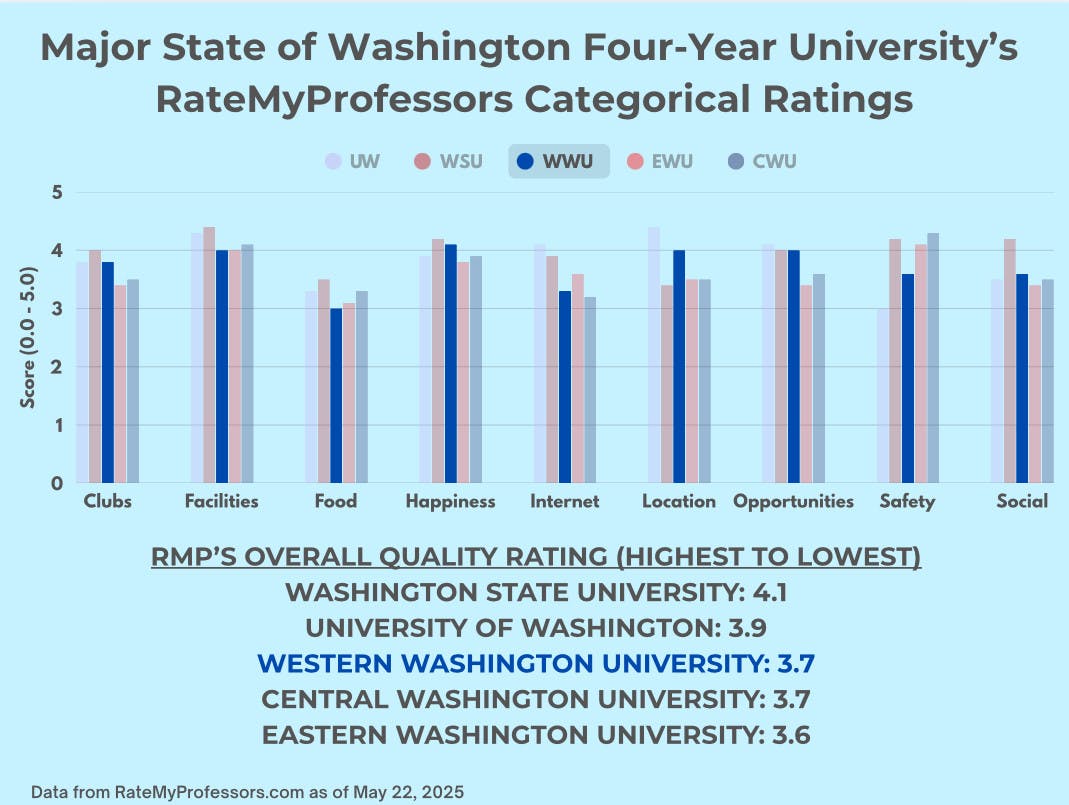
A bar chart representing different categories rated on Rate My Professor. The chart features notable public four-year universities in Washington state. // Graphic by Cameron Riggers
Reviews on Rate My Professors aren’t always a reliable measure of a class’s quality. The most extreme experiences—positive or negative—are usually the ones appearing in reviews, said Dr. Kristi Lemm, a social psychology professor at Western.
“I think the students who post on sites like Rate My Professors tend to be the ones who have the strongest opinions one way or the other,” Lemm said. “Students who think a class is fine don’t tend to go to that medium. The ones you see are typically students who absolutely love the class or who are very unhappy about something.”
Emmett Elsom, a environmental sciences student at Western, agrees. He and his friends check RMP during registration but remain skeptical of the reviews, as some can be exaggerated.
“I take Rate My Professors with a big grain of salt, but I always do look at it,” Elsom said. “Some professors only have okay scores, but I know the reason is because they had to teach a class that wasn’t that interesting or one they hadn’t taught before.”
For Elsom, it ultimately comes down to what each student wants out of a professor and a class.
“Still, I’ve seen reviews that I’m thankful for,” Elsom said. “Sometimes people say, ‘Google this person before you take their class,’ and I’m glad I did.”
While RMP can be a helpful tool, it isn’t the only way to give feedback. Like many universities, Western also conducts official course evaluations offering structured feedback on instructors and curriculum.
That data is often more useful to professors, like Neff.
“I find course evaluation comments to be more useful than Rate My Professors comments because everyone is required to fill it out,” said Neff. “Instead of the people who feel a commitment to communicating, building the internet repository or the people who are really angry, I'd rather hear a sampling of everyone.”
Cameron Riggers (he/him) is a campus life reporter for The Front. He is a news and editorial journalism major. Additionally, he writes about the Western Hockey League for soundofhockey.com and can often be found at a rink around the Pacific Northwest. You can follow his work on Twitter/X @CameronRiggers and can reach him at CameronRiggers.thefront@gmail.com.