
Western Washington University police and administrators aim to protect free expression while maintaining campus safety during protests, but students continue to respond to outside demonstrators with strong reactions.
Recent protests have renewed conversations about how the university enforces its expressive activities policy and how students react to potentially controversial demonstrations.
Tiny Heartbeat Ministries, a Christian anti-abortion group based in Pullman, has been visiting Western for several years. They usually demonstrate with large signs with pictures of aborted fetuses to protest abortion.
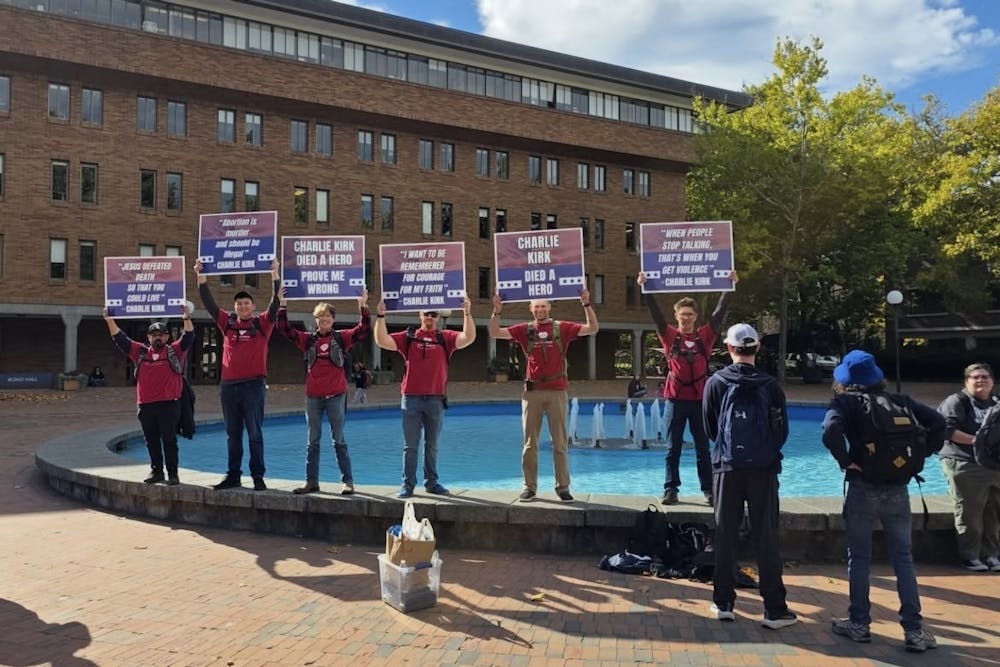
"Generally, we come to Western to show that abortion dismembers, disembowels, and decapitates innocent human beings,” said Andrew Kerin, president of Tiny Heartbeat Ministries via email. "On October 1st, we came to Western to defend that Charlie Kirk died a hero by standing for Jesus, standing for truth, and encouraging dialogue."
The Oct. 1 demonstration resulted in two student arrests on fourth-degree assault charges following altercations with the group. One student took a hat from a demonstrator, and another tried to pull one into Fisher Fountain in Red Square, according to police records.
“The two arrests were an unfortunate situation. Our officers are sometimes faced with difficult decisions when responding to such events; however, we need to make sure everyone upholds the law while engaging in free speech,” Western Police Chief Katy Potts said via email.
Counter-protests are common during Tiny Heartbeat Ministries’ demonstrations. Students often organize to offer alternative messages.
“Western’s a very vocal campus. We have strong beliefs,” said Neva Perez, president of Western’s chapter of Planned Parenthood Generation Action.
Generation Action organized an event last spring before one of the ministry’s demonstrations, where they drew and wrote pro-choice messages on the bricks of Red Square.
While some students choose to confront the demonstrators directly, Perez said she’s found that the most effective response is often to do nothing.
“Non-engagement is effective because they want to fight,” Perez said. “If you don’t give them any fuel for the fire, then there’s nothing for them to keep doing.”
Other students have used different tactics to push back. During past demonstrations, students stood in front of the ministry’s signs, held pro-choice posters, or attempted to drown out the demonstrators — including one student who repeatedly dropped a metal pipe on the bricks during a protest last spring.
Potts said that while most demonstrations on campus remain peaceful, the department is prepared to intervene if situations escalate.
“The students at Western are generally quite adept at navigating demonstrations and responding appropriately when they encounter views with which they may not agree,” Potts said. “However, there are times where the line is crossed, and a response may be considered criminal. Our role is to respond swiftly, investigate the incident thoroughly, and take the most suitable course of action.”
Pat Gillham, a sociology professor and member of the Campus Public Safety Advisory Council, said Western police have generally tried to maintain a balanced approach when dealing with protests.
“I think our police recognize that some things they could do might escalate things, and they try to avoid that,” Gillham said. “That’s a sign of a department that cares about protecting people’s rights to protest.”
Still, tensions remain high during visits from the ministry.
“These groups try and get a reaction out of students,” Gillham said. “Exhibiting graphic photos of fetuses is obviously going to antagonize people.”
Gillham said that managing those tensions requires both students and demonstrators to respect the rights of the other to free speech and demonstration.
Perez agrees.
“Free speech is important and it’s important for these groups to be able to express what they believe in just as much as it’s important for Planned Parenthood Generation Action to express what we believe in,” she said.
Ellie Wright is a second-year at Western studying News/Editorial Journalism and Political Science. As a reporter for The Front, she writes about campus news. When she’s not chasing stories, she enjoys reading, hiking, and taking care of her houseplants. You can reach her at ellie.thefront@gmail.com.