

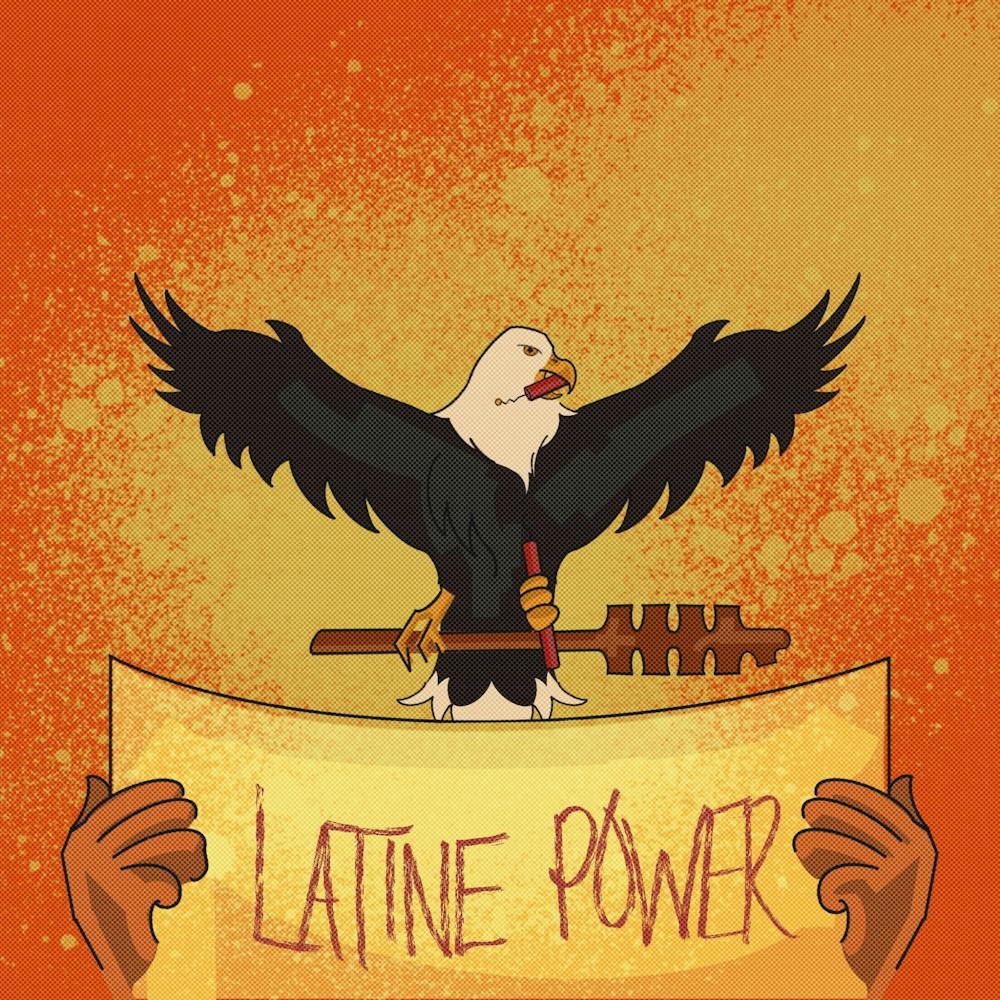
“For all people, as with individuals, the time comes when they must reckon with their history. For the Chicano, the present is a time of renaissance, of renacimiento.”
These are the first words of El Plan de Santa Barbara, a constitution of sorts, adopted at a conference in Santa Barbara, Calif., in 1969 by a group of students from dozens of universities across the state. That same day, they formed the social movement organization Movimiento Estudiantil Chicanx de Aztlán, focused on the advancement of Chicanos in higher education.
The Western Washington University chapter took shape shortly after. Despite its decades-long history, its activities were halted by the COVID-19 pandemic.
Now, five years later, first-year student Jasmin Montano and second-year Venecia Iraola will serve on the board for the reestablished chapter this fall.
“We’re stepping into some big shoes,” Iraola said. “We want to restore the legacy; that’s on my heart.”
Iraola’s aunt, Tacoma-based artist Maribel Galvan, is a MEChA de WWU alumna — a member from 2005-2009 — and the Arts & Cultural Center director for Mi Centro.
In Galvan’s time at Western, the group’s activism extended past campus. They rallied for farmworkers’ and students’ rights and brought identity workshops to Whatcom County schools.
Mechistas were directly involved in the creation of Fairhaven College of Interdisciplinary Studies’ Raza Latina Studies Minor in 2008 and advocated for the Ethnic Student Center’s (ESC) expansion.
Founded in 1991, the ESC first housed five clubs: MEChA de WWU, the Black Student Union, the International Club, the Native American Student Union and the Asian-American/Pacific Islander Student Union.
Tucked away on the third floor of the Viking Union, the ESC was “the core that kept us together,” Galvan said.
Andrea Tafoya, migrant specialist for the Ferndale School District and adviser to Ferndale High School MEChA, was involved with MEChA de WWU from 2007-2012.
Tafoya recalled frequent collaborations between MEChA and NASU in her time at Western. Iraola and Montano hope the new chapter will collaborate with NASU and other ESC clubs in events and activities.
The annual Low Rider Show at Western, hosted this year by Latinx Men in Higher Education, is a tradition started by MEChA. Tafoya once co-chaired the event, which invited people of all ages and backgrounds to watch performances by Latine dance groups, enjoy community and see low riders — customized cars low to the ground that have been a staple of Chicanx culture since the 1940s.
Verónica Vélez, Woodring College associate dean for academic affairs and professor of secondary education and education and social justice, will serve as MEChA de WWU’s adviser this fall. She advised the group previously in 2014.
Vélez’s background as the daughter of immigrant parents and a community organizer with migrant families for 15 years fuels her passion for MEChA.
“I will always respect where young people want to take this world,” Vélez said.
MEChA has always been a student-led activist organization. Understanding that, Vélez feels her role as an adviser is to remind students they’re not alone and support them in their work.
Alvaro Vicente-Ortiz, multicultural programs coordinator for the Mount Baker School District, was a chapter member from 2000-2007.
Vicente-Ortiz comes from an Indigenous and Guatemalan background. For him, the “Chicanx” in Movimiento Estudiantil Chicanx de Aztlán does not strictly mean Mexican American. Chicanismo is a mindset unrestricted by borders or racial classifications.
As defined in El Plan de Santa Barbara, “Chicanismo simply embodies an ancient truth: that man is never closer to his true self as when he is close to his community.”
Embodying Chicanismo is “to recognize and have a love for who you are, yourself, your cultura and your family,” Vicente-Ortiz said.
Even with “Chicanx” in its name, MEChA chapters have often opened their doors as an invitation to Latine and non-Latine individuals of all backgrounds.
Montano said their focus is “on issues facing the Chicanx and Latinx communities” broadly.
Iraola and Montano are confident the chapter will grow to be just as large, if not larger, than its predecessor. Regular meetings and programming will begin this fall.
“Once you’re a mechista,” said Tafoya. “A mechista for life.”
Josh Hernandez (he/they) is a campus news reporter for The Front this quarter. He is a third-year journalism news/ed major. Outside of journalism, his other interests include literature, geography, and music history. You can reach him at joshhernandez.thefront@gmail.com.


