

Editor's Note: This story was updated to correct that another faculty vote last rear reaffirmed support, not this year, and to change a false statement that said faculty and staff positions have been folded, only staff positions have. The Front regrets the errors
The idea for an electrical and computer engineering department began to take shape two years ago during discussions between the engineering and design department program directors.
A faculty vote in the 2022-2023 academic year “got the wheels turning,” said Andy Klein, professor and director of the electrical and computer engineering program. Another faculty vote last academic year reaffirmed support for the new department.
The engineering and design department comprises four majors: Electrical and computer engineering, polymer materials engineering, manufacturing engineering and industrial design. Klein will chair the new electrical and computer engineering department when it splits from its current department at the start of the fiscal year, July 1.
Unique from the other engineering programs, the new electrical and computer engineering department will offer a graduate program that was funded by the state in 2024.
The department invites current third-year students to take a handful of graduate-level courses in fall that can eventually be applied to a fifth-year Bachelor of Science or Master of Science program, said Klein.
Students in and not yet in an engineering and design program are invited to apply this fall to begin the program in fall 2026.
Steady growth from the student body was just one factor considered in electrical and computer engineering’s expansion. The program has become more isolated from the rest of the engineering and design department since relocating to Kaiser Borsari Hall in winter 2025.
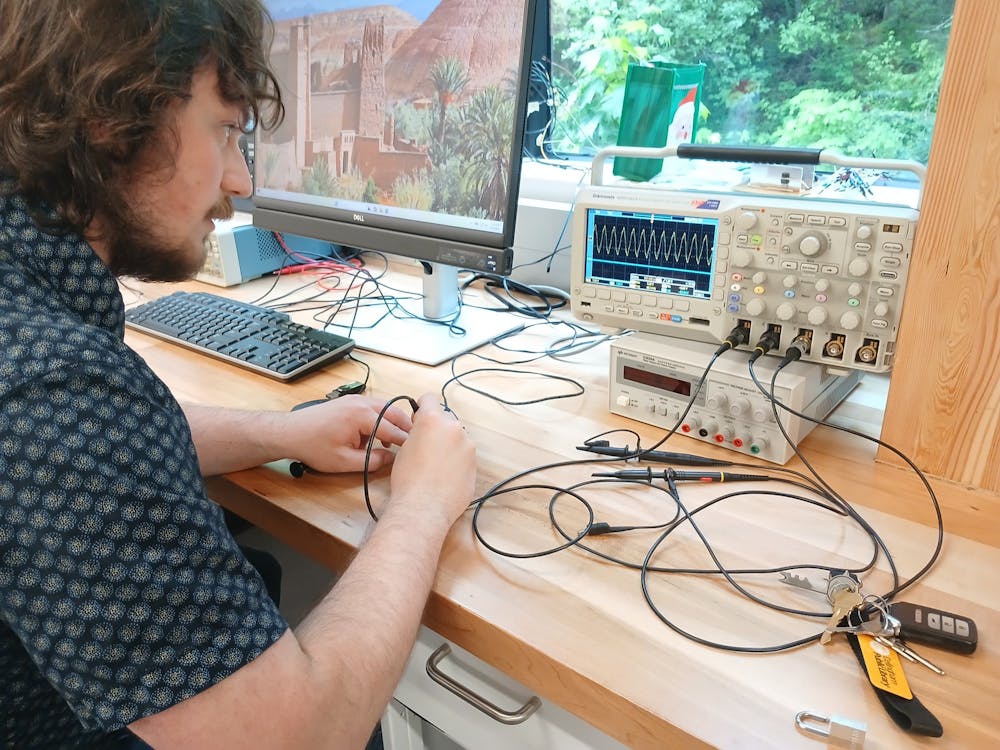
Fifth-year electrical and computer engineering student Ethan Hatlelid said Kaiser Borsari Hall’s increased space and resources have made collaboration between students easier. Though he’s graduating this spring, he’s glad future students will have access to what the new building offers.
“The classrooms are significantly better,” Hatlelid said. “It’ll be way better for students to be able to experience what they’re learning firsthand.”
Amid budget cuts affecting programs and departments across Western’s campus, Klein said the new department will be “a cost savings to the university” because some staff positions have already been folded.
Kai-Mei Fu is a professor of physics and electrical and computer engineering at the University of Washington who began their research in UW’s Quantum Defect Laboratory in 2012. Much of Fu’s students’ work is simulating, designing and testing devices and the manipulation of empty states of atoms in crystals to integrate in devices.
Though quantum physics is a century-old field, quantum information, described by the National Institute of Standards and Technology as “the marriage of quantum physics and computing theory,” has only begun to gain traction in recent decades.
The Quantum Initiative and the National Quantum Initiative Act, passed in 2018, advanced research and technological development in the U.S. with federal funding, according to the Senate Committee on Commerce, Science and Transportation website.
“Now that we can finally control quantum states, they become a playground for engineers,” Fu said.
The field’s substantial growth in less than a decade has translated to students’ greater interest in the Quantum Defect Laboratory, said Fu.
Klein said the electrical and computer engineering department’s focus will be on the growth of the graduate program. Once that reaches a sustainable level, more focus will be devoted to undergraduates.
“Being able to supply a local source of engineers is one of our number one goals,” said Klein.
Josh Hernandez (he/they) is a campus news reporter for The Front this quarter. He is a third-year journalism news/ed major. Outside of journalism, his other interests include literature, geography, and music history. You can reach him at joshhernandez.thefront@gmail.com.


