
One of the biggest methods of resistance since President Trump’s inauguration has been widespread boycotts targeting companies that have cut diversity, equity and inclusion programs and profit from their ties with Israel.
These movements have sprung up all over social media in the form of infographics and TikToks, rightfully urging people to take action in the form of consumer boycotts.
With these posts calling for change come hundreds of comments bringing shame to those who can’t participate. However, taking to social media to reprimand people who aren’t boycotting can be perceived as performative activism. These comments are a placeholder for real activism work, much like the black squares posted to Instagram for Blackout Tuesday in 2020.
On the surface, boycotts seem relatively low-effort for ordinary people to participate in; avoid these specific companies and products and you’re good to go, morally speaking. Unfortunately, that’s not always the case.
“It’s important to cover how capitalism and monopolies have made it nearly impossible for poor people to boycott and survive,” said Kevin Leja, a leadership team member from Indivisible Bellingham, a local organization that champions nonviolent civic engagement.
Pat Gillham is an associate professor of sociology at Western Washington University with research interests in social movements, civil disorder and social control. He says that his ability to participate in boycotts is due to privilege.
“People get on their high horses about things and it’s like, okay, it feels good to get mad about something or to point your finger at something,” Gillham said. “But that virtue signaling doesn’t really necessarily get you where you want to be if you’re really trying to create change.”
Participating in boycotts and posting resources about them isn’t a bad thing; anyone who can participate should. Shaming regular people in the comment section of their own posts is a different story.
“It’s awesome to post those lists and those resources, but when you take it to the next step and make moral judgments on people, that’s just not helpful at all,” said Zoe Wiley, a Western alumna.
Before jumping to conclusions in the comments about why someone isn’t boycotting, consider their reasoning. According to a study conducted by the Society for Consumer Psychology in 2024, people experiencing poverty are less likely to participate in boycotts. Disabled people, while not inherently less likely to participate, face countless barriers that can make boycotting significantly more difficult.
“If you create a situation where only some people are seen as being committed to a movement, or if you alienate potential allies … then you’re not going to be very effective at getting done what you want to do,” Gillham said.
Wiley is a caregiver for a woman with dementia and Alzheimer’s and also recently helped her grandmother move into an assisted living facility. Her grandmother doesn’t leave the complex much due to mobility issues. In lieu of venturing out to the grocery store, she utilizes Amazon to deliver necessities right to her doorstep.
“It’s a convenience thing, it’s an ability thing. It’s totally access-based,” Wiley said.
Though the corporation has been targeted in the past, calls for a boycott arose again in 2021 when Amazon and Google partnered with the Israeli government for Project Nimbus. The contract provided the Israeli military with computing power and AI tools used for facial recognition and tracking, directly aiding in the genocide of Palestinians.
Wiley does the majority of the grocery shopping for the woman she provides care for. Though she is conscious of boycott targets while doing her own shopping, she opts to save the woman and her husband money where she can.
“At the end of the day, do they have the products they need to survive and keep going and thrive?” Wiley said.
She says that the kind of people she typically sees making these kinds of comments on the internet come from a place of privilege, whether that be having access to nonboycotted goods or coming from wealth.
The woman and her husband are retired social workers and are politically progressive, but they no longer have the capacity to dedicate the same time and energy to these issues as they used to.
“If their lives looked entirely different, they would care so much. But they just can’t right now,” Wiley said.
Avery Cunningham-Soper has been a Starbucks barista for almost a year. She has been actively boycotting the company since 2022 and only applied for the position out of desperation to find a job.
“I’d been searching for a job for almost a year. A year and a half of nothing,” Cunningham-Soper said.
The former CEO of Starbucks, Howard Schultz, is a heavy supporter of Israel and the company as a whole is notorious for union busting. In 2023, Starbucks Workers United (SBWU) expressed its solidarity with Palestine, leading to Schultz allegedly targeting locations with outspoken union members.
The post from SBWU was used as grounds to sue the union over trademark infringement — another attempt to retaliate against unionized stores and a major reason the company is the target of boycotts.
“If I don’t do a good job, which is selling away my labor and selling a bunch of drinks and making the company a lot of money, then that leads to layoffs,” Cunningham-Soper said.
She’s concerned that people will make snap judgments about her character when they see her with the drinks she brings home after work. She doesn’t spend her own money at Starbucks, but utilizes the benefit of a free shift drink and meal as well as her weekly markouts. The location she works at is one of the last stores in Bellingham to not be unionized.
“I’m walking around as a little logo. I’m a walking advertisement now, which is so fun … Especially as an anxious person who wants to boycott,” Cunningham-Soper said.
She said that it takes a lot of cognitive dissonance to work for a corporation that has such poor labor practices and ties to Israel; if she could find another job that provided the same hours and pay, she would take it.
Participating in boycotts is easier said than done, especially when the cost of living is growing every day. According to the U.S. Bureau of Labor Statistics, the price of meats, poultry, fish and eggs increased by 1.3%, with beef specifically increasing by 2.7% in April 2026. Additionally, fruits and vegetables increased in price by 1.8%. For comparison, in March 2024, the price of meats, poultry and eggs rose only 0.9%, with fruits and vegetables rising a mere 0.1%.
In 2025, Walmart was the target of multiple pressure boycotts due to the rollback of its DEI policies. Additionally, though they have no physical storefronts in Israel, Walmart has acquired multiple Israeli tech companies and has donated $1 million to an Israeli disaster relief fund after the October 7 incident in 2023.
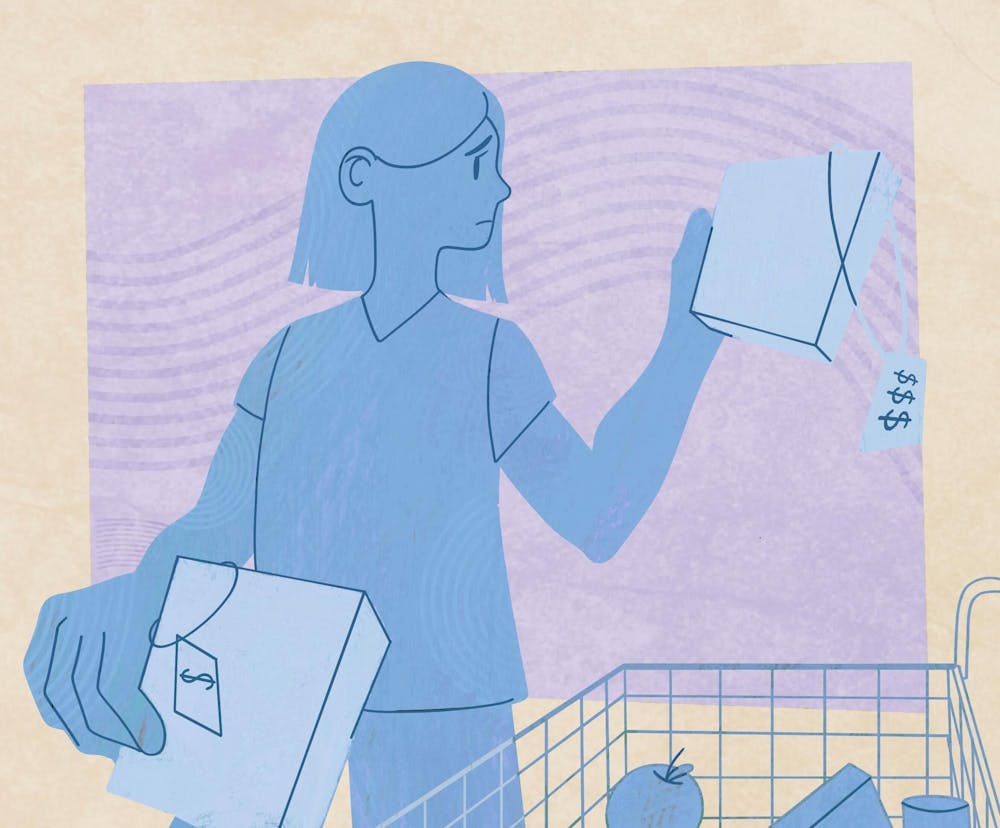
Staple food items are typically cheaper at blacklisted companies such as Walmart as opposed to alternative grocery stores. A dozen eggs from Walmart costs $1.47, while a dozen eggs from the Community Food Co-op in downtown Bellingham costs $4.99. A 36 pack of eggs at Walmart is only $4.32 — 67 cents cheaper than one dozen purchased at the co-op. Likewise, a loaf of bread from Walmart is $1.48, but $7.29 from the co-op. These low prices make Walmart the not-so-easy choice for progressive consumers who may be experiencing financial hardship.
“If the cheapest food you can get comes from Walmart and you don’t have a lot of money, then a boycott of Walmart is not going to be something you want to be part of,” Gillham said.
You don’t know someone’s personal reason for not boycotting, so don’t assume it’s because they don’t care about the issue at hand. Instead of leaving a passive-aggressive comment, focus your energy on people who have the ability to boycott but choose not to. Or, better yet, give back to the community in a way that’s meaningful.
“You might not be able to boycott bad food companies, but you can volunteer at the food bank,” Wiley said.
If you’re unable to volunteer, there are a myriad of ways to show support for these causes. Even just publicly voicing your support goes a long way; sharing the stories and fundraiser links of Palestinians affected by the genocide is quick, easy and free.
“We have a bunch of local, state and national actions that people can take right from their armchair,” Leja said.
The WWU Divest Apartheid Coalition is a student coalition comprised of representatives from Students for Justice in Palestine, Jewish Voice for Peace, the Arab Student Union and other associated students.
The coalition was responsible for organizing the 2024 pro-Palestine encampment on the Old Main lawn as well as the subsequent memorandum of understanding, which lays out the agreements negotiated with Western.
“Boycotting does take thought and intention, but that is the very least we can do,” a spokesperson for Jewish Voice for Peace on behalf of the Divest Apartheid Coalition said in an email.
Groups like the coalition are instrumental in holding people accountable and ensuring successful resistance tactics. In doing so, they are preventing further political apathy and complicity in genocide.
It’s important to make the distinction between someone who’s able to boycott and chooses not to and someone who is financially or circumstantially not able to participate.
“Shame is not helpful. It turns people off from the viewpoint that you have,” Wiley said.
Being able to boycott is a privilege not everyone can afford. If you’re fortunate enough to have the ability, you have the responsibility to participate in boycotts and support those who can’t.
“Voting with your dollar is super important,” Wiley said. “Everyone should have that in the back of their mind and do it when possible, but there are times where it’s just not.”
Raleigh Nolan (she/they) is an opinion reporter for The Front. She is a journalism major and a women, gender, and sexuality studies minor. Raleigh is originally from Michigan and has lived in Bellingham since 2021. Since then, she has made many wonderful friends and adopted a sweet/evil kitty named Olive. Some of her favorite spots in Bellingham are Rumors Cabaret, Avellino Coffeehouse and Colophon Cafe. You can reach her at raleighnolan.thefront@gmail.com.