

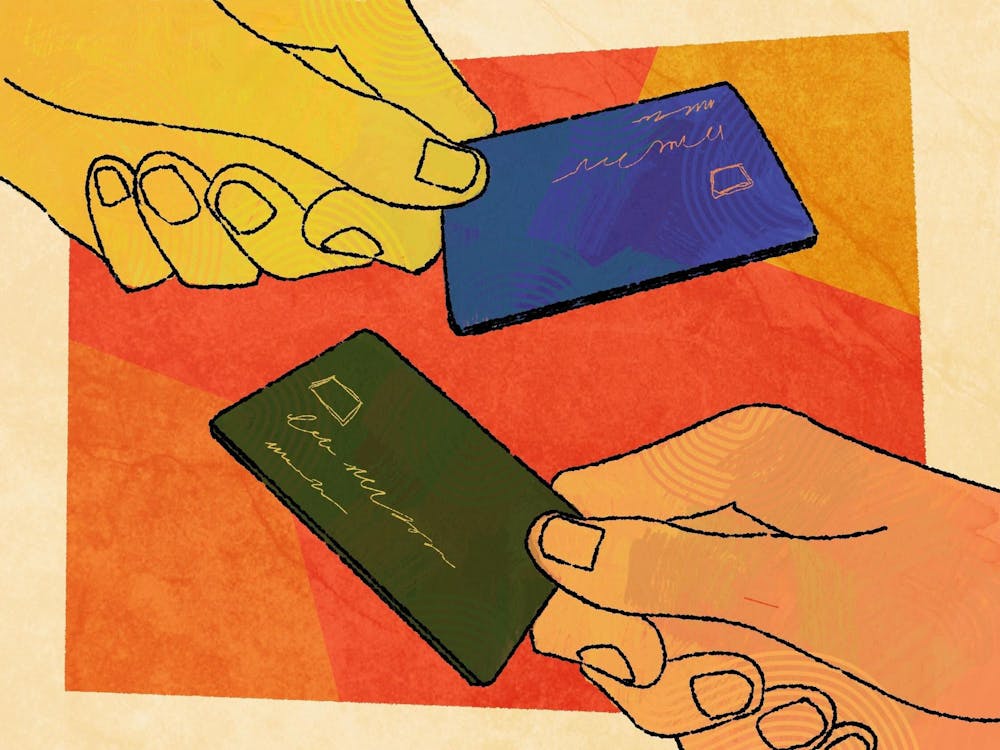
When Western Washington University first-year Adam Sutherland tried to buy food on campus, he had cash in hand, but no way to use it.
After his debit card was deactivated and its replacement was still in the mail, Sutherland said he was unable to make purchases on campus due to the lack of cash payment options.
As Western continues shifting toward cashless payment systems in places like dining halls, markets and the Western Associated Students Bookstore, students experience a new campus environment – one built on speed and convenience, yet with fewer payment options.
Sutherland said it makes everyday purchases unexpectedly difficult and left him feeling that the system limits access to people who rely on cash, who don't have access to a bank account or people without dining dollars.
“One of my cards deactivated so I couldn't use that one, and so I wasn't able to spend anything on campus because they don't accept cash,” he said. “I don't really get the point of it … it kind of locks people out.”
Western officials say the shift reflects how most students already prefer to pay.
Paul Wilson-Scott, resident district manager of Western Dining Services, said the move to cashless systems was driven by safety, efficiency and changing student habits.
“We adopted cashless payment systems in 2023 to improve safety, streamline operations, and better align with how students and guests already prefer to pay,” he said in an email response to The Front. “Transactions tend to move faster without cash exchanges, which is especially noticeable during peak meal periods.”
Lara Konick, the AS Bookstore director, said the significant decline in cash transactions prompted the cashless transition for the bookstore.
“We were just seeing cash go down, down, down as a percentage of payments that were tendered at the register,” she said. “We're trying to manage that in a way that has as little effect on students as possible, but also gets the work done that has to get done.”
Konick said that there have been few issues so far, but she is watching closely to see how it will hold up during busier times, such as the move-in weekend rush at the beginning of fall quarter when families help buy students’ materials.
“We'll see if we run into any issues,” she said. “That would be the time we'd get the most cash, but even that being said – worst case scenario – we'll figure it out.”
While the shift has streamlined operations, it also raises questions about access and flexibility for students who rely on cash or encounter issues with digital payment methods.
Catherine Armstrong Soule, a marketing professor at Western who specializes in behavioral pricing, said cashless systems can impact cash-reliant students and spending behavior.
“Cashless marketplaces in an in-person setting, like on campus, can certainly be viewed as inequitable because they disadvantage those that are unbanked and those that only use cash,” she said. “But there are more impacts on individuals who choose to pay with digital payment forms.”
For many students, the shift to cashless may go unnoticed in day-to-day life. But in moments when digital systems fail, the absence of cash can become a problem.
Soule said digital payments reduce the “pain of payment,” making transactions feel easier, but sometimes leading to increased spending.
“There is a lot of consumer and marketing research on ‘pain of payment’ and the idea that spending actual cash is more painful psychologically as you are seeing and feeling giving up that money,” she said. “It is also very easy to see that balance going down and up in real time … so I would say it’s easier to track these days but still easier to spend.”
As Western continues to adjust to cashless systems, its evolution may depend on whether it works for all students.
“Western is a great place all about supporting each other and supporting our students. So it's not like we're saying we will never take cash again … we're just saying for now it's working,” Konick said. “It is in our best interest to do what works best for students.”
Manna Spiro (she/her) is a campus life reporter. She is a third-year public relations student excited to start her first quarter writing for The Front. Manna directs the style and beauty team for The Rage Magazine and can be found going on spontaneous adventures with friends around Bellingham. You can contact her at mannaspiro.thefront@gmail.com.