
With Washington having the third-highest gas prices in America, Western Washington University students and professors may opt to replace their daily car commutes with public transport. However, limited route availability causes difficulties for those seeking alternatives to driving.
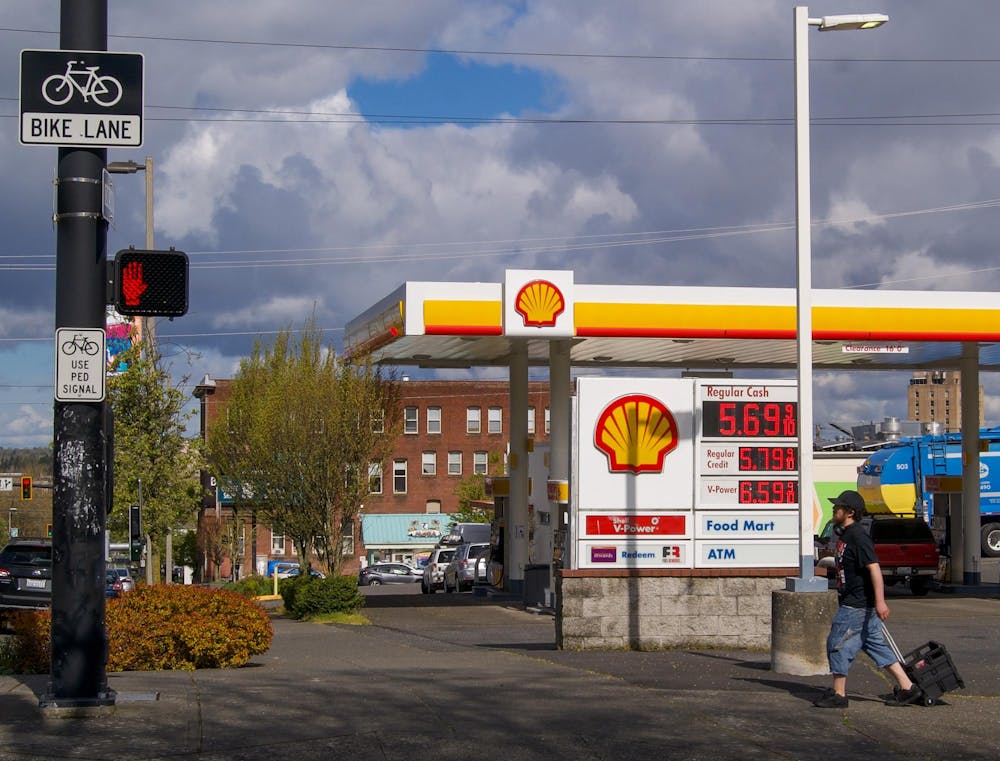
For the first time since the start of the Russia-Ukraine war in 2022, Bellingham residents are seeing gas prices averaging around $5.34 per regular gallon, according to the American Automobile Association. Amid the ongoing war in Iran, global supply chain disruptions have led to a surge in the price of crude oil per barrel, now resting at around $90.
“I have to think about if it’s worth it to drive my car,” said Kenzie Korez, a first-year at Western who commutes to campus three times a week.
Korez said he only drives when absolutely necessary, relying on the bus for most transport.
The Whatcom Transportation Authority spends $4.7 million annually operating routes through WWU, according to the WTA-WWU contract. WWU students and faculty pay 40 cents per ride, compared to a member of the general public, who pays one dollar.
To keep reduced prices available to the university population, Western provides the organization with $600,000 in yearly funding. Despite the lower fare, Korez said that the bus is sometimes unreliable, with many crucial lines not offering service past 10 p.m.
In addition to these concerns, bus routes don’t cover the needs of long-distance commuters. Western history and honors professor Arna Elezovic has taken Interstate 5 up from Seattle to campus two to three times a week for four years.
Elezovic drives a hybrid car, effectively cutting down her gas spending. Still, Elezovic’s eight to 10 weekly hours on the road aren’t ideal and she would prefer a reasonable public transport alternative.
“The train takes four to six hours one way with a minimum one-hour drive through Seattle,” Elezovic said.
When filling out the recent Western Washington University transportation survey, Elezovic urged the school to consider long-distance commuters, hoping for a possible carpool or more direct shuttle.
Western economics professor James McCafferty said that at the current gas prices, consumers are much more likely to consider changing their driving habits, leaning toward taking the bus, biking or walking.
“Above $5 (per gallon) is the magic number,” McCafferty said. “People really start paying attention.”
McCafferty consistently monitors the price per barrel of crude oil, a metric for current and future prices at the pump. Currently bouncing around $80 to $90, there has been a dramatic increase in per-gallon costs within the last six months.
Despite surging prices, McCafferty said that general oil demand has been declining in recent years. This decline affects production levels, encouraging companies to maximize profit by increasing the price per unit.
According to McCafferty, this increase is not equally distributed among all gas stations. For example, gas prices in Bellingham may be higher around Western’s campus, as students tend to be less cost-sensitive.
“Somehow in the United States, we have this alignment with gas stations, we think they’re our friends,” he said. “They’re a business.”
McCafferty urges students to be aware of the tactics gas stations employ to maximize profit, many of which have more to do with future predictions of market value than current global events that could affect prices.
The Western Active Transport department, directed by Andrea Reiter, focuses on providing students with safe and reliable access to campus.
The Active Transport department is responsible for negotiating the school’s contract with the WTA, as well as monitoring parking policy and providing free late-night transport via the ride-share app, the Starlight Shuttle.
“Our goal is that everyone coming to campus has the option and access to do so without a car,” said Reiter in an email to The Front.
The department’s website offers a Commute Cost Calculator designed to assist with budgeting, advocating for alternatives to driving whenever possible.
Still, students and professors are likely to continue struggling with rising prices, McCafferty said. Global tension on the supply chain is not likely to ease up any time soon, and according to McCafferty, the option of not driving is simply not available to some commuters.
The pursuit of alternatives remains important to both Korez and Elezovic, who not only want cheaper gas, but also easier methods of getting around.
“It’s a lot of driving hours,” said Elezovic. “You don’t get those back.”
Gray Pendell Jones (he/him) is a campus life reporter. He is a pre-major on the environmental studies/journalism track, happy for the opportunity to work with a dedicated team of reporters at The Front. Gray enjoys rock climbing, backpacking and catching a quick sunset on the beach. Originally born in Albuquerque, he is still searching for good Mexican food in Bellingham. You can reach Gray at graypj.thefront@gmail.com.