

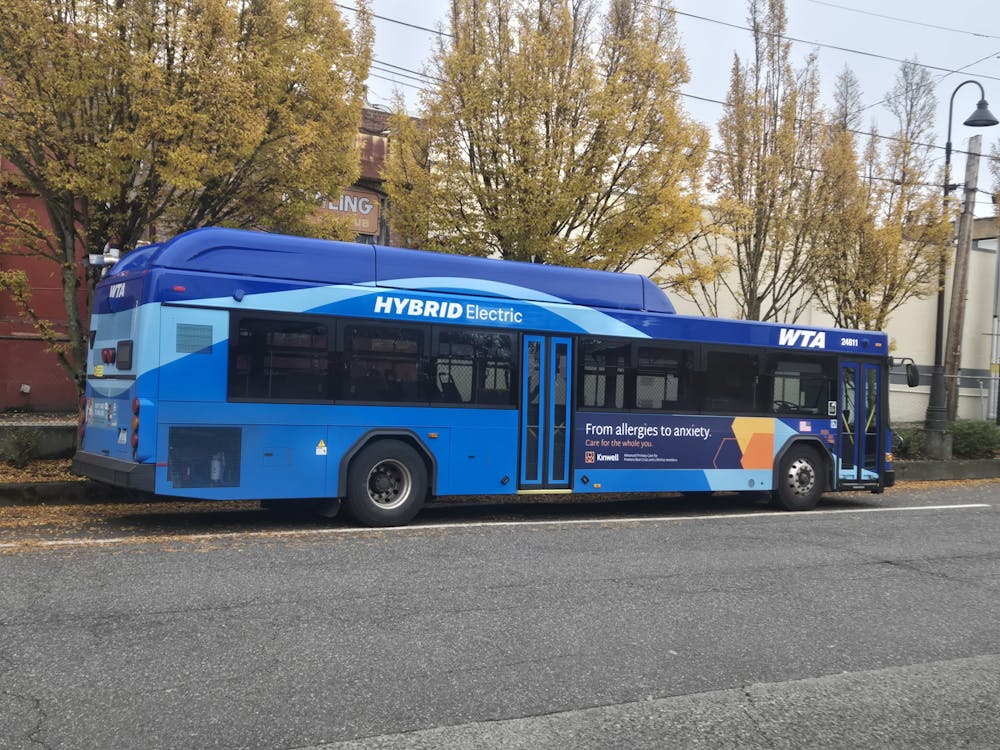
Whatcom Transportation Authority is focusing on renewable fuel and is temporarily putting electric vehicles aside.
As of April 2025, WTA stopped using fossil fuels in its bus fleet. Today, they have 12 electric buses, 15 hybrid electric buses and 41 conventional buses that use renewable fuel.
“We are steering away from those (electric buses) because of the lack of infrastructure around charging them,” said Edwin Williams, a member of the WTA board of directors. "It's not practical at the present time. The buses are too expensive.”
The 12-year lifespan of a hybrid-electric bus costs more than $425,000 compared to a conventional bus, according to the WTA. Electric buses need infrastructure for charging stations, and the current electric buses do not meet WTA’s standard for range or performance.
Williams said that there's only so many miles you can drive the buses before you need to charge them again.
“If you had to drive it up to Blaine, it'll get to Blaine, but you'd have to sit for another 45 minutes to charge it up again to come back,” Williams said.
Originally, WTA wanted to transition to a zero-emission or an all-electric fleet by 2040. However, lack of infrastructure, vehicle performance issues and a lack of federal support has hindered progress towards that goal.
Maureen McCarthy, the WTA director of community and government relations, said that the WTA board of directors noticed significant problems with the buses in addition to the high costs.
“We had a change in the federal administration and then found there was less support for us to continue along that transition,” McCarthy said.
According to the Pacific Northwest National Laboratory, renewable fuels are produced from renewable resources such as, biodiesel made from animal fats and bioethanol made from sugar cane or corn.
Diesel buses have a substantial impact on the environment and public health in the neighborhoods they drive through, said Xi Wang, an assistant professor at the Institute for Energy Studies and the Department of Environmental Studies at Western Washington University.
“It's been shown diesel buses have long term cardiovascular and respiratory impacts that can lead to cancer,” Wang said. “It's especially impactful on more vulnerable populations like school age children who have been shown to have reduced lung capacity and higher rates of pneumonia if they are around diesel buses.”
WWU Students for Renewable Energy said increasing the number of electric buses in Bellingham increases equitable access to clean air, especially as many students in Bellingham rely on public transit to commute.
Noah Tigre, a member of Students for Renewable Energy, is a college student who works with kids. Tigre said that the air inside the buses has been shown to be worse than the air outside, and no one wants kids to be exposed to exhaust every morning.
“It's the responsibility of WTA to protect the well-being of its riders and the members of our community,” Tigre said.
Originally, WTA said that fixed route transit vehicles have a lifespan of 12 years, and they planned to stop using diesel buses only at the end of their lifespan to ensure they get the full value out of past investments.
McCarthy said since the electric and hybrid buses are new, WTA is not planning on replacing them or getting rid of them. Currently, 40% of the fleet is electric or hybrid electric.
“Most of the electric buses we have are very new. So we will continue to have those buses in our fleet for at least 12 more years,” McCarthy said. “That will be the case for quite a while. We won't really know until it's time for those to be retired what we're going to replace them with.”
According to the WTA, electric buses only achieve a 10% greater carbon efficiency than buses with renewable fuel.
Wang said this issue impacts riders. “There are lots of differences in operating them that WTA and other transit authorities will need time to adjust to,” Wang said.
WTA said that they are looking at low or zero-emission options for paratransit minibuses and rideshare vans, but there are no suitable options on the market, and there are no renewable substitutes for propane or gasoline.
“Public transit in any form is going to be better for fuel use than any type of driving, be that electric vehicle or not,” said Frankie Middlehoven, a member of the Club for Urban and Environmental Sustainability at WWU.
In a study for the WTA in 2024, Transpogroup found a 67% reduction in carbon dioxide emissions for renewable fuel compared to diesel fuel.
McCarthy said that the board of directors found running conventional buses with renewable fuel achieved almost all of the carbon benefits that hybrid buses would produce.
“We remain committed to this,” McCarthy said. “It's not taking the path that we had hoped, but WTA's board is committed to lowering our carbon emissions, and I think being really wise and creative about it.”
Adah Bassok (she/her) is a city news reporter for The Front this fall quarter. She was previously a campus life reporter for The Front, and she is a news and editorial journalism major at Western. Outside of the newsroom, you can find her reading and exploring the outdoors. You can reach her at adahbassok.thefront@gmail.com.


