
Dorothy Young’s memories of March 27, 1964 are crystal clear.
That day, in her home in Anchorage, Alaska, she, her daughters Gretchen, Susan and Karen, as well as Gretchen’s friend Michelle Wiley, weathered the second-largest recorded earthquake in world history.
“I had been in earthquakes before, but this one just kept going,” Young said.
Dishes flew out of the cupboards. A loud sound, which Young likened to “a freight train going right through (her) living room,” could be heard as the shaking ensued. The floor, she said, was “almost rolling… rising and falling in little waves.”
The impact was also felt elsewhere in the neighborhood. Young’s husband left to take family friend Dick Sutherland home; he returned a while later, ashen-faced.
“The Sutherlands’ house is gone,” Young said as she quoted her husband. There was “nothing but blue sky” where the Sutherland home once stood. While no one was killed, the house was destroyed, its debris having gone down a nearby bluff.
The magnitude 9.2 earthquake, which struck south-central Alaska that day, left 139 dead and $400 million of property loss in its wake.
A similarly powerful earthquake will hit the Pacific Northwest in the future.
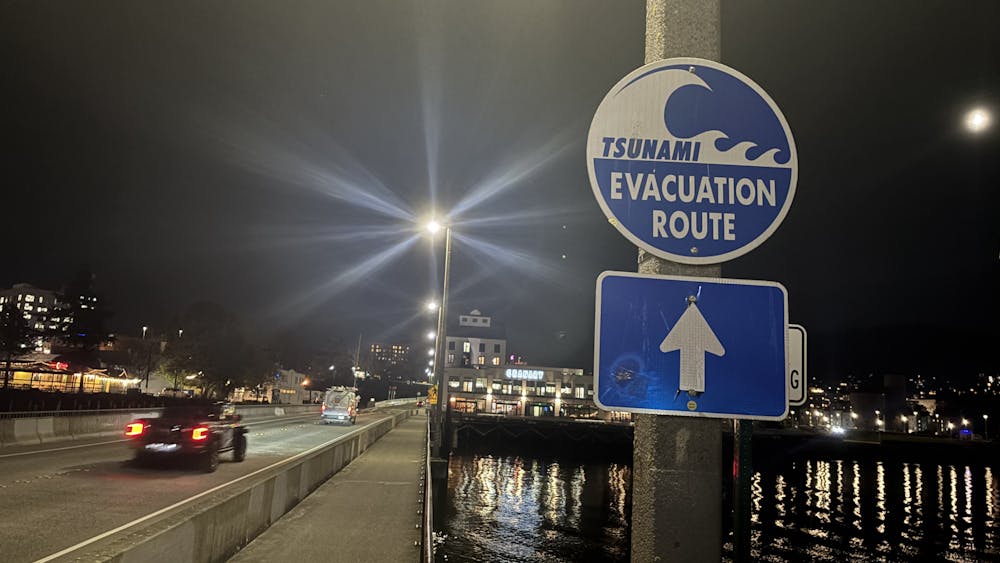
According to the Washington State Department of Natural Resources, it would stem from a roughly 620-mile-long rupture of the Cascadia subduction zone. The shaking is expected to generate “a massive tsunami,” which would hit the Washington coast “about 20 to 30 minutes after the earthquake.”
The department also notes that massive earthquakes often trigger landslides and soil liquefaction. The latter, which occurs when strong shaking causes water-saturated loose soil to liquefy, would likely result in severe damage — or total collapse — to any building standing over it.
While Bellingham might escape the worst of the quake, it would still likely suffer; the city itself says some of its areas could be inundated by up to 18 feet of water, and a tsunami is probable.
“The thing about tsunamis is that it’s not just one and done – they last,” said Dr. Paul Bodin, the manager of the Pacific Northwest Seismic Network. “You can have tsunami impacts hours – and even days – afterwards.”
After an earthquake, the Washington Military Department would be responsible for coordinating the state’s response to emergencies. According to Karina Shagren, the department’s communications director, restoring “essential lifelines” – such as power, water, and communications – would be a top priority in the aftermath of the earthquake.
“Through its Emergency Management Division, (the Washington State Military Department) would lead the effort to coordinate emergency services across the state,” Shagren said in an email. “The State Emergency Operations Center at Camp Murray would become the coordination hub, bringing together staff from state agencies, the Washington National Guard, and local and federal partners.”
According to Shagren, these staff would be responsible for various duties, including prioritizing resources and directing help wherever it’s needed most.
“The Military Department would also work closely with FEMA and other regional partners … which allows additional resources to flow in from other states,” Shagren added.
It would be impossible to list every action Western Washington University would take in the aftermath of the earthquake, according to Director of Emergency Management & Business Continuity Monica Jackson; however, a few priorities are set.
“Broadly, Western's focus would shift... to the priorities of life safety, damage assessments, notifications and communications to our campus community, activation of our Emergency Operations Center (EOC) … and regional coordination with local and state agencies to support response and recovery efforts,” Jackson said in an email.
She added that Western would provide mental health resources and turn its attention to resuming classes “as soon as appropriately feasible in the recovery phase of the incident.”
Jackson stressed that coordination begins long before any incidents, with Western working closely with agencies ranging from local fire departments to regional emergency management agencies. After an incident, the EOC would be responsible for Western’s coordination of emergency services, as well as the university’s decision-making.
Jackson highlighted Western’s progress towards earthquake preparedness, emphasizing that “many campus buildings have been evaluated and retrofitted to meet updated seismic standards.”
She added that the university regularly conducts drills and tabletop exercises to prepare for “various types of incidents.” This quarter’s Western Alert test — conducted in late October — took place on the same day as this year’s Great Washington ShakeOut, a day where earthquake drills are conducted in various settings around the state.
When it comes to what Washington has learned from other earthquakes, Dr. Bodin called educating the population the most important step.
“We need a lot more information and education,” Dr. Bodin said. “When people are afraid, they don't prepare; they just give up. So we've learned that preparedness (involving) that educational step is a fundamental thing that needs to be worked on.”
On their end, Dorothy Young and her daughter Gretchen – now Dr. Gretchen Huizinga, a research fellow at AI and Faith – said the one thing that helps them most is faith.
“I don't live in fear,” Young said. She knows an earthquake will happen again, and that the event might be strong enough “that we'll just be lucky to come out alive.”
“If something started shaking like that now, I would be differently afraid than my five-year-old self,” Dr. Huizinga said. “I just want to prepare myself in every way, including spiritually, for eventualities to come.”
Carlos Braga (he/him) is a campus news reporter for The Front this quarter. In addition to his work at The Front, Carlos also does journalistic work for Bellingham’s KMRE-FM and WWU’s The Rage magazine. You can reach him at carlosbraga.thefront@gmail.com.