
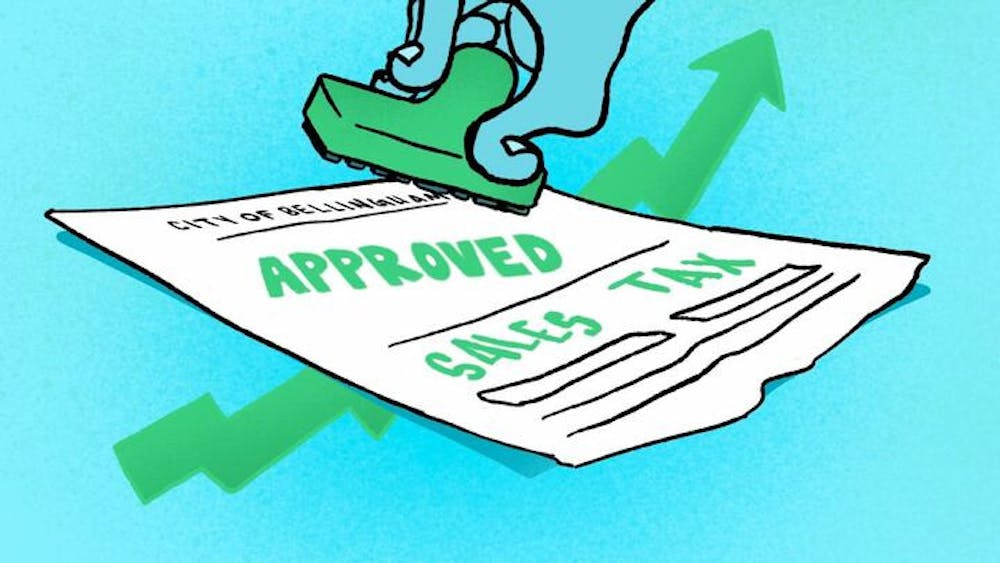
In 2026, Bellingham will introduce a 0.1% tax on purchases, adding a dime to all costs.
David Brauhn, the city of Bellingham’s assistant communications and community relations director, said that the state allows cities to use funds from this sales tax for a broad range of public safety-related purposes.
“The term ‘public safety' is not a euphemism for ‘police.’ The city invests in many resources to provide for community safety,” Brauhn said. “The sales tax proceeds will allow the city to make continued investments in public defenders, the GRACE program, domestic violence and sexual assault services…and other human services programs that support vulnerable community members.”
According to the city’s 2026 budget overview, sales tax accounts for the largest portion of the general revenue fund, comprising 23.6%.
“The amount of sales tax you pay in Bellingham is 9%. I believe this new sales tax would bump us up to 9.1%,” said Adam Wright, the director of the Center for Economic and Financial Education at Western. “Businesses are the ones in charge of collecting the tax, but consumers are by and large the ones who pay for it.”
The sales tax would increase costs on retail goods, but not groceries or prescription medications. To combat and balance the budget deficit, the city has had to cut staffing positions in addition to increasing taxes.
“The sales tax revenue indirectly reduces the deficit in the general fund by funding those public safety programs and services, allowing the city to shift financial resources to other areas,” Brauhn said. “The tax increment is small; it will add no cost to a cup of coffee and about $15 to the cost of a used car. Together, these small amounts will add up to nearly $4 million in revenue for the city in 2026.“
Wright said that the $4 million would come from $4 billion in retail sales, because it is a 0.1% tax. According to the Washington State Department of Revenue, Bellingham received $3.8 million from retail sales revenue in 2023.
“One way I've seen in the past that we end up with even bigger budget shortfalls is that we have sort of a new revenue we expect coming in, and the revenue comes in a lot less than what we think,” Wright said. “There's a lot of headwinds for consumers right now. You think about tariffs, business uncertainty, global uncertainty with trade.”
In the 2026 budget, 31.8% of the general fund expenditures are going to the fire department, and 31.7% are going to the police department. 10.1% is going to the parks department, 6.5% to the library and 3.3% to planning.
“I think it's kind of gross to be adding a sales tax right now when a lot of people are struggling,” said Violet Hollander, a student at WWU. “It follows the same language that the House bill 2015 follows. So it says that it can be used for criminal justice, which is a very vague thing. And that just means more money going to the police.”
House Bill 2015 was passed in May of 2025. The Washington State Legislature website says its goal is to “improve public safety funding by providing resources to local governments and state and local criminal justice agencies, and authorizing a local option tax.”
Brauhn said that the sales tax will only fund existing public safety programs and services. He said it will not be used to add more police positions.
“If the City Council had not approved the sales tax, the City would have had to cut $4 million in expenditures, resulting in fewer staff members, programs and services,” Brauhn said. “Bellingham is not alone. Local governments across the country are facing similar budget challenges caused by higher costs and lower revenues.”
The sales tax will go into effect January 2026.
Adah Bassok (she/her) is a city news reporter for The Front this fall quarter. She was previously a campus life reporter for The Front, and she is a news and editorial journalism major at Western. Outside of the newsroom, you can find her reading and exploring the outdoors. You can reach her at adahbassok.thefront@gmail.com.