

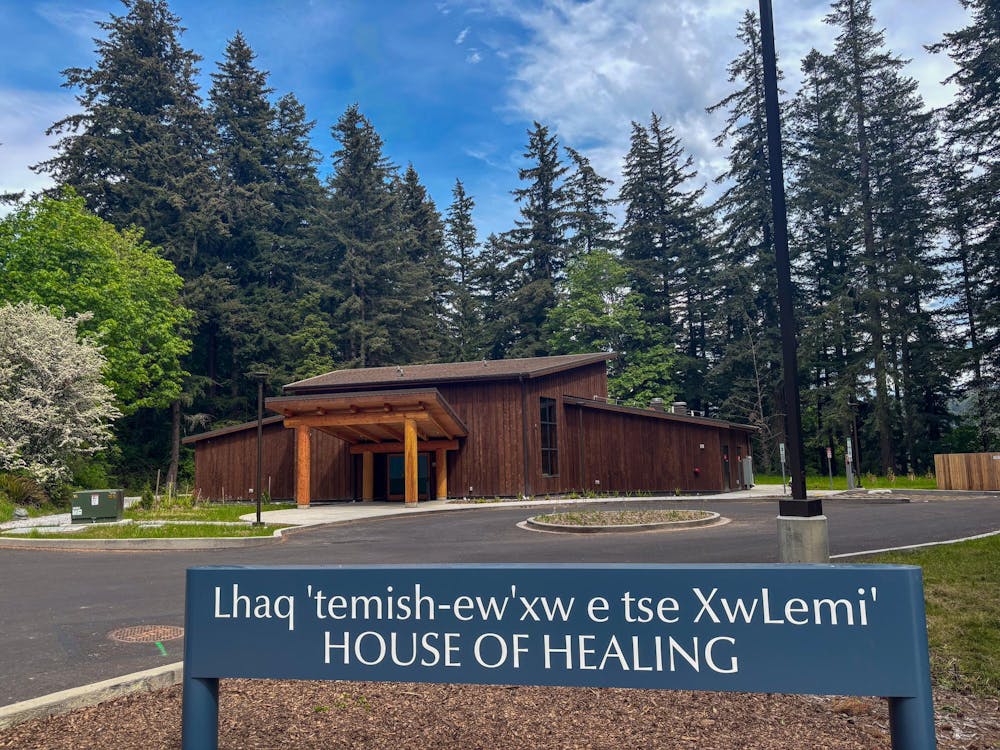
After years of conversation and planning, the Lhaq'temish-ew'xw e tse XwLemi' – House of Healing will open to the public on May 14, 2026, during the Native American Student Union's annual Spring Powwow and Coastal Jam. The longhouse sits at the south end of the Sehome Arboretum.
This building is the physical result of decades of student activism and demands to university leadership.
"This wasn't something the university decided," said Hailey Abella, a student co-chair of NASU. "This is what students decided."
In 2016, NASU officially demanded that Western Washington University build a longhouse as one of five demands in their Red Letter to university president Sabah Randhawa alongside a tribal liaison position, full powwow funding, government-to-government training with local tribal governments and verified tribal enrollment for Native-designated scholarships.
Western first officially proposed the longhouse construction in August 2020. It wasn't until April 2024 that a groundbreaking ceremony brought more than 200 people to the Sehome Arboretum, where Lummi Nation Blackhawk Dancers moved over the wet ground as Indigenous alums, Western staff and Lummi children broke earth for the House of Healing.
For current NASU students, the moment carries real weight.
"Knowing that there's a specific space on campus for us to be at, and for professors and advisers in our community to be able to all be in one shared space, is super important," said Frank Miedema, a Blackfeet student, co-chair of NASU and senior in environmental policy and critical Indigenous studies. "When I found out this was already a thing at universities like OSU and UW, the idea of not having it kind of felt like we were missing out."
Generations in the making
The road to the House of Healing stretches back much further than 2016. danisətən Michael Vendiola, who sits on the cultural advisory board and whose daughter Michaela was a NASU member and one of the three authors of the Red Letter, has watched this vision cross generations.
His now-wife, Michelle George, and her sister Andrea refounded NASU in the late 1980s. Their organizing energy helped produce the Ethnic Student Center and kept the longhouse idea alive even after an early waterfront proposal was passed over for housing units in the early 2000s.
When Michaela became a student at Western years later, she and other NASU members wrote the Red Letter, picking up work her parents had started before she was born.
Western will become the fifth university along the I-5 corridor to build a longhouse, following Evergreen State College, which opened the first in 1995.
"Calling it a longhouse is a nod to our cultural history," Vendiola said. "But we know that we utilize it in a way that really pushes us into the future."
What the building means
"Our elders are kind of the center of our ways of knowing and cultural bearers," Vendiola said. "You don't get that in college education. A longhouse provides that opportunity to really connect the community."
The building is designed to bring tribal perspectives into Western's academic and social life, a space where traditional ecological knowledge, treaty rights, food sovereignty and Indigenous arts can all be part of campus conversation.
The cultural advisory board, formed in May 2023, was charged with ensuring those values were built in. Vendiola was invited to serve alongside his wife Michelle, his mother Diane and his daughter Michaela — four members of one family consulting on what a longhouse means to Coast Salish communities and how to make the space feel like home to Native students from nations across the region.
"We wanted to have things in the building that tribal students would recognize culturally when they came there, so that it would be similar to their home space," Vendiola said.
According to students who walked through during construction, the result is unmistakable. Massive cedar logs line the roof and cedar support beams frame the entryway. The windows face into the surrounding woods rather than toward the road, creating a sense of enclosure and privacy Miedema described as clearly intentional.
"It was so clear the amount of detail and thought process that was put into the building," he said. "It will be a very homey, comfortable place to be at."
Inside, 29 paddles representing each of Washington's federally recognized tribes now hang in the space — a detail Maiyuuraq Manouk Jones, a fourth-year environmental science student and Iñupiaq Inuit from Alaska, described as both educational and political.
"I think that brings visibility to those nations that are in Washington," she said, "and there's a lot of education too, to students that might wander through the longhouse."
Food, culture and a kitchen at the center
Among the features students pushed hardest for is the kitchen. For NASU members, food is central to community.
"I'm a hunter and fisherman, and a lot of people in our group are," Miedema said. "Being able to share food that we harvest was super important."
The kitchen will be supported by large freezers, a dehydrator from a grant partnership with Western's Outback program, a fish pit, an outdoor meat processing area and a garden for traditional and medicinal plants.
For Jones, these features reflect how the organization already operates.
"We spend so much time at our adviser's house doing those kinds of things — making jam, drying different plants, traditional plants," she said.
The longhouse will bring those practices into a home of their own. The building was designed for how this community actually lives.
Visibility, retention and what changes are coming
One of the most persistent problems the longhouse addresses is simple: Native students at Western often can't find each other.
"Sometimes it's hard for Native students to find NASU their first year, or they don't know that it's there," Jones said.
Seniors sometimes discover the organization right before graduating, wishing they'd found it sooner. A permanent building on campus changes that.
The stakes are higher than belonging, though.
"The university does struggle with Native student retention,” Miedema said. “Making sure that Native students are able to graduate at the same rate that other students are — which currently is not the case — is super important.”
The House of Healing is one part of fulfilling the Red Letter's original promise of the university taking responsibility for Native student success.
For Vendiola, the building represents a larger reckoning.
"The history of education for Native people has not been a favorable one in American history," he said. "The longhouse would represent the potential of a state university really coming to terms with some of that history."
Looking forward
For the students graduating this spring — many of whom spent years watching the building go up — the hope is simple.
"When you're in the longhouse, it's this physical manifestation of students' needs and a direct request that was made," Miedema said. "I hope future students are able to appreciate that and feel empowered to continue to see changes across campus."
The House of Healing opens to the public on Thursday, May 14 from 3:30-6 p.m., leading into the Coastal Jam from 6-11 p.m. The annual Spring Powwow follows the next day, with grand entries Friday, May 15 at 6 p.m. and Saturday, May 16 at 11 a.m. All events are free for students, and all are encouraged to attend.
"If you've never been to (a powwow,) it's really special," Miedema said.
Emma Smith, a graduating accounting major and Salt River Pima student, added that the powwow's MC was already planning to welcome first-time attendees.
"It's a very welcoming space," she said. "Everyone's welcome. Everyone should come."
Ellie Wright (she/her) is a journalism and political science major at Western. She is the diversity, inclusion and outreach editor for The Front this quarter. When she's not working, she enjoys reading, hiking and taking care of her garden. You can reach her at ellie.thefront@gmail.com.


