
Trigger Warning: This news story contains content related to sexual assault, which may be distressing or upsetting to some readers. Please take care while reading.
Every April, we wear teal ribbons, share infographics and post hashtags in honor of Sexual Assault Awareness Month. While awareness campaigns have helped spark necessary conversations about consent and survivor support, they often fail to address the stereotypes and dangerous misconceptions that continue to silence survivors.
For Liv Tracy, a 22-year-old musician from Spokane and a sexual assault survivor, April isn’t just about awareness. It’s about validation and recognition.
“I was so full of shame and embarrassment and all of those bad things, and no one ever made me feel ashamed,” Tracy said. “I was very lucky. I had a lot of people around me that were willing and open to listen and to talk to me.”
One of the most persistent myths around sexual assault is the belief that "real" assault involves physical violence, a stranger in the dark or overt resistance. This harmful narrative ignores the vast majority of assaults, which are committed by someone the survivor knows, often in spaces they once considered safe.
According to the Rape, Abuse & Incest National Network (RAINN), roughly 8 of 10 assaults are committed by someone known to the victim. Freezing, a trauma response scientifically recognized as tonic immobility, is just as valid as fighting back.
“I was in an abusive relationship from when I was 15 to when I was 18. When I ‘started’ dating him, he demanded that I date him, and I did not want to do so. I had very little experience,” Tracy said. “He knew I was in a vulnerable place and took advantage of that, and that can happen and does happen to lots of women.”
Mass media often doesn’t talk about stories like Tracy’s. Many times in popular shows and movies, the portrayal of sexual assault can be potentially harmful and inaccurate.
“When we see what we see on the screen it is very easy to just assume that that’s what it’s like in real life,” Tracy said.
Survivors who don’t fit the “traditional image,” such as those who were drinking, wore revealing clothing, didn’t report the incident immediately, or are from marginalized groups like Black, brown, queer, disabled or undocumented communities, often face more difficulty being heard, understood or supported.
Tracy, speaking from her experience as a woman with autism, expressed concern for her community. “People who have disabilities and also autistic women are at a skyrocketing high chance of being assaulted,” Tracy said.
According to a study about the extent and nature of autistic people’s violent experiences during adulthood from the National Library of Medicine, almost 60% of adults with autism reported experiencing sexual violence (56.8%) and physical violence (58.5%). The study was compared with the percentage of adults without autism, which was 28.2% for sexual violence and 36.4% for physical violence.
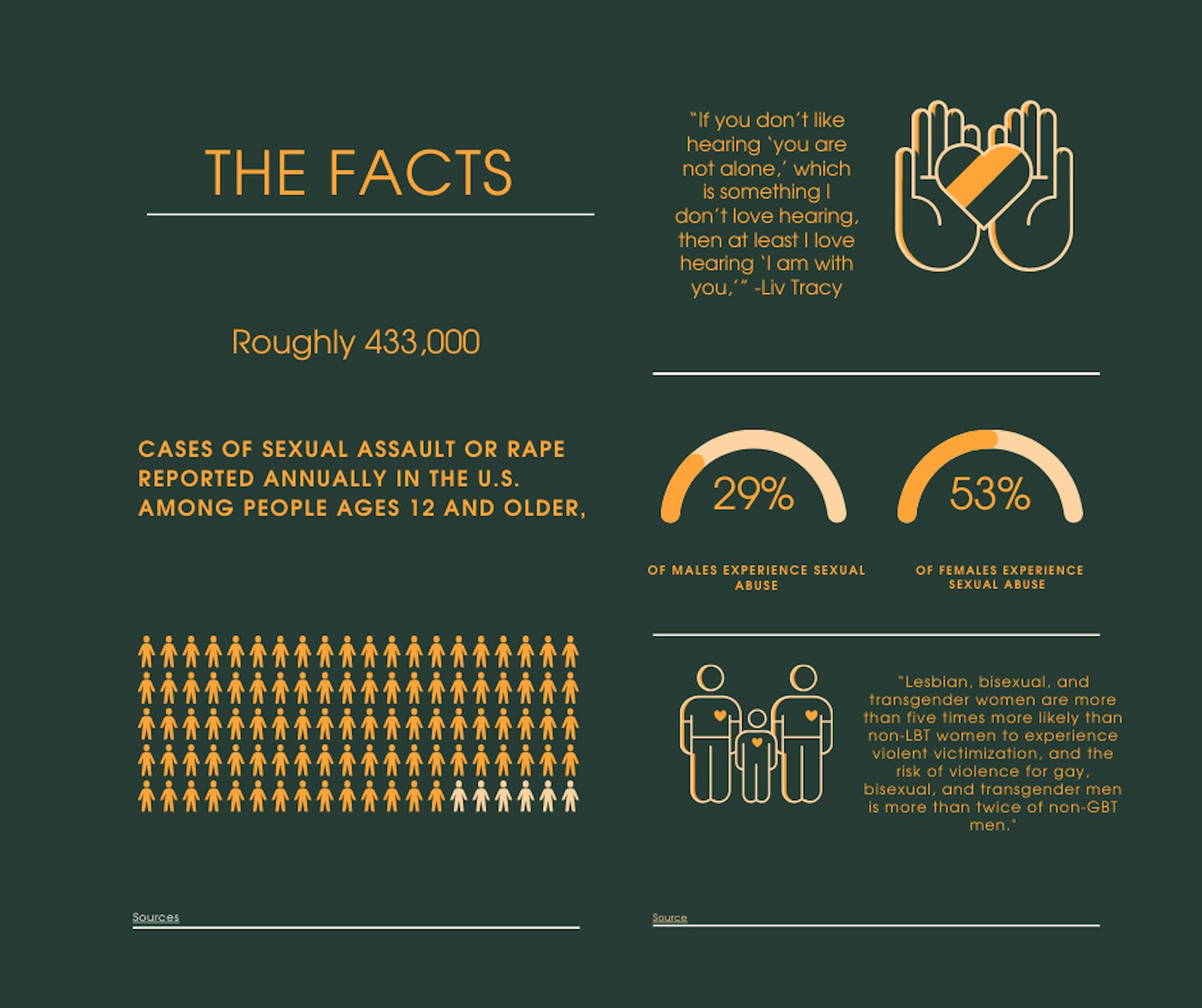
An infographic highlighting statistics behind victims of sexual assault created on April 23, 2025. // Infographic by Kaitlyn Ward
Olivia Jackman, a social worker for Revive Counseling in Spokane, emphasizes that popular perceptions of sexual assault often overlook male survivors, especially those with disabilities, due to harmful assumptions that men cannot be victims or should always be able to defend themselves.
“I think that people aren’t as empathetic towards male victims because it doesn’t happen as often or because women are perceived as weak and men aren’t,” Jackman said.
Jackman said that this lack of empathy stems from deeply ingrained gender stereotypes that suggest men should always be strong, stoic and unaffected by trauma in the same way women might be. Just because it isn’t as common, doesn’t mean it doesn’t happen. Almost a quarter (24.8%) of men in the U.S. experience some kind of sexual violence in their lifetime.
“Pretty much every client that I’ve worked with, even males, will tell me that they’ve been raped, whether it was a family member or when they were on the street,” Jackman said.
When we post “believe survivors,” we must be ready to back that up with real accountability. It's important to believe those whose stories challenge our assumptions, who name perpetrators in our communities, and who speak about survival in complex and sometimes uncomfortable ways.
What Sexual Assault Awareness Month should be about is holding that discomfort. Discomfort arises when awareness calls for action like speaking out, addressing jokes or comments or pushing for change. It's about unlearning the myths, challenging the narratives and making space for all survivors, whether they speak out publicly or process their trauma quietly.
Chloe Van Dyke, an employee at Boundary Bay Veterinary Specialty Hospital, shared some of the ways her workplace confronted sexual harassment after experiencing issues with a previous job.
“I think the part that gets missed a lot is follow-up from management, which is one of the more important pieces,” Van Dyke said. “It shows that they haven’t forgotten and they’re still there for you. It’s important because if you just let it fade out, then you’re giving people the opportunity to continue with the negative behavior.”
It’s not just about awareness. It’s about action. Listening without judgment. Supporting survivors without conditions. Reimagining a world where accountability is more important than protecting reputations.
Tracy is still healing. Some days are harder than others. What she wants, more than sympathy or performative slogans, is simple.
“Belief, warmth and unconditional and ever-changing love are things that a community should present those not only who have experienced sexual abuse, but to any marginalized person,” she said.
And in this month of awareness, listening is the least we can do.
If you or someone you know is dealing with the effects of sexual abuse, the following resources offer confidential help and support.
- National Sexual Violence Resource Center
- National Sexual Assault Hotline, Confidential 24/7 support
- YWCA Housing and Contact info
Kaitlyn Ward (she/her) is an opinion writer for The Front this quarter. She is a fourth-year news writing and editorial journalist minoring in psychology. When she’s not reporting, she loves singing and spontaneous road trips. You can reach her at kaitlynward.thefront@gmail.com.