
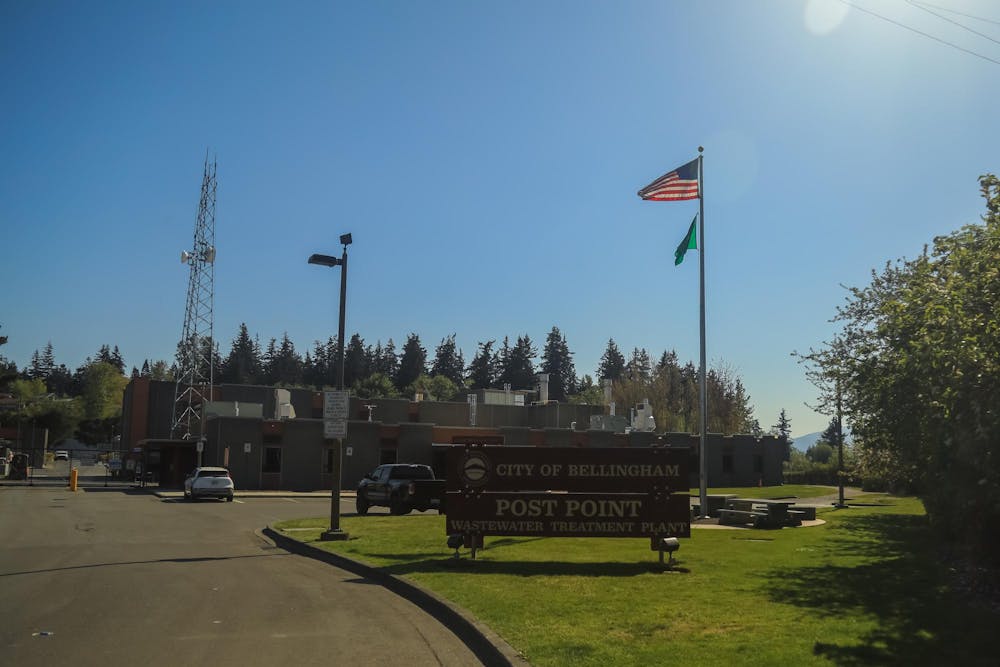
Slated upgrades for the incinerators at the Post Point Wastewater Treatment Plant have left local environmentalists frustrated, with a $40 million price tag pushing community members to look at alternatives.
The upgrades come after violations of the Northwest Clean Air Agency’s air quality standards and seek to improve the facility’s quality and control of emissions, according to the City of Bellingham. The high upfront cost of the upgrades has made it a polarizing issue amid larger plans to switch to an alternative waste management system for Bellingham in the near future.
Ryan Bowman is a community activist from Bellingham who has spoken out about environmental concerns for roughly 10 years.
“Obviously, they have already had issues with environmental air impacts and the city was fined for that, which prompted them to make this move,” Bowman said. “The evidence towards investment in the incinerator is that there will continue to be violations because it’s not going to be properly able to be compatible with the standards as they move forward. So that to me is problematic and I don’t see that as an intellectual forward-thinking solution.”
Bowman said that environmental advocacy group RE Sources brought the matter to his attention. They’ve led the charge in spreading awareness regarding the incinerator issue and have asked the city to consider multiple alternatives.
“Our temporary one, just so that we could do it within a year, is to temporarily landfill. So that would mean putting the sewage sludge into trucks and then onto a train, and it would take it down to one of two landfills,” said Kirsten McDade, North Sound waterkeeper at RE Sources. “Then it would go into these sophisticated landfill areas where it is lined with thick plastic to prevent any toxins from being leached into groundwater.”
The city has been hesitant to adopt a landfill approach as a replacement for the incinerators. While the initial cost is significantly lower – the city projects it at $4 million – the annual cost of operation would far exceed that of the incinerators, costing $70 million over 10 years compared to the incinerators’ $9 million. RE Sources, however, claimed to have found different numbers.
“We have estimated that over 10 years it would cost $35 million, so about $3.12 million per year,” McDade said.
McDade said that the landfill approach would only be a temporary solution used for five years or less. For a more sustainable and long-term solution, RE Sources has advocated for a gasification facility: a system that breaks down compounds instead of burning them by using limited oxygen instead of excess.
“You’re heating the sludge up, but you’re not burning it because it’s in an enclosed cap. So it brings up the pressure really high, so you have high heat, high temperature and the material is broken down thermochemically that way,” McDade said. “It destroys PFAS, uses a lot less energy because the energy that is created by burning this organic material is brought back into the system, and it powers the system.”
The city is still looking at other alternatives to incineration for waste management and has been for the past decade. Starting in 2015, the city spent several years researching an anaerobic digestion system, but ultimately cancelled it in 2022 due to high cost and concerns regarding PFAS.
Now, the city is authorizing a comprehensive sewer plan to evaluate alternative measures going forward. The plan looks at infrastructure conditions, regulatory requirements, population growth and available technologies for a thorough analysis of all of the potential factors that a new waste management system would impact.
Riley Grant is a communications and outreach manager for the Bellingham Public Works department. She explained that maintaining and operating the incinerators is the city’s short-term solution while they continue progress on the comprehensive sewer plan.
“The city is currently in the early phases of that work. The process includes technical analysis, evaluation of alternatives, and policy discussion, along with opportunities for community input,” Grant wrote in an email. “Because the plan is just getting underway, specific findings and recommendations have not yet been developed.”
The incinerator upgrades are slated to start in early 2027, according to the City of Bellingham. With the improvements approaching quickly, activists say they’re frustrated at what they feel is a lack of input.
“We have felt that a lot of the negotiations and discussions have occurred behind closed doors without a lot of community engagement,” McDade said. “There hasn’t been an opportunity to have a dialogue.”
Ethan Hunting (he/him) is a city news reporter for The Front this quarter. He transferred to Western this year to join as a third-year news/editorial journalism major. Outside of news writing, he’s usually out hiking a trail, perfecting his cooking or reading a book. You can reach him at ethanhunting.thefront@gmail.com.