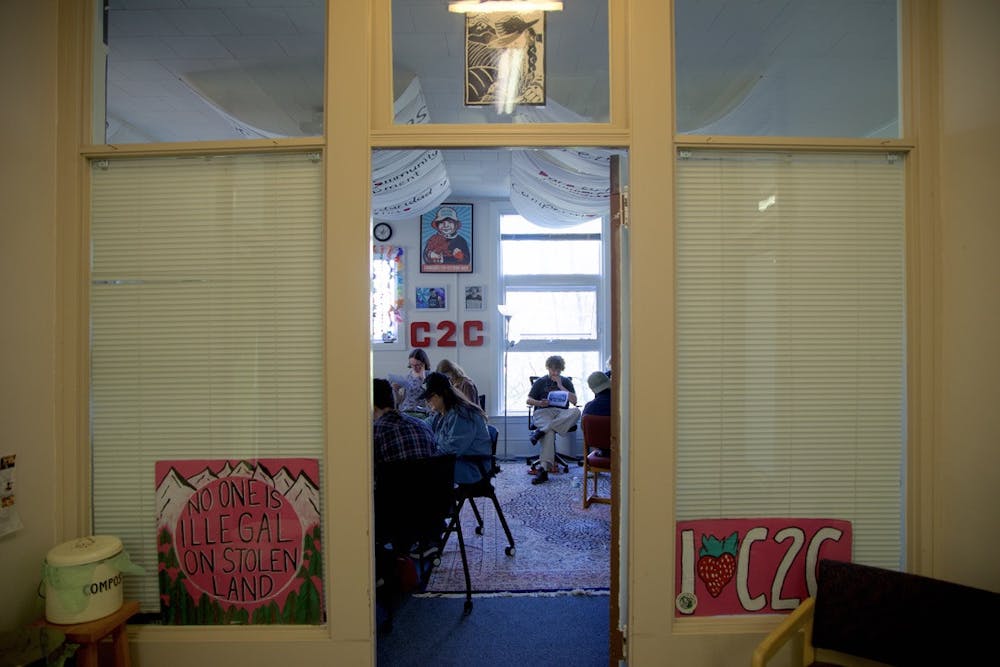
A small room in the Clover Block building in downtown Bellingham beams with light and the sounds of community. It hosts Community to Community’s participation labs — one of many events the group organizes to fight for better conditions for farm workers, immigrants and food sovereignty in Skagit and Whatcom counties.
C2C works to shift community discussion into action at the local level. Their participation labs aim to teach community members who feel unheard or unsure how to take action in their towns. Community members can get involved in local organizing efforts by volunteering time, donating money or attending participatory labs.
C2C’s art activism department uses artistic expression to help change the narrative around immigration and food sovereignty, and give community members a chance to express themselves through creation. They also work to create a solidarity economy in Skagit and Whatcom counties, focusing on sustainable, affordable and equitable agroecology.
The group, which has operated in Bellingham for 22 years, gained attention for their fight for immigrant rights in the wake of President Donald Trump’s second term. Trump focused much of his presidential campaign on immigration, and his administration is on track to deport roughly 500,000 people by the end of 2025, according to the Migration Policy Institute.
Bellingham residents, like Western student Dawson Moore, have turned to C2C to help ease the helpless feeling many have in today’s political climate.
“I felt like I needed to start doing something explicitly outside of Western,” Moore said. “I want to try to make a change locally.”
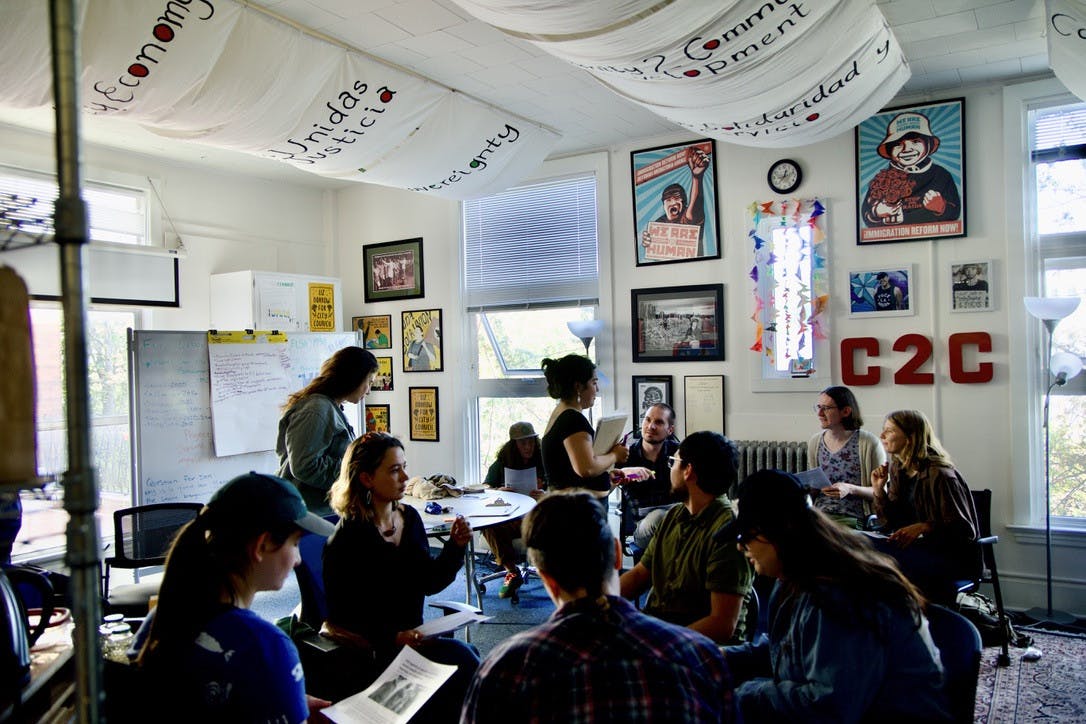
Participation lab attendees break into small groups to read news stories about ICE activity in Bellingham, Wash., on May 22, 2025. The event was led by C2C staff and volunteers. // Photo by Tori Lehman
The immigration crackdown has had sweeping consequences across the U.S. as citizens and non-citizens have been threatened with deportation. The cases of Kilmar Abrego Garcia, who was mistakenly deported to an El Salvadorian prison, and Mahmoud Kahlil, a Columbia graduate student and green card holder who was held in custody for 104 days, have made international headlines.
Locally, ICE took 37 Bellingham roofing workers into custody in April and arrested union farm worker Alfredo "Lelo" Juarez Zeferino in March. Lelo’s case has become a focus for C2C as they work to secure his release from detention at the Northwest ICE Processing Center in Tacoma.
“[Lelo] was working really hard to try to get an immigrant resource center in Bellingham,” said Liz Darrow, the participatory democracy coordinator for C2C. “We're hoping every day that he'll be let out.”
The participation lab hosted by C2C on May 22 focused on this uptick in ICE presence in communities. The event was led by volunteers and was intended as a community meeting where people of all political views could come together to discuss current issues and learn about the history of ICE and immigration policy. The event often broke into small groups where participants reviewed recent news about ICE activity and shared what they knew about immigration policy.
Fear and anger were the largest emotions in the room. Many attending members expressed disgust with the treatment of citizens and non-citizens alike who were confronted or arrested by ICE.
Concern was also expressed about the Trump administration’s January decision to allow ICE enforcement in “sensitive places” — such as courtrooms, places of worship and schools. Although the U.S District Court of Maryland blocked this decision in February, ICE has continued to wait outside sensitive places to conduct arrests. According to a Pew Research Center study conducted in March 2025, 65% of Americans oppose immigration arrests at places of worship and 63% oppose it at schools.
“It feels a bit like there’s nothing we can do,” Moore said. “My stress levels have skyrocketed.”
Brenda Bentley is the founder and coordinator of the art activism department at C2C, where she connects community members through art nights. She said artwork is a way to not only express and alleviate the negative feelings people have, but to change the narrative around immigration.
“Art can be very powerful and shift people's minds in a way that words sometimes cannot,” Bentley said.
C2C’s immigrant rights efforts extend beyond just immigrants. The group helps push affordable housing and low-wage earner protection bills through the legislature, like House Bill 2114, which limits rent increases to no more than 7% per year.
“All of the issues that impact people who live and work here, impact farm workers too,” Darrow said.
C2C’s most recent participation lab was on July 3 and focused on food sovereignty, local food systems, and the work that is done within Whatcom County, with speaker Rhys-Thorvald Hansen, chair of the Whatcom County Food System Committee. Their upcoming lab will be held on July 17 at 5:30 p.m.
“I guess the silver lining of having such a massive nightmare at the federal level is that people get to know each other better as neighbors,” Darrow said.
Tori Lehman (she/her) is a city news reporter for The Front this quarter. Tori is in her third year at Western majoring in environmental journalism and minoring in women, gender, and sexuality studies. She enjoys immersing herself in nature and reading essays from authors like Joan Didion and Rayne Fisher-Quann in her spare time. You can reach her at torilehman.thefront@gmail.com.