

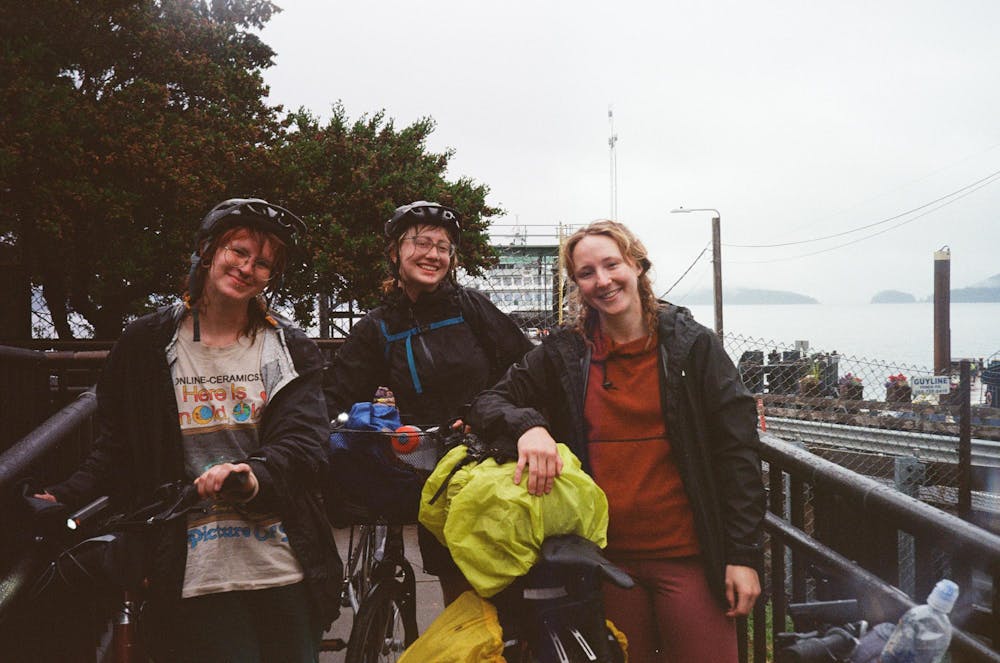
I jerry-rigged my life to a bike for a weekend, I now strive for that ability in my everyday life.
My friends and I had been planning this trip for months: bikepacking to one of the San Juan Islands, Lopez. We had prepared everything, except we had yet to try to fit all three bikes onto the rack I had borrowed.
With 30 minutes to spare, the bikes were not fitting. Three different kinds of bikes stood in front of us. We took them off the rack and back on again, playing Tetris with wheels and handlebars.
Eventually, after taking off a couple of tires, the bikes and us were on our way to Anacortes, making it just in time to bike onto the ferry.
We had no idea if we had a place to sleep that night. We had a first-come, first-served campsite picked out at Spencer Spit State Park. The only thing that was wavering was our hope that there would be room for us.
Our ferry landed on Lopez Island, and the race began with the other bikers on the ship. The bike ride was only 4 miles, a distance I have biked countless times, but an enormous hill stood in front of me.
My bike, a mediocre 7-speed gravel bike, struggled to get up the hill. My friends on a mountain and road bike flew past me, but I kept trekking along.
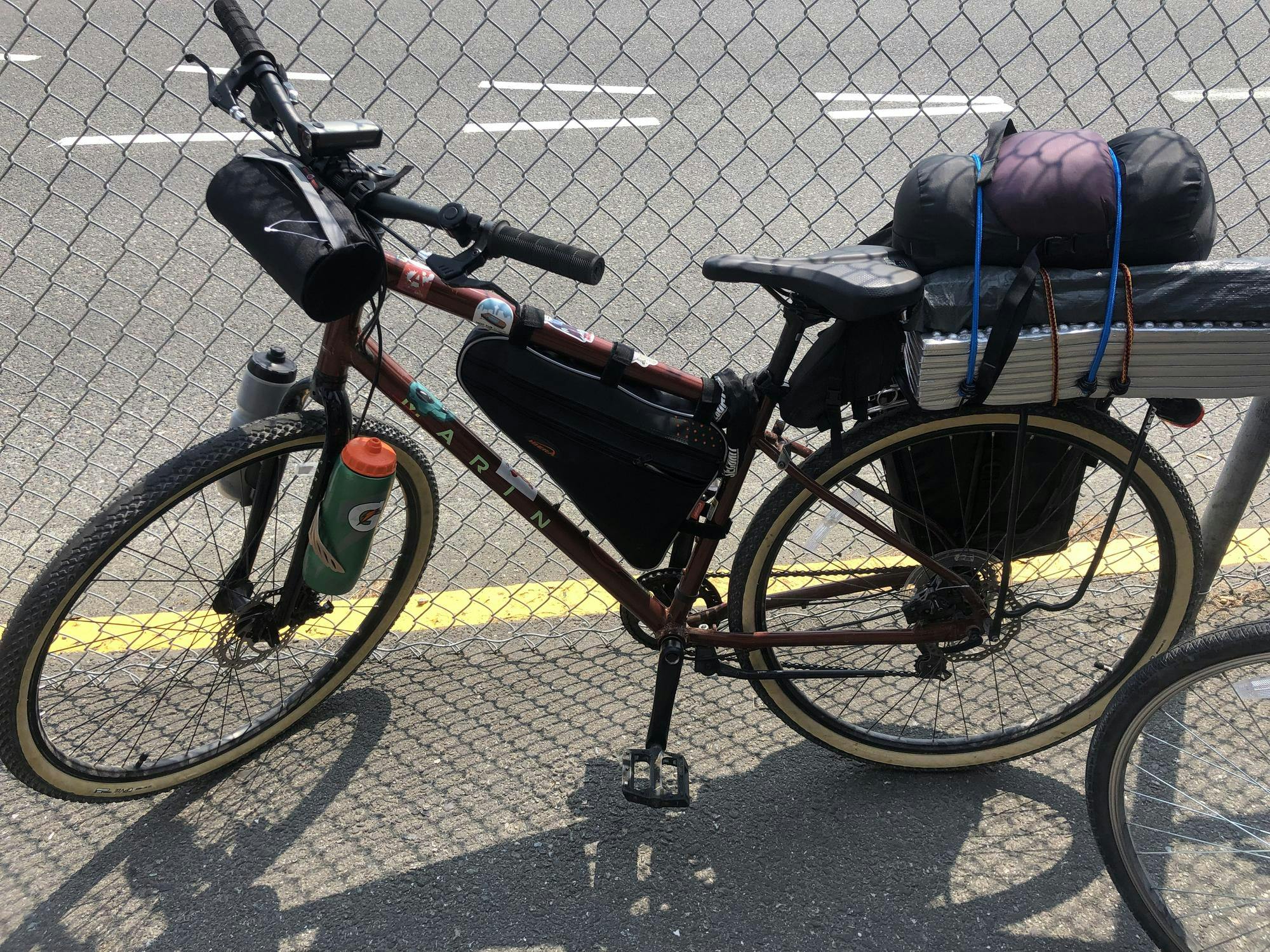
Mars Wetzbarger’s bike before boarding the ferry in Anacortes, Wash. on July 27, 2024. Bungee cords hold everything down. // Photo by Mars Wetzbarger
It felt powerful that everything I needed was on my bike, bungee cords and borrowed gear making this trip possible. Wherever I needed to go, I knew that I needed the ability to pedal there. It reminded me of my love of walkable cities, the use of public transportation and biking to my destinations.
In a world of multi-lane freeways, I want the return of the walkable city. Being surrounded by cars and a lack of sidewalks or safe bike lanes, I wonder if a truly walkable city exists.
Bellingham is separated by a freeway, dividing the old and new parts of our town where it feels terrifying to bike along cars zooming past me with barely any bike lane.
Bellingham was incorporated in 1903 and consolidated four settlements along Bellingham Bay: Bellingham, Whatcom, Fairhaven and Sehome. These areas have a grid street pattern, which provides easier bicycle connections.
However, areas of the City located to the east and north that were added later have less dense road networks with less connectivity. This presents bicycle access challenges and often results in busier major roadways being the only option for bicyclists.
“I-5 divides these two parts of the city and acts as a barrier between the older part of the community and the newer parts of the city due to the lack of connections to safely cross the freeway. Also, many of these connections involve arterial streets and freeway interchanges which have higher vehicle traffic volumes and speeds,” according to the City of Bellingham’s Bicycle Master Plan.
I believe that the standards of what makes a city bikeable and walkable should be improved. I want parts of my town to have car-free areas. I want to feel safe as a pedestrian or biker.
Nicholas Zaferatos, professor of urban planning and sustainable development at Western wrote in an email that it is difficult to modify our car-oriented urban landscape into walkable communities. This is due to the National Highway Act in the 1950s which funded the construction of the interstate highway system.
“The 2014 Bicycle Master Plan (BMP) defines a 170-mile Primary Bicycle Network and identifies 229 bikeway and crossing improvements on a prioritized project list. Since 2014, the City has implemented 132, or 58%, of the total BMP projects,” according to the City of Bellingham’s Transportation Report on Annual Mobility (TRAM).
Implementing these projects looks like: Road diets (removal of vehicle lanes), resurfacing existing and the removal of on-street arterial parking can all allow for bikeway facility installation, according to the TRAM.
Morgan Walden, the active transportation coordinator through Transportation Services at Western Washington University, coordinates events centered around Bike Month, a national event celebrated every May nationwide.
“(Biking) has changed my life,” Walden said. “I'm physically stronger than I've ever been, I feel so much more connected with my surroundings because I feel every hill, I smell everything, I feel every season more intimately.”
This is the first year they are doing a bike pledge. Inspired by housing sustainability’s go for the green pledge. The pledge includes committing to bike to school/work/around town 2+ times a week for May, according to Walden.
I come at this topic through the lens of an able-bodied person. As exhausted as I get on my bike ride up Billy Frank Jr. St, I can do it.
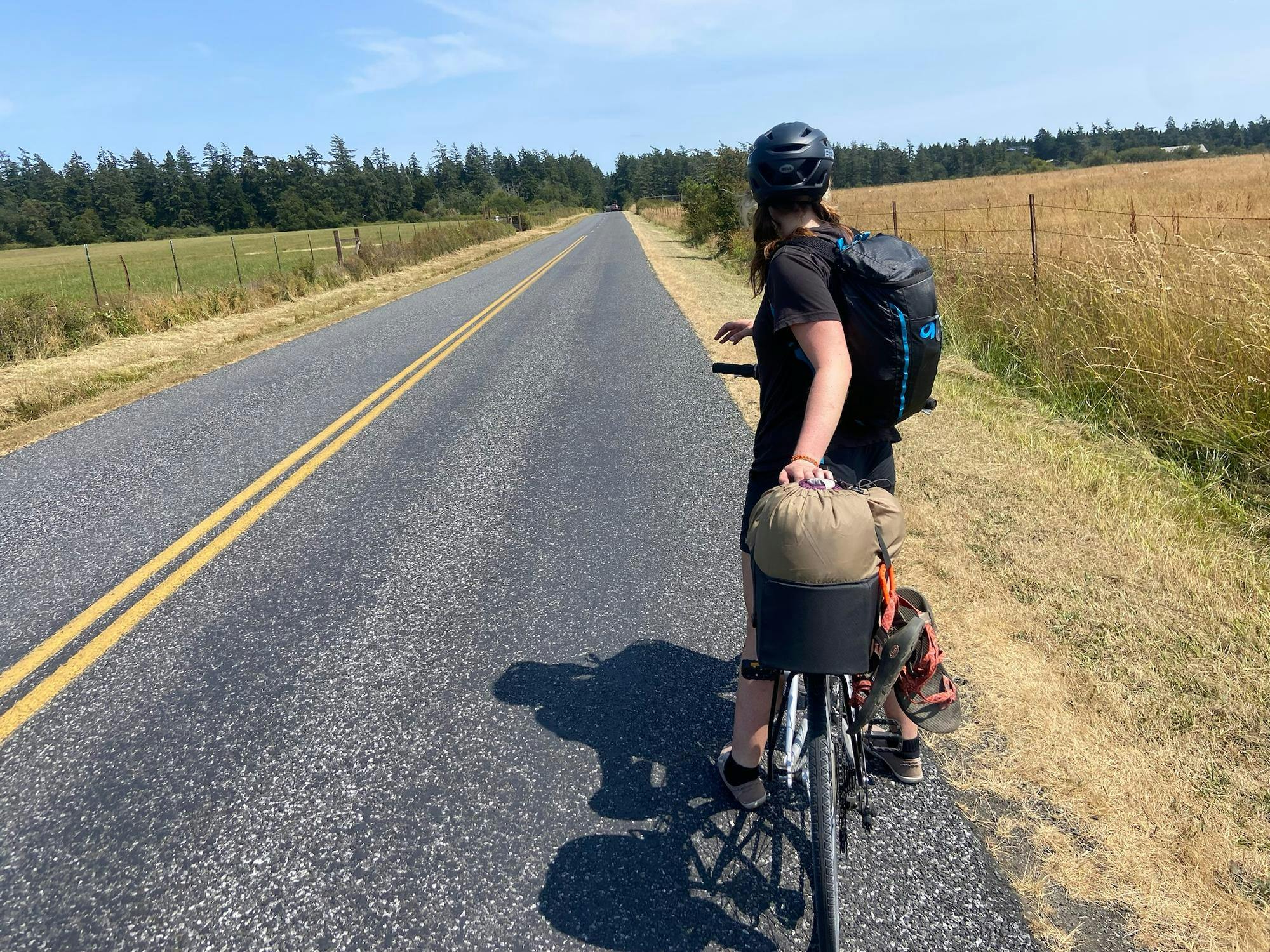
Lila Gill on a bike on Lopez Island, Wash., on July 27, 2024. On the back of the bike, a filled-to-the-brim basket and sandals are strapped on. // Photo by Mars Wetzbarger
The seasons and weather are a constant consideration. What I wear and how I eat to feel energized are crucial. Movement and breath power me through my everyday life, it just happens to involve two wheels and pedals.
“A transportation system that supports easy and safe access by foot will help the City of Bellingham meet other goals around reducing fatal and serious traffic-related injuries, reducing
greenhouse gas emissions, and creating a community that is affordable and socially and economically vibrant,” according to the City of Bellingham’s Pedestrian Master Plan.
The benefits of this type of transportation benefits not only our lived environment but also our mental environment. I feel power when my feet and strength can get me to where I need to go. My interactions and relationship with my environment is crucial in my day-to-day life.
“You see people biking, and you learn to recognize people's bikes. There's just a community that comes with it,” said Walden.
My bike ride back to the ferry after the two nights camping on Lopez was somehow even steeper. It poured rain the whole time and frankly, I was hungover. But through the pathetic nature of being exhausted and dirty, I felt a connection to my body and the street beneath my wheels.
Mars Wetzbarger (they/them) is a campus life reporter for The Front. They are in their third year at Western, majoring in Environmental Journalism. In their free time you can find them climbing rocks and playing with their cat. You can contact them at mars.thefront@gmail.com.


