

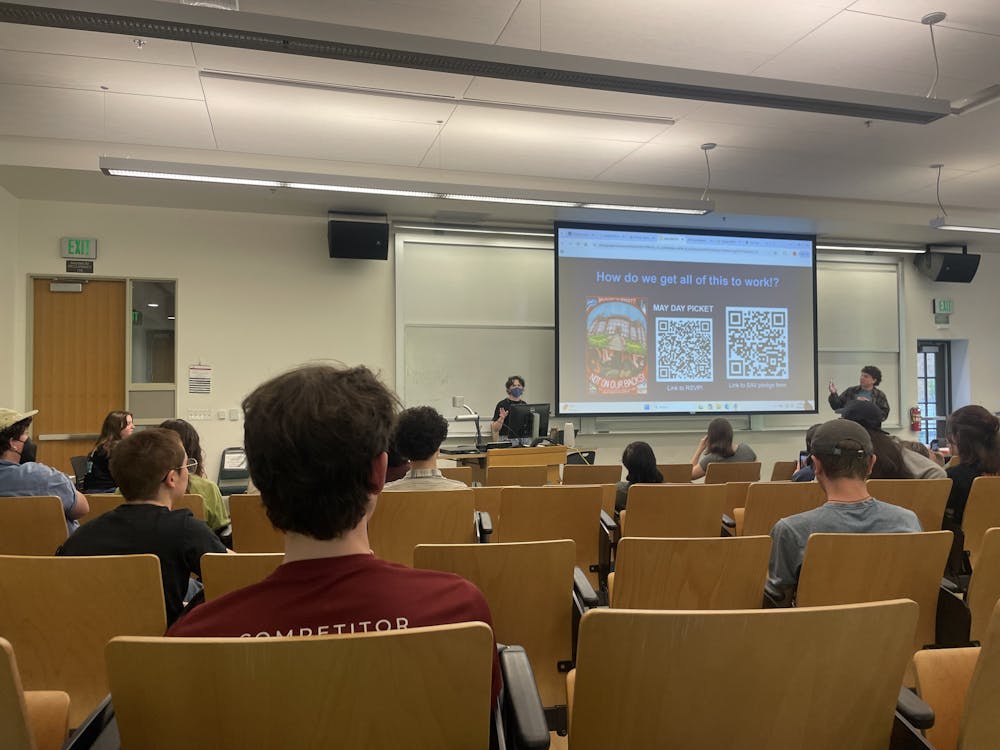
About 50 resident advisors, lifeguards and other operational student employees from Western Washington University’s Western Academic Workers United gathered in a town hall meeting on Thursday, April 24, to discuss the union’s upcoming strike authorization vote, which will run from May 6 to 9.
This vote would permit the 12 elected OSE bargaining committee members to announce a strike at a later date.
The effort is aimed at achieving recognition as a bargaining entity, according to WAWU’s website. If given bargaining status by the university, the committee could negotiate for a contract which would guarantee certain workplace rights for OSEs.
For the voting results to be considered, 51% of OSEs must vote. Of that 51%, two-thirds must vote in favor of a strike for one to be authorized.
The OSE branch is half of the broader WAWU student union, which originally filed to unionize in 2022. The other half, known as educational student employees, were given a contract after eight months of bargaining and a two-day strike in 2024. Their bargaining led to wage increases and various job protections.
Aspen Cates-Doglio is a member of WAWU’s OSE bargaining committee and the vice president of governmental affairs. Cates-Doglio said the potential contract’s contents would be similar to the ESE’s, but with additional protections for the unique nature of certain OSE jobs. For example, the OSE sector of WAWU wants increased mental health care for student employees who are first responders in crisis, such as resident advisors and lifeguards.
Unlike ESEs, who were granted bargaining rights by the state legislature in 2023, OSEs are not recognized by the state as a bargaining unit. Although the National Labor Relations Board legally protects non-union strikes, there are some caveats. In many cases, employees cannot be fired for striking, but their employer may replace them.
Western administration has determined legal recognition as a necessary prerequisite for bargaining power.
Peter Pihos, an associate professor in Western’s history department and United Faculty of Western Washington’s former president, rebutted this. He said there is a precedent of other Washington university unions receiving administrative recognition before state recognition.
Sebastian Mayotte, vice president of activities for the Associated Students executive board, has been a WAWU member for about a year. Mayotte said he acknowledged Western's budget situation and how it may impact WAWU organizing. The recently passed state budget will leave a financial discrepancy of about $18 million.
He said he is leaning towards voting in favor of strike authorization but knows that sacrifices might be made to receive better working conditions.
“If you can’t pay an employee well and give them a good living condition for their pay, it’s not a position that should exist,” Mayotte said.
He said that while he has not had a large capacity to involve himself in recent union organizer efforts, he appreciated the effort WAWU has made to regularly reach out to student employees and encourage participation.
Pihos said he finds WAWU’s success in organizing both undergrad and graduate workers inspirational.
“I just consider myself very privileged to have had a front-row seat to witness the organizing of WAWU and its incredible success in building a union where a lot of union people thought it wasn’t possible or couldn’t be done,” Pihos said.
Pihos said even with budgetary and legislative setbacks, building up unions strengthens a university’s core and asserts the importance of higher education throughout Washington.
“Let’s build a bigger table rather than fight for scraps at the table that we have.”
Hailey LeRoy (she/he/they) is a campus news reporter for The Front. She is a third-year environmental journalism major. Outside of the newsroom, you can find her skating with the Bellingham Roller Betties, singing choral music, or perfecting elaborate eyeshadow looks. You can reach them at haileyleroy.thefront@gmail.com.


