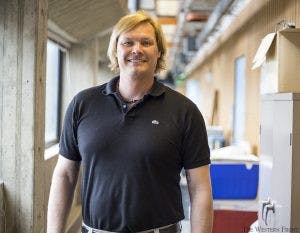

While in the Himalayas, geoscientist and Western professor John All was researching climate change. He took one wrong step and plunged 70 feet into a glacial crevasse. After the fall, All woke up on a 3-foot ledge with a dislocated shoulder, internal bleeding and 15 broken bones, six of which were vertebrae. At this time, he was alone at camp 2 on Mount Himlung and had no one to call for help. With one functional arm and an ice axe, he climbed seven stories up and survived the night alone. On a 2014 trip to Nepal, 16 members of All’s team died in an avalanche prior to his fall. All said he attributes the perils of his Nepal trip to the rapidly warming climate which caused the glaciers to melt and make the region more dangerous.
“I’ve [faced death in] so many different ways. But I’ve continually fought and kept moving forward.”
John All
“It used to be when you had several hundred feet [of] thick ice, it could undulate underneath,” All said. “But when you remove that top layer, then when it undulates, [the ice] cracks, breaks and falls off.” While in Nepal, All studied climate change by collecting samples of ice and snow and analyzing how the accumulation of dust and ash from industrial areas was affecting the region. In March 2017, All released his book, “Icefall: Adventures at the Wild Edges of Our Dangerous, Changing Planet,” about his experience in Nepal. All’s environmental and climate research took him across the world to the African savannas, to the summits of the Andes in South America and deep into the Amazon rainforest. He said he’s been held at gunpoint nine times, stepped on a black mamba and chased by hyenas while doing research. “I’ve [faced death in] so many different ways,” All said. “But I’ve continually fought and kept moving forward.” In his lifetime, All said he’s seen numerous changes in alpine environments. He’s studied how people utilize natural areas and how people’s livelihoods are affected by the changing climates of the world. “The whole world is being changed. The climate is changing. There are ever-growing populations,” All said. “It’s this one-two punch that hits natural ecosystems.” All said his love for climbing and the environment led him along this adventure-filled path. He said he initially believed climbing was solely a hobby and couldn’t be used to progress his career, but in 2010, he received a Fulbright Grant to work in Nepal. While there, he realized he could combine his two passions in his career. In 2010, All started the American Science Climbers Program, a volunteer organization that collects environmental data in the mountains to further study climate change. Now, as a professor in the Huxley College of the Environment, All started the Mountain Environments Research Institute. The program is based on the American Science Climbers Program, but specifically aimed to educate and train students. “After the crevasse, I really realized we need to be able to approach these areas in teams, safely,” All said. “The way that starts is with students.” All enlisted the help of faculty members from different departments to allow students of different majors who are interested in alpine environments to participate. Eric DeChaine is an associate professor in biology and member of the Mountain Environments Research Institute Executive Committee. “It’s a nexus for bringing together faculty and interested parties in alpine mountain environments, whether it’s for the communities that live there, the plants that live there, the snow or the ice,” DeChaine said. All said he decided to bring the program to Western due to the proximity of the Cascade and Olympic mountain ranges, and the passion the faculty and students have for the environment.