
Preparation
Aware of the risks and rewards of mountaineering, I began to plan my trip soon after the start of winter quarter. Physical conditioning, proper gear and a competent, reliable climbing partner were on my itinerary. If any one of these conditions were left unchecked, my chances for success would diminish significantly. As far as gear goes, two pieces are absolutely critical for mountaineering. The first was an ice axe, a tool that allows you to climb steep icy surfaces by jabbing the sharp end of the axe into the ice. The second were crampons, spiked boot attachments that kick sharply into the ice and aid in the climbing of steep faces. Much to my parents dismay, my partner, Austin “Squirrel” Headrich, and I elected not to use climbing ropes. Our decision was based off the abundant snowfall this winter that prevents deep glacial gaps called crevasses from being open at the time of our climb; many experts would probably decry our decision as naive. I maintained a strict regimen of weightlifting and cardiovascular training in the months leading up to the climb. From my experience, once I reach about 10,000 feet of elevation my body starts to become much weaker from the lack of oxygen in the air.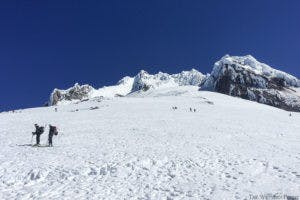
The Climb
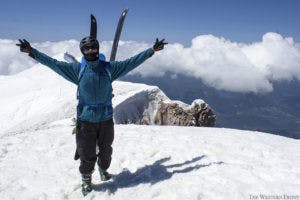
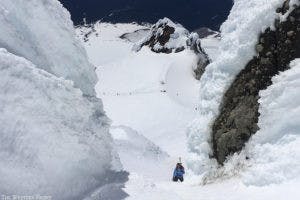
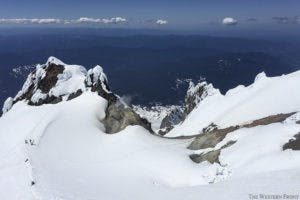
On the morning of our push to the summit, my partner and I awoke to find the weather conditions could not be more ideal. Zero clouds, no wind and a cool spring temperature. In order to beat the crowds, we chose to take a later start than most climbers. We hopped on the first chair possible and rode up the high-speed quad to the top of Palmer snowfield located at 8,540 feet. The climb starts with a long and monotonous hike above the Timberline ski area and took us up from the top of Palmer Snowfield. The next section took us from the top of Palmer to the Devil's Kitchen, a section of open thermal vents at around 10,400 feet that intermittently release steam and gas reeking of rotten eggs. Despite the smell, this is one of my favorite sections of the climb; it provides a direct view into the geothermal activity of an active volcano. One climber close to us joked that the smell was not helping with his hangover; I tried to ignore him as not to think about the beers I too had consumed the night before. After the Devil’s Kitchen, my awareness heightened as we approached the Hogsback, a narrow and steep ridge that runs up the mountain to the final obstacle between us and the summit. With my ice axe in-hand, I left the physically exhausted Headrich behind me and carefully proceeded up the hairline ridge one step at a time. This was the time when experience in the mountains and ability to control one's body really comes into play; a fall on the Hogsback likely means a long and painful slide into the volcanic rocks waiting below. Reaching the top of the ridge, I looked back to find Headrich had overcome his fatigue and was not more than five minutes behind. I took the time waiting for him to eat my last energy bar and drink a few more sips of water while staring up at the last and most difficult section of the climb, a narrow 700-foot scramble through the ice-shrouded crown of the mountain, aptly named the pearly gates. Descending under the 500-foot cliffs to the entrance of the gates, I was profoundly scared by the realization that if the mountain decided to shed its winter ice I would be crushed to death by the mountain I love so much. I moved through this section as fast as possible, and made it to the entrance of the pearly gates of the summit before me. Climbing tenaciously up the 50-degree slope, the next 10 minutes felt like hours but I crested the final slope and was greeted by a view that filled me with a sense of just how small human beings really are.