

Correction: A previous version of this story misidentified Dexter Davis' statements. This story has been updated for clarity and to correct the error. The Front regrets the error.
When it comes to sunny days, students at Western Washington University know how to seize the opportunity.
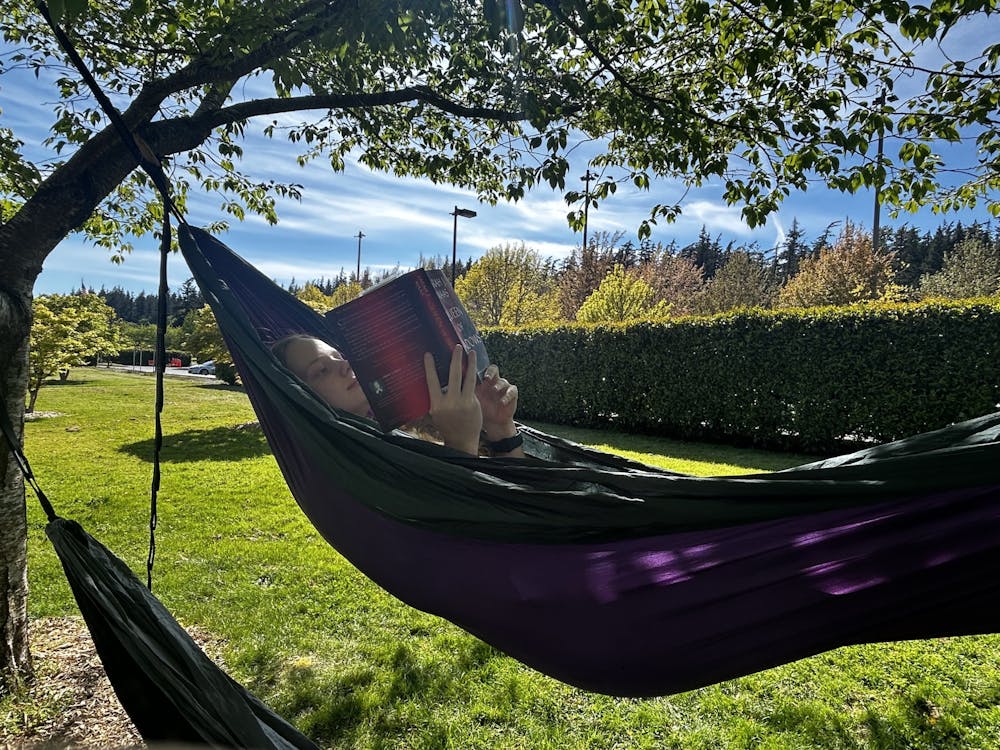
Whether it’s lying back to enjoy the water spouts from Fisher Fountain in the middle of Red Square, or bringing a hammock to campus and setting up shop in one of the many cherry blossom trees lining the pathway up to the center of campus—it’s all part of the experience.
While there are many ways to recreate at Western, for those lounging around with nothing much to do, hammocking might be the way to go.
Stacking up–literally
There are those who do it traditionally, those who stack on top of each other and some who take theirs to new heights—literally.
Western student Sophia Craft set up her hammock nearly twice her height, 7 feet above the ground, despite the recommendation not to exceed 3 feet. The extra height gave her a fresh perspective on relaxation, she said.
“It’s just nice to hang out in the sun with your friends all day,” Craft said. “It’s good for everyone’s attitude in general. I find myself enjoying life a lot more compared to fall and winter quarters.”
The mental health benefits of outdoor relaxation aren’t just anecdotal—studies support it. Spending time in nature has been shown to reduce stress, improve mood and even enhance cognitive functioning, according to the American Psychological Association.
For Craft, she finds relaxing outdoors positively impacts her academic mindset.
“In spring quarter, the academics may get way harder, but the weather makes it all way more enjoyable,” Craft said. “It’s definitely helped me relax way more.”
A 2020 meta-analysis in Environmental Research found exposure to green space significantly lowers cortisol levels, a key indicator of stress. The study also found younger people who spend time in nature report lower anxiety and depression levels.
Still, Craft admits the comfort can be distracting at times.
“It is sometimes a little hard to get it all done,” Craft said. “Considering how comfortable I can get in here, it can be hard to find the motivation, but it’s definitely helped me to have a more positive attitude.”
Hammocking for the long haul
While some students use hammocks for brief escapes, others take it to the next level. Dexter Davis lived out of his hammock for two months in summer 2024.
“There are different levels of experience,” Davis said. “Camping in Bellingham calls for a lot of [experience], but it’s super rewarding. I love being out in what feels like the middle of nowhere, waking up to the sounds of birds and the sun hitting my face.”
For Davis, hammocking offers more than recreation—it’s a lifestyle. He prefers hammock camping to the traditional tent, noting the importance of adding gear like sleeping pads and rain tarps for comfort.
Some of his favorite off-campus spots include Teddy Bear Cove and Larrabee State Park along Bellingham Bay.
But privacy is prized.
“It’s a little bit weird sometimes when you pack all your hammock stuff up,” Davis said. “You get all the way out to your spot, and then there's another person hammocking there, and you’re just like… bruh.”
Overcrowding is a real concern, which is why many students guard their favorite hangout spots. Still, some well-known areas remain popular, such as the Arboretum, Old Main Lawn and the Communications Facility pathway.
Finding the perfect spot—and respecting it
As far as other hammocking etiquette, Craft says to keep the energy light. Steer away from making many loud noises and avoid encroaching on other people’s spots.
“Hammocking is supposed to be a very relaxing opportunity,” Craft said. “So I think it would be nice to be quiet and calm… there are no real rules for how loud you have to be necessarily, but I think it's important to understand the vibe.”
It’s just a great time to hang out with friends. Evie Papich and her friends enjoyed a sunny day inside of a hammock.
The perfect spot for them is pretty self-explanatory. Find open space and somewhere comfortable.
“What makes a good spot is the distance between the trees, and if it’s sunny plays a big factor,” Papich said. “Another factor is if you can see some good people-watching or have just a beautiful view.”
Her friend Jillian Slonecker set up the hammock initially. She had one before she came to Western and advised those considering the university to do the same.
“I’m someone who’s always had a hammock ready and available,” Slonecker said. “All through high school I kept one in my car. Have to have it.”
Be careful though—too many people climbing into the hammock can wind up in catastrophe, as their friend Owen found out, collapsing their hammock when he tried to join in.
Their friend Anna Ammann put it simply.
“Three peas in a pod is fine, but I think four might just be too many,” said Ammann.
Cameron Riggers (he/him) is a campus life reporter for The Front. He is a news and editorial journalism major. Additionally, he writes about the Western Hockey League for soundofhockey.com and can often be found at a rink around the Pacific Northwest. You can follow his work on Twitter/X @CameronRiggers and can reach him at CameronRiggers.thefront@gmail.com.


