

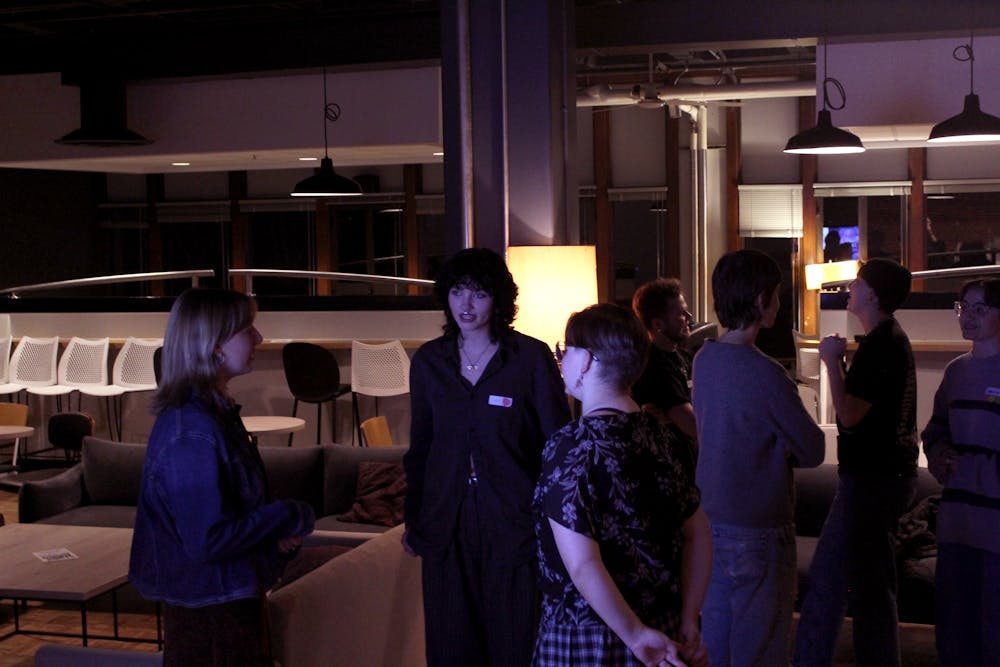
One January evening, a group of students gathered at the Underground Coffeehouse looking for a space to belong. They were there for a speed banding event geared toward Western Washington University’s queer and femme-identifying student musicians.
Queer + Femme Speed Banding was organized and facilitated by Ava Geddicks, Western Art and Music Productions’ concert coordinator, who designed it as a way for emerging student musicians to meet and network with others who share similar interests and goals, whether that’s forming a band or just making connections. Musicians rotated through small groups discussing their musical experiences, goals and inspirations.
Lyds Schmidt, a first-year student at Western, attended the speed banding event hoping to find other musicians to go to shows and play music with.
“I know a lot of people are super artsy and creative and musicians here, I just haven’t really gone to many events and tried to find people yet. This is my first time going out and doing that networking,” Schmidt said.
This specific event aimed to be an inclusive space for musicians who have historically been excluded from the music industry.
“For queer and femme speed banding, I think it’s super important that people are able to meet each other and connect with each other, because in such a male-heavy field, finding that connection with other people that share your experience is just so valuable,” Geddicks said.
A 2023 study by USC Annenberg on the gender, race and ethnicity of artists, songwriters and producers of popular music found that across the 11 years studied, only 22.3% of artists were women and women comprised only 6.9% of band members. In 2022, only 14% of songwriters and 3.4% of producers were women.
“One of the main reasons why I wanted to do this is because it could be really isolating to be a woman or a queer person in the scene right now. It’s really easy to be pushed down by that fact and the weight of what the scene is like,” Geddicks said.
Felicia Youngblood, associate professor of Women, Gender and Sexuality Studies at Western, said that women and queer folks face a multitude of challenges when trying to “make it” in the music industry, one of them being exclusion from networks of connections.
“There are a number of things that need to fall into place, and some of it is hard work, some of it is luck and a lot of it is who you know and who they know. And traditionally, that network has been very cis-het male dominated,” Youngblood said.
Evan Stubbs, a first-year student studying music at Western, said that the speed banding event was a space where he felt more comfortable being vulnerable as a musician.
“For me personally, I’m a trans guy and interacting with a lot of cis, straight men is very intimidating for me because I feel like I can’t be vulnerable around (them), so it’s very difficult for me to open up musically to them,” Stubbs said. “So an event like this is very helpful because I feel like I can be more vulnerable in this space.”
The vulnerability of being a musician combined with the vulnerability of being openly queer means that the existence of inclusive spaces provides a unique sense of safety.
The business side of the music industry poses another challenge for emerging queer and femme musicians when venues hesitate to feature these artists, fearing a risk to their profits.
“This capitalistic ideal that we have in our society that somebody has to earn a lot of money to be worth it is also a problem,” Youngblood said. “You have to create space very purposefully and not keep artists out of a space just because you assume that they’re only going to draw a specific number of people or a certain type of crowd.”
Geddicks said that providing a diverse range of programming and appealing to a diverse range of audiences is at the forefront of her mind while doing work for AMP.
“Even if every event doesn’t sell out a show or fill out a room, it can still be so important to make those people feel represented,” Geddicks said.
Since entering the music scene as a queer and or femme person can already be intimidating, it’s important for these musicians to have representation to know it’s possible for them to make it in the industry.
“It’s one thing to look at a stage with a whole bunch of people who look nothing like you and just assume that’s not a place for you,” Youngblood said. “It’s another thing to look at a stage where one person, half the people, all the people, are in some way related to your experience and walk away knowing that you could make it there too.”
Erica Stavnem (she/her) is a sports and recreation reporter for The Front. She is a second-year Western student and is majoring in visual journalism. In addition, she is a member of Western’s sailing team. She enjoys reading, camping and travel. You can reach her at ericastavnem.thefront@gmail.com.


