

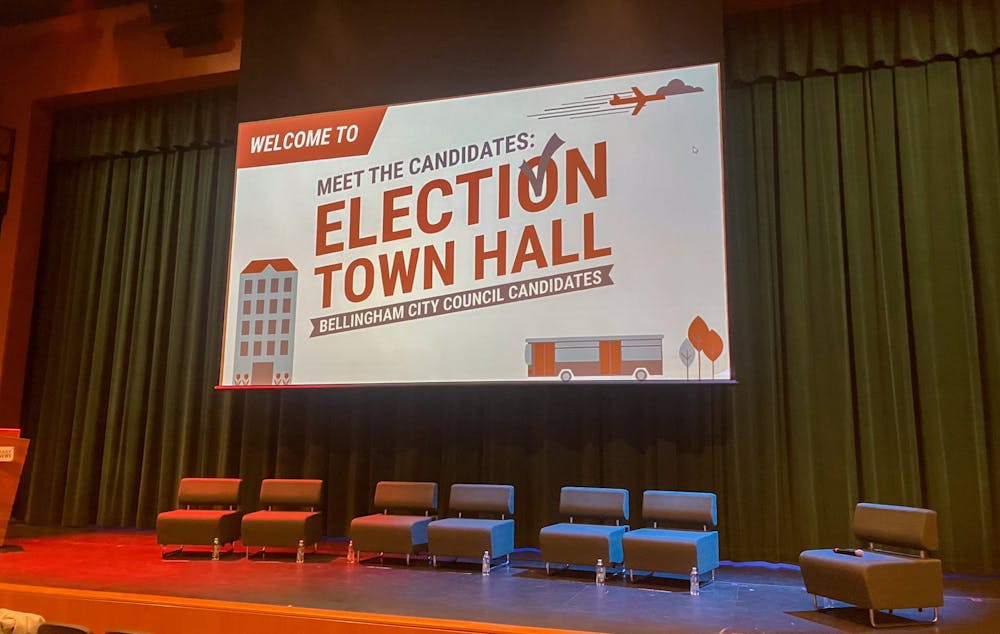
With Election Day nearing, candidates for Bellingham City Council gathered at a town hall meeting on Saturday, Oct. 11 at Sehome High School to discuss housing, protecting vulnerable groups and their rights, communication and biking infrastructure.
The town hall meeting, put on by Cascadia Daily News and led by executive editor Ron Judd, and editorial consultant Dean Wright, invited Bellingham residents to hear from the candidates running for city council. Over 100 people came to the town hall.
The candidates in attendance were Hollie Huthman (Incumbent), Leah Wainman of Ward 2, Edwin H. "Skip" Williams (Incumbent), Kerri Burnside of Ward 4, Michael Lilliquist (Incumbent) and Andrew Reding of Ward 6. Incumbents are those who currently hold office during an election.
Housing
Housing was at the forefront of the issues covered at the town hall. With the median rent in Bellingham having increased 16.8% from 2023 to 2024 and the median home price having increased by 127.9% over the last decade, candidates brought up how changes with zoning laws and infills can help mitigate the housing crisis.
“The one way to solve it is to create housing at all levels. Single family, multi family, tiny villages, whatever, to be able to meet that need and to develop policies that are going to support that,” Williams said. “We are on the way to doing that in a number of ways, and some of which is changing the zoning codes; changing it from having 25 different codes that have no relationship to each other to something that's more consistent citywide.”
According to Williams, whose ideas were supported by Lilliquist, this would make it easier to build more housing in the area.
“Rather than having hundreds of residential codes,” Lilliquist said, “we now have given direction to simplify those into three residence areas: low density, medium density and high density, to make it easier for people to build.”
Lilliquist also believes that public-private marketship and direct investments, which involve government contracts with private companies to build or manage projects, is needed to help solve the housing crisis. This differs from his opponent, Reding, who believes in market-based solutions like deregulation or subsidies that encourage private investment to increase housing supply.
Judd mentioned how with new zoning laws and infills, there are different tolerances to what residents of Bellingham are willing to accept in order to build new housing, something that Burnside had noticed while talking to constituents. She believes that it’s something the city council needs to take into account when trying to solve the housing crisis.
“I was talking to a family that has a traditional single-family home that had a double lot that was split, and so they had a home in front and a home in back,” Burnside said. “They shared something I hadn't thought about; the conflict it caused when they moved in and the lack of parking. So they now park on their front lawn, and the neighbors don't like how that looks, but there's nowhere else to park. If they park on the street, they have neighbors that come over and express their extreme dislike [for it].”
Protecting vulnerable groups and their rights
In the audience Q&A, the question of how city council members and the city of Bellingham plan to protect the citizens and their rights was brought up, something all city council candidates vowed to defend.
Huthman explained that in 2017, the city council passed an ordinance protecting immigrants. This, along with the Keep Washington Working Act also passing at the state level in 2019, ensures that local law enforcement does not assist with immigration enforcement.
“That is not the purview of local law enforcement,” Huthman said. “They are concerned with local issues, and so there is no assistance with immigration enforcement.”
Huthman further explained the protections the city has, such as not asking for immigration status unless it is a legal requirement, as well as joining in class action lawsuits against the federal government.
“We've joined in on a class action lawsuit against the federal government regarding HUD funding,” Huthman said. “As a city, we were told that we would not receive HUD funding if we didn't comply with certain requirements from the federal government regarding immigrants, abortion rights, LGBTQ+ rights. And of course, those are values that we hold deeply in the city of Bellingham, and we're not willing to compromise on those values.”
This comes on the heels of the city council passing a resolution that affirms that the city of Bellingham is a place that protects the rights of individuals regardless of their identity.
Email responses and council communication
Another topic brought up by an audience member was the lack of responses by city council members when a constituent emails them.
Huthman highlighted how emails sometimes get stuck in the group email address for the city council. She explained that all council members receive the email but aren’t allowed to discuss between each other on who should answer it. She made note that if you wanted to reach them, you should email their individual emails.
Both Wainman and Burnside brought up the idea of having quarterly town hall meetings, as well as updating the technology used within the city council to ensure emails are seen and heard by council members.
“There's so much opportunity to use workflows to drive email direction and where it goes,” Wainman said. “There is definitely a tech solution there, for sure.”
Reding also suggested that the format in which city council meetings happen should change, suggesting that the public comment section of a council meeting should happen at the beginning of the meeting and not the end, something he took from his time as a city councilman in Florida.
“In Florida, the public comment always preceded the city council meeting,” Reding explained, “and we also had a practice of inviting experts that were not necessarily the city staff to make presentations to the council before we made any key decisions or votes, and sometimes we got very valuable information by doing that.”
Bike lane network and safety
The final topic of the town hall meeting was expanding the network of biking infrastructure and safety in Bellingham, something that all candidates agreed needed improving.
Reding, who doesn’t own a motor vehicle, noted that painting stripes on the road isn’t enough to ensure the safety of bike riders and that “we've got to go more Dutch, to put it bluntly.”
This was something Lilliquist, who implemented Bellingham’s first bicycle master plan, agreed with his opponent on.
“Andrew and I agree on one thing, which I repeatedly said, that paint alone is not enough to create genuine safety,” Lilliquist said. “The physically protected and buffered bike lanes are better.”
Wainman explained how she would enjoy seeing a network of bike lanes and trails that are able to connect the northern neighborhoods in Ward 2, like King Mountain and Cordata, so that it’s easier for them to get to places like downtown Bellingham. She said that she would like to see more bike paths that lead to daycare centers and schools so parents don’t feel obligated to have to drive to school and can instead ride bikes together with their kids.
City council members serve four-year terms, except for the At-Large council members, who serve a two-year term. City council members make $71,076 per year.
Election Day is on November 4 with mail-in ballots being available to send in starting October 15. Registration & Voting Aids are also available on October 15.
Bodey Mitchell (he/him) is a campus life reporter for The Front this quarter. He is a second-year Journalism pre-major. In his spare time, Bodey can be found snowboarding or playing guitar. You can reach him at bodeymitchell.thefront@gmail.com.


