

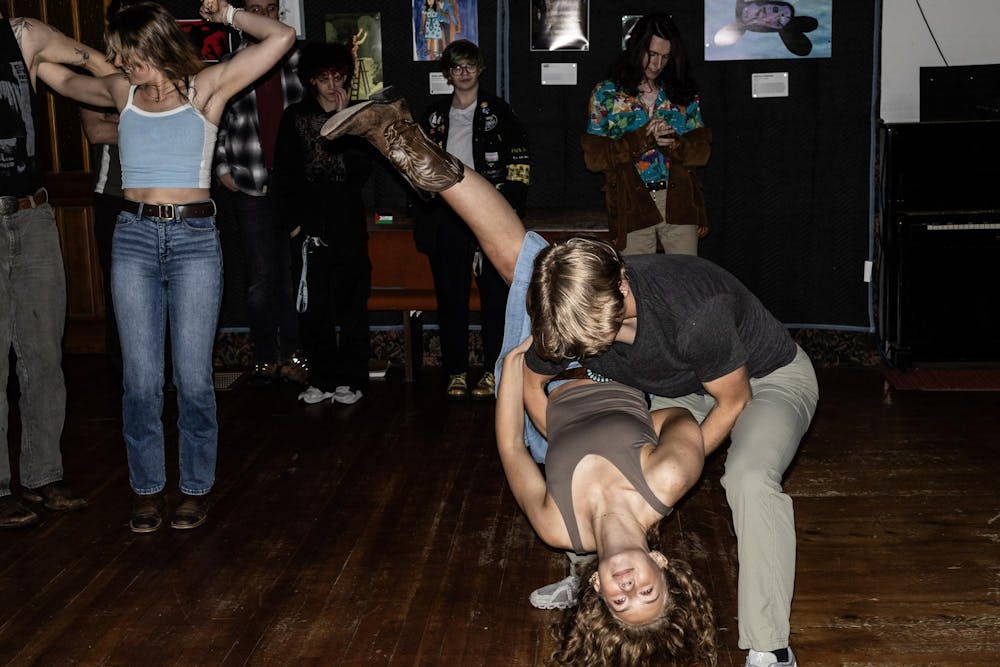
The Viking Swing club hosts weekly swing lessons for all levels of dancers at Western Washington University, specializing in teaching the basics of old-school, country swing dancing.
Every Wednesday from 7 p.m. to 9 p.m., Viking Swing officers rent out the Viking Union and offer lessons to beginners. Students are encouraged to learn the dancing styles that officers have passed along while practicing the art of swing.
From being the Swing Kids pre-COVID-19, to Swing That Thing Dance WWU and rebirthed into the Viking Swing club, officers Bechler Ybarrondo and Zachary Martin have watched the club shift drastically from how it began in the early 2000s.
Ybarrondo and Martin sat down with The Front to shed new light on the inner workings of the club.
Q: What draws students to practice a dance rooted over 100 years ago?
Martin: The fact it is an old-style club is cool because it gets translated through 100 years. People come not knowing what swing dancing is at all; people come for the community. We are doing the best we can to do these same moves that people were doing in the Golden Age of Hollywood and pre-world wars, and now we are doing it in the Viking Union.
Pre-COVID, there was a decades long, running club of swing kids and it got gutted. Our specific class group in the last five years is in a very different place culturally speaking when it comes to social outlets and interaction. I think there’s a really deep desire for community-based things, and that is why people come in solo.
Q: Where does the club get their dance inspiration from?
Ybarrondo: Coming from Idaho, the resources I was given when I was coming into dancing (were) old couples at bars. You'd show up and they're dancing, and then you started dancing, and they are like, “Yeah, that is not how that works.”
The Bellingham community is kind of absent in terms of country swing dancing. Jazz swing is very established here.
Now, country swing, also known as rodeo swing, is the main style that Viking Swing teaches. We try to break out the traditional dances like the Texas two-step, which came from ballroom dancing. Part of the reason people are so drawn to country swing is because it can take away some of the entry barriers with partner dancing.
Q: How has membership grown or declined in recent months?
Martin: Usually, at the beginning of the quarter, when we start with our country scene units, is when we consistently have 100 members every week.
It dips about halfway through every quarter when we transition units, just because change affects a lot of people and a new dance style isn't for everybody. Plus, midway through the quarter is when midterms pick up and people end up dropping off.
Ybarrondo: Membership is there, but the general comfort of jazz swing dancing has declined. When the club was Swing Kids, dancing had a stronger base for jazz-style swing dancing, like the Lindy Hop and the Charleston, but then all those dancers graduated out of the club.
In years past, you had that membership base of 100 plus people showing up and it was exclusively jazz swing, country swing was not on the dance floor. That being said, all the other styles come with their pros and cons as well.
Q: What could a total beginner expect from their first lesson?
Martin: Every single week, we do totally beginner lessons. Sometimes they are adapted if there are a lot of returning beginners, but every single week there are people who have never been there before. It's very beginner friendly and that’s one of the biggest emphases we have.
Once you learn the basic moves, you have enough of a repertoire of moves to do them in a social setting. You can go from nothing, to trying a 40-minute lesson, to then being able to participate (in) how the club functions for the remainder of the night.
Ybarrondo: When you are starting out with country swing dancing, you don't always need to be on time to the music. A lot of times, when you see a good dancer, they are on tempo and on beat; their moves feel like a conversation.
Q: Do you guys want to go back into jazz swing?
Ybarrondo: Ideally we would want to merge the both. The core foundation of the club is in both jazz and country, and there are others, but we don’t exactly have the time to focus on those.
There are only eight weeks we can dance in the quarter. If we only did four lessons of country and four lessons of Lindy Hop, that's a pretty harsh crash course timeline for jazz swing especially.
With country swing, there is still not a ton of time, but you can get out on the dance floor. Jazz swing is going to take a little more of a learning curve.
It's a matter of how much time we can commit to both and trying to figure out how we can have the socials run a bit smoother over external events, now that we do have the leadership capabilities.
Q: Why did the club decide to change the name?
Martin: We’ve made a lot of executive changes and shifted how the club functions, so we felt that the rebrand would help us share those new changes to the public better.
The club was formed three years ago as Swing That Thing Dance WWU. It was a really big mouthful – I do outreach and event planning. Viking Swing is just a much easier name, it rolls off the tongue.
You know, I am also thinking from a PR standpoint: what's easier to market? Our Instagram handle is WWU Viking Swing. If you are searching up WWU Viking Union – which is one of the biggest followed accounts of Western – and ours is right underneath them.
Julianna Quarto (she/her) is a third-year student studying journalism and public relations at Western. She is currently reporting for the sports and recreation beat at The Front. Outside of the newsroom, she can be found doing yoga, playing piano or guitar, or making beats on her computer. You can reach her at julianna.thefront@gmail.com.


