

Bellingham’s Urban Forestry Management Plan is currently paused due to a limited number of staff and their abilities.
American Forests defines urban forestry as “the planting, maintenance, care and protection of tree populations in urban settings.” In 2020, the City of Bellingham began creating the Urban Forest Managment Plan. They said the goal was to “develop strategies that would help maintain a healthy and desirable urban forest with well-coordinated, consistent, efficient and sustainable long-term urban forest management."
Blake Lyon, the planning and community development director for the City of Bellingham, said the goal of the Urban Forestry Management Plan was to inventory and understand the health of the trees. The plan also aims to find a balance between maintaining the environment and developing housing.
“Housing is a big need for our community. And we know that we have to increase the number of housing that's available. And sometimes that comes with developing land and the removal of trees,” Lyon said. “Trying to find that balance, find that kind of right size of protecting and preserving our habitats, but then also being able to provide some of that much-needed housing and business opportunities just kind of make a city function and run.”
Due to limited staff capacity and because the city is currently in a $10 million budget deficit. They've proposed cutting services or relocating them, reducing staffing by eliminating vacant jobs and increasing the local sales tax in the 2026 budget.
“The challenges of the budget have made it harder to have the appropriate staff to pick that back up in a meaningful way, “ Lyon said. “Things are just taking a little longer than we generally anticipated.”
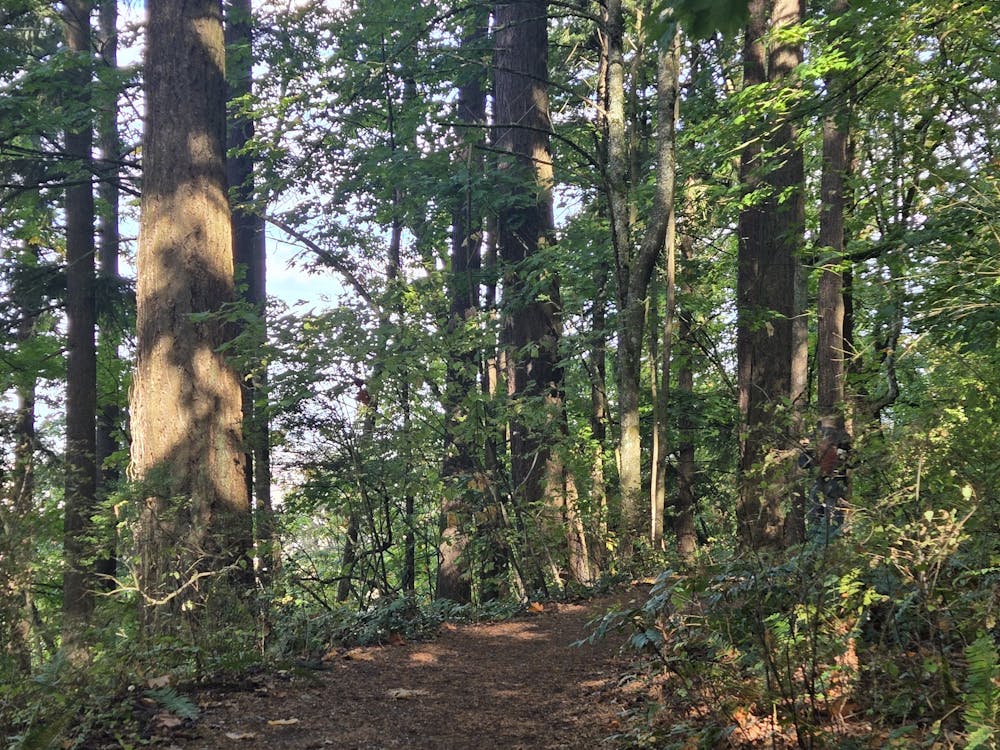
Bellingham’s urban forests are trees on public and private property, including state trees, park trees, open forest spaces and trees in parking lots and backyards. According to the City of Bellingham’s website, the city and urban growth areas together have approximately 10,076 acres of forest.
Paul Kearsley, an instructor in the College of the Environment at Western, said that as society grows, there’s an increasing interface between wild lands and the city.
“There's a lot of value in keeping those spaces and maybe finding ways to intersperse them into development, and especially leave healthy forests intact because they're so quickly destroyed, and it is so long to regrow them, “ Kearsley said. “I think that with smart planning and a creative process and some good policy, there is a balance that can happen.”
North Carolina State University found that trees significantly reduce runoff by absorbing water through the roots. They found that urban forests also reduce the risk of flooding and promote the restoration of groundwater.
“Open space is critically important in urban areas to allow for natural processes like dissolution, absorption to take place, say from surface water runoff during precipitation events,” said Gigi Berardi, a professor in the College of the Environment at WWU.
While the Urban Tree Forestry Plan is on pause, the city has implemented the Landmark Tree Protection Ordinance, which protects trees that are considered “landmark trees”. Landmark trees are trees that have a trunk diameter of 36 inches or more. They have historical significance to the area and are important to local wildlife.
The city built an inventory for landmark trees and established a permitting process for tree removal. The city has also launched Community Tree Programs to plant trees on private lands.
Lyon said the Landmark Tree Ordinance made them refine and rethink the Urban Forestry Management Plan.
“In a city the size of Bellingham, approaching 100,000 people, there's absolutely a number of different reasons that urban forestry, trees in general, play huge benefits and dividends,” Lyon said. “Just ecologically from a habitat perspective and the flora and fauna that rely on those trees to have a healthy and robust life.”
According to the Washington Trails Association, urban forests can improve mental and physical health, reduce blood pressure and enhance immune functions.
“There are also just elements of magic where forests and plants can really stop a person from time to time if people are cued into it,“ Kearsley said. “I think that type of experience is small and easy to overlook, but is a really humanizing and grounding and connecting experience for people who are living in an urban context.”
Adah Bassok (she/her) is a city news reporter for The Front this fall quarter. She was previously a campus life reporter for The Front, and she is a news and editorial journalism major at Western. Outside of the newsroom, you can find her reading and exploring the outdoors. You can reach her at adahbassok.thefront@gmail.com.